

To the Soon-To-Be Pastor

As I packed up my office and prepared to enter into my first full-time ministry opportunity, my boss came in with a book as a parting gift. “The First 90 Days” by Michael D. Watkins. The premise of the book is simple: “The actions you take during your first few months in a new role will largely determine whether you succeed or fail” (page 1). Admittedly, I don’t think it’s wise for pastors to be building their goals and strategies solely from the wisdom of secular books about the workforce like this one. However, getting started on the right foot as a pastor will pay dividends for your service to the flock in the long run, and because of this, I chose to read it. As I read the book and began serving my new church family I regularly found myself exactly where Watkins wrote that I would be and felt the pressure he said I would feel. I came to appreciate the reality that the first 90 days of a new job are important, and hard, whether you are a CEO or a new minister.

With the semester coming to an end this spring, many seminary students across the country have their eyes toward the horizon that is graduation. And with that graduation will come ministry opportunities for many young alumni. These opportunities will be an answer to prayer and the start of an exciting journey for the glory of God. They will also be hard, especially those first few months! So for the soon-to-be vocational pastor, here are some exhortations to guide you in those first crucial months:

If you’re in seminary reading this, chances are you’ve heard the stereotypes about new pastors fresh out of school. Naïve and ambitious, filled with head knowledge from the rigorous theological study but with hands and hearts that haven’t quite caught up. You may think you won’t fall victim to these stereotypes, but then again so did everyone else! So how can you serve in your new post for those first 90 days and guard yourself against these tropes?

First, your earliest days in ministry need to be marked by a posture of clarifying and defining expectations every day. What do your elders want to see you do in these first few months? What do you want to see happen? The closer those answers can align, the better it will be for you! Most pastors are hired to do more than one thing at their church. Some expectations of the job cannot be fulfilled immediately. Do you and your elders agree on which things need to wait and which things can be done from day one? You can never over-clarify what is expected of you those first few months but a lack of clarity can cause conflict and division that takes more time to resolve and holds back ministry.

Second, in your first three months garner as many easy wins as you can. A word of caution here: a proper definition of “win,” is essential to this being effective. An easy win is not a major change or philosophical shift that requires a plethora of time and energy. An easy win is fixing the leaky faucet in the bathroom. An easy win is updating the website if there are some outdated events posted on the homepage. Ask the elders if there are any younger men eager to be discipled and take them out to coffee, or serve on the greeting team. If you’re really eager for an easy win, volunteer to run slides on Sunday mornings! Easy wins serve the church, give you easy confidence boosts, and help you assimilate into the community. Many people will have a healthy dose of skepticism about a new pastor. Finding easy ways to build credit and express your love and service to them is an easy way to honor them and the Lord. Maybe most important, you are not too special to run slides on Sunday and easy wins put us back into a righteous humility.

Third, remember that swinging for the fences raises your chances of striking out. Seldom does a church need an all-star, especially when they hardly know the guy. Let your first 90 days be marked by hitting singles. The allure of the home run in ministry never goes away, and sometimes God calls people to swing for it, but I can almost guarantee God has not called you to hit home runs right away. Preach the Word, pray for people, attend your new small group, and be ready to fulfill the normal duties and responsibilities of ministry. The more you try to impress people or change things in the name of growth or improvement the more you may actually convey pride and a demeaning attitude toward them and the prior pastor. If God has called you to the ministry, He will have you there long enough to see the home runs 5 years from now.

Ultimately, if you are called by God to enter into a new church as a shepherd, let your first 90 days be marked by prayer and praise. Consider the way Paul models prayer for churches as he begins many of his Epistles and urges Timothy to pray for all people (1 Tim. 2:1). Those examples are a good reminder for us that elders are meant to be devoted to prayer (Acts. 6:4). In those first few months you’ll be learning simple things like small group schedules, which children go to what classroom on Sunday morning, and your schedule will be packed with lunches and coffees as you acclimate. It’s easy to forget to come before the Lord on behalf of your flock during the transition. In your first 90 days, don’t wait until you know their names to pray for them. Learn their names by praying for them! Carve out some time and begin praying through the membership rolls the minute you arrive. It will always be tempting to do something other than pray.

In the same way, it will often be tempting to wallow in discouragement early on. We must be grateful for the opportunity. Even when early problems arise, don’t lose sight of the fact that God has put you there and that the people you serve are trusting you with serious aspects of their spiritual formation. Likewise, be grateful for the grunt work you never daydream about in your seminary courses. Filling out an expense report is much better than having no money! Ultimately, praise the Lord for giving us that Savior on the cross, Jesus, the true and great shepherd who you now get to model in your ministry through the grace He offers. Truly there is no better feeling knowing that regardless of these first 90 days, eternity with God is sealed now and forever.

Jonah’s Audience Unlocks Our Preaching

I don’t remember a lot from Sunday School as a kid, but one picture that remains clear in my mind was coloring the picture of Jonah in the belly of the fish. That picture, which so beautifully engages imaginations young and old, makes the Book of Jonah exciting and difficult to preach.

With a familiar story like Jonah, I have had to fight the temptation to skip exegetical work because I think I know what is going on already. This familiarity makes preaching the first two chapters easy but the last two quite puzzling. In case you need a reminder in the first two chapters, Jonah heads the opposite way on a boat from the mission that God gave him. God sends a storm and the sailors, after trying everything else, listen to Jonah and throw him overboard. God appoints a fish to swallow Jonah. In the depths of the sea, Jonah cries out to God and the fish spits him onto shore. In chapters 3 and 4, Jonah goes to Nineveh. After a rather short sermon, the city repents and God does not destroy them. The story concludes with an angry prophet outside of the city who does not understand God’s mercy. It ends with a final question from God to Jonah: will the prophet begrudge God’s grace? The preacher is left with a different question. What do you do with an ending like that? The whole book becomes clearer when we consider the audience to whom the book of Jonah was written.

Jonah’s Audience

This is the spot where familiarity can really hinder clarity. We know the story, so we don’t take the time to dive into the context. Think about it. Jonah was written at a particular time for a particular people. That’s true of every book. Jonah was not written to the prophet; he is the main character! Jonah was also not written to the Ninevites. If it were for the Ninevites, then it would not have ended up in the Hebrew Scriptures. Jonah was originally intended for the people of Israel. It was for the Northern Kingdom who saw a great enemy named Assyria casting a shadow over their land whose capitol was Nineveh. Understanding the audience of Jonah helps us answer the question of Jonah. Namely, trust God when what he appointed is different than what you expected.

Appointed vs. Expected

From the beginning of the story until the end, God is doing something different than what Jonah and the original audience would have expected. The call to go to a rival nation is not expected. The storm that frightens the sailors was appointed by God but was far greater than anyone expected. The fish was appointed by God and saved the rebellious prophet. The prophet proclaimed God’s Word and the Ninevites (of all people!) unexpectedly repent. Finally, the Lord speaks to Jonah after showing His mercy to the Ninevites and we don’t expect Jonah’s reaction. All of it is about expectations and reality, what the prophet expects and what God appoints. Jonah expected destruction. He wanted to sit and watch God destroy the enemy of God’s people. Yet God was merciful, gracious, slow to anger, and abounding in steadfast love. God had one last thing to appoint for Jonah and the people of Israel to understand. The Lord appointed the plant, the sun, and the worm to give Jonah relief and take it away. God appointed the plant to show mercy for a moment in hopes that Jonah would love the mercy more than he hated the Ninevites. But sometimes when what we expect is different than what God appoints, we cannot move beyond it. God wants Jonah to love His character and to desire it for himself.

Loving God’s Character

Jonah knew God’s character. He quotes the familiar refrain in Jonah 4:2 from Exodus 34:6, “I knew that you are a gracious God and merciful, slow to anger and abounding in steadfast love, and relenting from disaster.” Beyond that, Jonah referenced at least 10 Psalms in his prayer of chapter 2. Jonah knows God’s Word and he know God’s character. The question for Jonah and for us is whether that knowledge will move from our heads to our hearts. Jonah rages at God’s kindness to his enemies. The Israelite audience was confronted with such an unexpected outpouring of grace. So, the question at the end is how we respond to God’s character. God is gracious and merciful, and we cannot despise God for being who He is. Will we let the message of grace and mercy come into our hearts even when it is extended where it is not expected? Will we be amazed by grace or offended by it? God’s grace is truly amazing in that it comes to all who will trust in Christ, a different prophet who sat outside a different city and was in anguish enough to die. His anguish was not anger; it was grief and it was for us. So, let’s love God’s character and be amazed at the grace given to rebels and enemies like you and me.


What is the Hypostatic Union?

Editor’s Note: The Theology in the Everyday series seeks to introduce and explain theological concepts in 500 words or less, with a 200-word section helping explain the doctrine to kids. At For The Church, we believe that theology should not be designated to the academy alone but lived out by faith in everyday life. We hope this series will present theology in such a way as to make it enjoyable, connecting theological ideas to everyday experience and encouraging believers to study theology for the glory of God and the good of the Church. This week, the Hypostatic Union.


“Who do you say that I am?” This question by Jesus is perhaps one of the most important questions we must answer, for life and death depend on it. Our answer is two-fold, as the intent of this series demonstrates. There is a fundamental, dogmatic answer that the Holy Scriptures teach and the Church witnesses through her confessional tradition: Jesus is the second person of the Holy Trinity, the true Word who took on true flesh in time to take away the sin of the world.

But this biblical and dogmatic confession of our Lord Jesus Christ isn’t abstract or ethereal. Rather, it is only because Jesus is the true Word who assumed true flesh that 1) our sins are taken away by grace, 2) we have an objective view on reality through our union with Christ, 3) we are able to imitate God in Christ by His Spirit, and 4) we have God as our treasure and hope forevermore.

The Hypostatic Union

Throughout history, the Church has referred to this reality as the hypostatic union. But why is this doctrine so important? Where is it in the Bible? Is this a new idea? What exactly is the hypostatic union? In 500 words or less (not including historical sources), here’s how I would explain the doctrine of the hypostatic union:

The hypostatic union simply means that Jesus Christ is truly divine[1] and truly human[2] in the most perfect union.[3] In His mysterious incarnation, God the Son, without loss of or change in His complete perfection, now subsists in both a truly divine and human nature, “not as parted or separated into two persons, but one and the same Son and Only-begotten God the Word, Lord Jesus Christ.”

That last phrase comes from the Chalcedonian Definition where biblical teaching of God the Son incarnate is defined and preserved.[4] After Chalcedon, four theological categories emerged to help to clarify the meaning of the hypostatic union. These four categories (underlined below), alongside the four negations in the Chalcedonian Definition (in parentheses below), aide us to better see and savor the Word made flesh for us and for our salvation.

  1. Enhypostastic (without division): there is no split or division in the Son because the person of the Son, who is the subject of both natures (He is the “who” of the divine and human nature), now subsists in (en-) the two natures (hypostasis).
  2. Extra Calvinisticum (without change): in the incarnation, our Lord Jesus Christ maintained and continued to exert the divine perfections. The assumption of human flesh did not alter or affect the divine nature; nor was the divine nature set aside.
  3. Communicatio Idiomatum (without confusion): there is no mixture of divine and human natures. As the natures remain distinct, they retain their particular attributes (e.g., divinity in John 1:1-4; 8:58 and humanity in Luke 2:52; Heb. 2:11-17) and those attributes can be predicated of the Son since he is the person or subject of both natures.
  4. Dyothelitism (without separation): in the person of the Son, there is a real union of the divine and human natures. As such, there are two real wills of Christ (dyo, two; thelema, will) located in each nature for us and for our salvation. This preserves our Lord as having a human will (e.g., Heb. 2:17) and denies three wills in the Holy Trinity.

In this magnificent hypostatic union, God the Son incarnate as the second Adam reconciled those who were alienated from God and made peace by the blood of His cross.[5] As our New Covenant head, only God the Son incarnate could reconcile God and humans through His sinless life, substitutionary sacrifice, and victorious resurrection. Therefore, not only do we owe our Lord right reverence and obedience, but we’re given the powers and capabilities to do so in our union and participation in Him.[6] As such, we have a sure hope that is undefiled and unfading in the blessed vision of our Lord.[7]

For the Kids:

Hi, kids! While there’s no perfect comparison, we should NOT say that the hypostatic union is like putting a banana and a strawberry in a blender for your smoothie; nor is it like adding your car seat to the car. We can simply say, Jesus, who has always been God, was born and continues to be a human just like you and me. Though, when he was born, he did not stop being God since God cannot change. It’s important that Jesus is truly human because God’s justice requires human obedience and punishment for sin. It’s also important that Jesus is truly divine so that he could “earn for us and restore to us righteousness and life.” (Heidelberg Catechism, Questions 16-17. For fun and memorable songs, see Shai Linne’s “The Hypostatic Union” and New City Catechism’s Q20-23.)

[1] Mark 2:3-12; John 1:1-4; 8:58; Col. 1:15-20; 2:9; Heb. 1:1-4

[2] Matt. 1:18-25; 26:38; Luke 2:52; John 1:14-18; Heb. 2:11-17; 4:15

[3] Rom. 9:5; Gal. 4:4-5; Phil. 2:6-11

[4] To read the Chalcedon Definition in full, visit here.

[5] Rom. 5; Col. 1:15-22

[6] Eph. 1:3-14; 2:13; 2 Peter 1:3-11

[7] 1 John 3:3


5 Tips for Learning to Preach as a Student Pastor

If your church has given you the title of “Youth Pastor,” “Student Pastor,” “Children’s Pastor,” or “_____ Pastor” then your church has called you to be a competent preacher whether you realize it or not. In 1 Timothy 3 the one competency Paul expects of any elder is that they are “able to teach.” The role of a student pastor is multifaceted, encompassing a wide range of responsibilities and skills. Yet, at the heart of this calling lies the same calling that marks all pastoral ministry—the task of preaching God’s Word.

As student pastors, we must constantly seek to grow in our preaching abilities, ensuring that our messages are both faithful to Scripture and engaging to our audience. Many people treat having a staff pastor who is able to preach as a bonus, but Paul considers it a necessity. In this article, we will explore five practical tips for becoming a better preacher as a student pastor.

1. Ask for Feedback (and Listen)

One of the most effective ways to improve as a preacher is to actively seek feedback from others. This may include soliciting input from fellow pastors, mentors, or even students themselves. By inviting constructive criticism and being willing to listen, we create opportunities for growth and refinement in our preaching. Invite people to listen to you that you trust and are prone to listen to. Ask them for real feedback and not simply affirmation of your gifts.

When asking for feedback, it is essential to approach this process with humility and a teachable spirit. Recognize that it is an opportunity to learn and grow, not merely to receive praise or validation. You’ll never get better surrounded by people who are overly impressed with you. As you receive feedback, be open to seeing things a different way, trying new things, and implementing suggestions during future opportunities.

2. Listen to Good Preaching

Another valuable tip for becoming a better preacher is to regularly listen to good preaching. By exposing ourselves to skilled expositors of the Word, we can receive insights and ideas that we may not have considered otherwise. Pay attention to the structure, illustrations, and delivery of these sermons, taking note of elements that resonate with you, but also what resonates with other people.

While listening to good preaching, be sure to maintain discernment and avoid the temptation to simply mimic another preacher’s style, content, voice, and mannerisms. I can still remember my first few years of trying to simply be “Great-Value John Piper.” Instead, seek out principles and techniques that can be adapted to your unique voice and your context with your students. You can do this better by not just listening to the one preacher you may be tempted to copy, but by listening to ten to twenty preachers you can synthesize information from. This practice will not only help you grow as a preacher but also expose you to a wealth of biblical wisdom and insight that will devotionally bless you.

3. Read Broadly

Developing a robust and diverse reading habit is another crucial aspect of growing as a preacher. As a student pastor, there can sometimes be a temptation to not read because people tell you that your job is to “just teach the basics.” While that assumption is not true, even if it was the point still stands. By reading broadly, we expand our knowledge and understanding, even of the basics, which in turn enriches our preaching. A well-rounded reading list might include theological works, church history, biographies, and even good fiction to shape your imagination.

As you read, take note of compelling arguments, turns of phrase, or illustrations that could be incorporated into your sermons. Additionally, reading widely helps to sharpen your critical thinking skills and deepen your understanding of culture, beauty, and story enabling you to better connect with any audience. Reading is formative and a major way God shapes anyone regardless of their position. Carve out time in your schedule to “take up and read” (regularly)!

4. Take Every Opportunity You Can to Preach

Experience is often the best teacher, and preaching is no exception. To grow as a preacher, it is essential to seize every opportunity you can to practice your craft. This may include preaching at nursing homes, prisons, or other small gatherings in addition to your regular student ministry responsibilities. You should never consider any opportunity to small or too unimportant.

Each preaching opportunity presents unique challenges and learning experiences, allowing you to refine your skills and adapt to different contexts. If you can preach an engaging exposition in a nursing home you’ve conquered what many great preachers never could. By embracing these opportunities, you will not only gain valuable experience but also develop resilience and flexibility as a preacher. I know that the thought of more prep, more travel, and more responsibility may seem daunting, but each opportunity will grow you in new ways and allow you to serve more people.

5. Preach as Well as You Can at Student Ministry

Lastly, it is crucial to give your best effort when preaching to your student ministry. Student ministry provides a unique context in which to hone your skills in illustration and contextualization. Student are people of story and metaphor, making them an ideal audience for honing your ability to craft compelling illustrations. Moreover, students inhabit a distinct cultural environment that demands you become adept at contextualizing your message in a way that is relatable, applicable, and engaging.

Resist the temptation to treat student ministry as a lesser priority or a mere stepping stone to a “more significant” preaching ministry. Instead, recognize the immense value and eternal impact of faithfully preaching the Word of God to your students. It is easy to fall into the trap of mailing it in for your Wednesday Nights out of a desire for more, feeling like it doesn’t matter, or thinking that no one is paying attention. This could not be further from the truth. Every word you say is indelibly shaping the souls of everyone listening. All preaching, no matter where it is, can and is used by God. By preaching as well as you can at student ministry, you not only serve your students but also develop skills that will benefit your ministry for years to come.


What is the Beatific Vision?

Editor’s Note: The Theology in the Everyday series seeks to introduce and explain theological concepts in 500 words or less, with a 200-word section helping explain the doctrine to kids. At For The Church, we believe that theology should not be designated to the academy alone but lived out by faith in everyday life. We hope this series will present theology in such a way as to make it enjoyable, connecting theological ideas to everyday experience and encouraging believers to study theology for the glory of God and the good of the Church. This week, the Beatific Vision.


One doctrine that you may never have heard of (but one that you really should know about) is the beatific vision. This “happy vision” or “blessed vision” is the blessed hope of beholding God in heaven, and it is the telos of the human soul. The beatific vision is what Moses was impatient to see on Mount Horeb (cf., Ex 33:18-23), and it has been the blessed hope of the vast majority of saints down through the centuries. This doctrine is what animated the prayers and contemplations of so many wonderful theologians like Gregory of Nyssa, Augustine, Anselm of Canterbury, Thomas Aquinas, John Calvin and John Owen. The overwhelming majority of Christians throughout the ages have said with Paul, “For now we see in a mirror dimly, but then face to face. Now I know in part; then I shall know fully, even as I have been fully known” (1 Cor 13:12). What makes heaven, heaven is that there we shall see the face of God. That blessed vision is the culmination of all our godly enjoyments in this life, and the satiation of all our desire. That blessed vision is the promised land we march on toward, the consolation that sustains us on our pilgrimage. We shall see God. While Christians have many desires and aspirations, the central point of every single one of them is the same as David’s: “One thing have I asked of the LORD, that will I seek after: that I may dwell in the house of the LORD all the days of my life, to gaze upon the beauty of the LORD and to inquire in his temple” (Ps 27:4). We see the beatific vision promised all over the Scriptures, including Isaiah 33:17, Psalm 17:15, 1 John 3:2-3, 1 Corinthians 13:12, and Revelation 22:5.

Even if you haven’t heard of this doctrine before, you are probably already primed and ready for it. “Christian Hedonists,” who have learned from John Piper that “God is most glorified in us when we are most satisfied in him”—those who have come to agree with Piper that the chief delight of the soul is “seeing and savoring Christ”—are ready to embrace the beatific vision. If you have learned from Lewis to ache for “the stab of joy,”[1] to reject playing with mud-pies in the slums for the sake of a holiday at sea,[2] and to go joyfully “further up and further in” to Aslan’s country forever, you are ready to embrace the beatific vision. If you have learned from Jonathan Edwards that heaven is “a world of love,” you are ready to embrace the beatific vision. If you have learned to pray with Augustine, “Thou hast made us for Thyself, and our hearts are restless until they find their rest in Thee,”[3] you are ready for the beatific vision.

This doctrine is relevant for so many areas of our life, but one in particular is the area of sin and temptation. If it is true that those who will see God are “the pure in heart” (Matt 5:8), and if the beatific vision is our blessed hope, we will come to hate our sin with a pure and holy hatred on account of what it keeps us from. We will hate our sin because it threatens to keep us from seeing God clearly, and seeing God clearly is what we want more than anything else. Therefore, the beatific vision can be a powerful motive for the pursuit of godliness in progressive sanctification.

For the Kids

The beatific vision is the fancy term for something every Christian looks forward to: the hope of seeing God in heaven. This is the hope of every Christian—every person who has come to trust Jesus to forgive them of their sin because of his life, death and resurrection, and to give them a new heart. When Jesus gives them that new heart, that heart comes with new desires and new hopes, and the biggest of those new hopes is that one day we will get to see God in all his glory. Jesus promises to fulfill that hope by faith now in this life, but the Christian will receive that promise with vision in heaven—and it will be the most beautiful thing they can ever imagine! His glory will be so beautiful, and they will be so happy, that they will never be sad or disappointed by anything ever again. Their enjoyment of him will keep growing, without stopping or slowing down, forever and ever and ever.

[1] See C. S. Lewis, Surprised by Joy: The Shape of My Early Life (Orlando, FL: Harvest, 1958).

[2] See C.S. Lewis, The Weight of Glory (HarperCollins, 2001).

[3] Augustine of Hippo, Confessions, book I, 1.5.


What is Union with Christ?

Editor’s Note: The Theology in the Everyday series seeks to introduce and explain theological concepts in 500 words or less, with a 200-word section helping explain the doctrine to kids. At For The Church, we believe that theology should not be designated to the academy alone but lived out by faith in everyday life. We hope this series will present theology in such a way as to make it enjoyable, connecting theological ideas to everyday experience and encouraging believers to study theology for the glory of God and the good of the Church. This week, Union with Christ.


I can remember the first time I heard of the doctrine of union with Christ. I was sitting in a classroom in north Texas listening to Dr. Sinclair Ferguson lecture on the doctrine of salvation. He had us to turn to Ephesians 1 and asked a student to read it out loud to the class. Every time the student read the phrase “in Him,” he said in his deep Scottish voice: “IN HIM.” 

When the student finished reading, he launched into 45 minutes on the beauty of the doctrine of union with Christ. I sat in the back of the room, tears in my eyes. I had been a Christian for 22 years and the gospel was surprising me yet again.

After class, in the student commons, Dr. Ferguson was chatting with students and I began to pepper him with questions about this doctrine.At one point, after what must have been my tenth question, Dr. Ferguson turned to me and said, “Young Mr. Worley, it’s all in Christ. Every blessing God has for His people. They are all in Christ. Where else would they be?”

He walked back into class, but I didn’t. I walked out of the building in a daze and I walked around the neighborhood for the next two hours. All I could think about was what Dr. Ferguson had said: “Every blessing God has for His people. They are all in Christ. Where else would they be?”

The doctrine of union with Christ changed my life. It changed the way I conceive of my relationship with God. It changed the way I read the Bible. It changed the way I pray. It changed the way I pastor. It changed everything.

Union with Christ

But, what is it? In 500 words or less, here’s how I would explain the doctrine of union with Christ:

Louis Berkhof defined union with Christ as that “intimate, vital, and spiritual union between Christ and His people, in virtue of which He is the source of their life and strength, of their blessedness and salvation.” That’s a really wonderful way of stating it.

This union is intimate in that it takes God’s people and places them into divine fellowship by placing them into the identity and under the covenant headship of the Son of God. It’s vital in that it is necessary for salvation. As John Calvin says concerning salvation, “We are deprived of this utterly incomparable good until Christ is made ours.” It is spiritual in that it is a “mystical” union, it isn’t some tangible thing we can see, but it is real nonetheless.

The doctrine of union with Christ lives in the prepositions of the New Testament and is often overlooked because of its subtlety. But like one of those optical illusions and brain teasers, once you see it…it’s all you can see. Let me just point to a few places: (emphasis added below to spotlight the doctrine)

  • Romans 6:5, “For if we have been united with him in a death like his, we shall certainly be united with him in a resurrection like his.”
  • 2 Corinthians 5:17, “Therefore, if anyone is in Christ, he is a new creation. The old has passed away; behold, the new has come.”
  • Ephesians 1:3, “Blessed the God and Father of our Lord Jesus Chrsit, who has blessed us in Christ…”
  • Ephesians 1:4, “…even as he chose us in him before the foundation of the world…”

And there are dozens more too!. In Paul’s writings alone we get a total of over 73 uses of the phrase “in (with, into, or through) Christ” with 24 of those times occurring in Ephesians.

John Frame said, “In Christ, is the most general thing that can be said about us as God’s people.”

I have often stressed that the doctrine of union with Christ is not primarily about me in Jesus, but about we in Jesus. The witness of Scripture is consistently pointing to the reality that when we are pulled into identification with Jesus, we are incorporated into His body, that is, all those who have been saved by grace through faith in Christ.

In Christ Jesus, we find all the promises and blessings of God for His people. Nowhere else.

The doctrine of union with Christ is an invitation to make our home with God in Christ Jesus. It is an unbreakable fellowship. Not because we strive to keep the faith, but because God the Father keeps His people in His forever love in the Son of God and by the power of the Holy Spirit.

Brother or sister, whether you have been a Christian for a year or a decade, I appeal to you: Meditate upon this doctrine, let it anchor your soul and may the gospel surprise you all over again.

For the Kids:

Hey kiddos! Imagine you are playing outside and all of a sudden a storm shows up. The rain is pouring down, there is lightning and thunder; would it be better to stay outside the house or to go inside? Of course it would be better to go inside the house, that way you have protection from the storm!

When God created the world, He created it good. But when Adam and Eve sinned in the garden, God’s good world was broken and all of a sudden everybody was caught up in a storm.

But guess what? God invited people to step out of the storm, by stepping into a relationship with God.

God invites us to make our home with Him by placing our trust in Christ Jesus. Jesus Christ is the home where God invites us to live with Him, safe from the storm, free from the penalty of sin.

Do you want to live at home with God? You can! In Jesus Christ, we are invited to live with God forever.


To My Friends Who Are No Longer Friends With Jesus

To my friends who are no longer friends with Jesus: I want you to know that if I am aware of you walking away from Jesus, I have prayed for you and even cried for you. A couple of years ago I was reading The Last Battle from C.S. Lewis’s “The Chronicles of Narnia” to our kids. I came across a passage that took my breath away and filled my eyes with tears. Tirian, the last king of Narnia, is meeting the former kings and queens of Narnia:

    ‘Sir,’ said Tirian, when he had greeted all these. ‘If I have read the chronicle aright, there should be another. Has not your Majesty two sisters? Where is Queen Susan?’

    ‘My sister Susan,’ answered Peter shortly and gravely, ‘is no longer a friend of Narnia.’

    ‘Yes,’ said Eustace, ‘and whenever you’ve tried to get her to come and talk about Narnia or do anything about Narnia, she says, ‘What wonderful memories you have! Fancy your still thinking about all those funny games we used to play when we were children.’

The reason I got a lump in my throat and then looked at my wife Melanie and saw that we were both tearing up is because we were thinking of you, friends. Walking away from Jesus is not child’s play. At the end of The Last Battle, it is revealed that there has been a crash and the kings and queens are in heaven. They are safe, eternally. Susan is not. But there is still time.

It seemed that you used to be friends with Jesus. You sang to him, you read his Word, you prayed to him, you talked about him with me.

Only God, and maybe you, know if that faith was genuine. But I do know this: the Jesus you used to confess with your lips is the same Jesus who can save you today. It doesn’t matter if it has been years or months of walking away from him, Jesus died and rose again not to make it possible for us to earn our way back to God, but to bring us to God. He will still do that for you if you will come to him.

You are not the first disciples of Jesus to deny Jesus. Do you remember Peter, one of Jesus’s closest disciples and friends? He denied Jesus three times, when Jesus most needed someone to come alongside of him and stand up for him.

Decades later Peter wrote in 1 Peter 5:8-9, “Be sober-minded; be watchful. Your adversary the devil prowls around like a roaring lion, seeking someone to devour. Resist him, firm in your faith, knowing that the same kinds of suffering are being experienced by your brotherhood throughout the world.” It has never been easy to be a Christian. What stood true two thousand years ago stands true today: there is a great enemy of your soul.

Peter knew that Satan is active in the world today, and he didn’t just think of the devil like a roaring lion. It’s like Peter was remembering how he had felt that enemy breathing down his neck on the night that he denied Jesus.

But there is someone else described like a lion in the Bible, the Lion of the Tribe of Judah. Jesus is the One who was promised to come and save us. He came and represented God to us as holy and righteous and yet as willing and ready and able to forgive for when we have failed him.

Precious Words of Promise

Some of the most precious words in the Bible are at the end of the Gospel of Mark. After Jesus has risen from the dead, the angel tells the women at the tomb, “…go, tell his disciples and Peter…” (Mark 16:7)

The other disciples had failed too. They had also said they would follow Jesus all of the way. But only one of them, John, stood at the cross at the end. God made sure they all received the message of Jesus’s resurrection— “Go tell the disciples…” But he also put this nugget of grace on the angel’s lips: “…AND Peter.” Peter was a disciple. But God was already moving towards Peter specifically in his specific sin, preparing his heart for restoration.

I don’t know what God has been doing in your lives recently. But reading this article is a start. There is some reason you clicked on it.

When Peter denied Jesus, Jesus looked at him. If you sense the Lord looking at you right now, you have two choices.

You can try to run from the gaze of Jesus just like Adam and Eve tried to run from the eyes of God. Or you can run to the gaze of Jesus and see that there is forgiveness and acceptance and restoration in his eyes.

This is what Peter experienced when the resurrected Jesus came to them later, when Peter had gone back to fishing. When Jesus appeared on the shore, Peter didn’t hold back. Peter couldn’t wait to be near Jesus again. He couldn’t wait for the boat to get to the shore. Peter jumped into the water to go towards Jesus.

He didn’t walk on the water this time; he simply threw himself into the water to get to Jesus. That may be what repentance looks like for you, what coming back to God looks like for you. Just throwing yourself towards Jesus.

If you do that, I know that Jesus will be waiting for you. Jesus himself promised it and sealed it with his redeeming blood: “All that the Father gives me will come to me, and whoever comes to me I will never cast out.” (John 6:37)

Friends, if you come back to Jesus, he will welcome you home as his friends, now and for eternity. I hope to see you there.


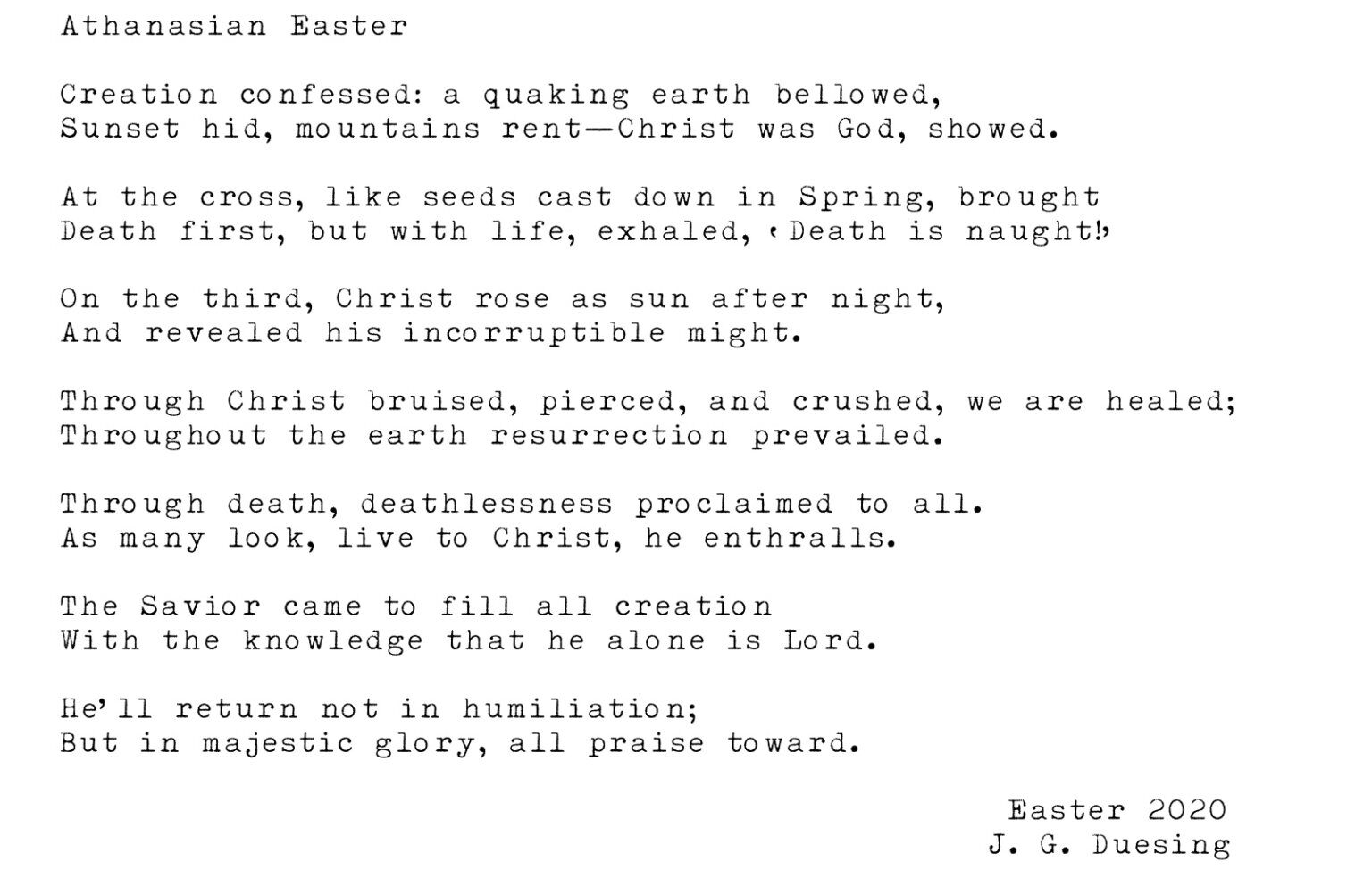
On the third day He rose again — A Sonnet for Easter

In the mornings this year I’ve been re-reading a fourth century masterpiece.

While Athanasius’s On the Incarnation is remarkable, it was C. S. Lewis who termed it a ‘masterpiece’ in his famous introduction to a new English translation of Athanasius’s work.

As I read through the chapters of De Incarnatione Verbi Dei, I started summarizing each of the fifty-seven sections in my own words and soon realized the helpfulness of this exercise.

Reading this old book has served to accomplish for me what C. S. Lewis hoped it would. Lewis advised, then in 1944, that in an era of modern controversies and division within Christianity “the only palliative is to keep the clean sea breeze of the centuries blowing through our minds, and this can be done only by reading old books.”

In specific, Lewis had in mind books that put forth a “standard of plain, central Christianity which puts the controversies of the moment in their proper perspective.” Even though it is now 2020 and we are not facing the same controversies of 1944, Lewis’s commending the reading of On the Incarnation does, indeed, put our controversies in perspective.

My reflection led me to another thought: could I condense and conform my thoughts on Athanasius’s work into a poem to summarize what I had gained? As only a poetry-appreciator, not a poet, I set out to learn more about form and structure and settled on a simple sonnet.

The sonnet, I learned, allows for poems with musicality but also to be read in silence. The 14-line structure and rhyming patterns function “like a box” and since sonnets are often meant to focus on a person, I thought it a good form to follow for a poem on the incarnation of Christ.

The result of my reflections on this “old book” was, first, a sonnet for Advent, and now the following sonnet for Easter.** Thanks to C. S. Lewis, it has helped me to keep this remarkable year in proper perspective.


**Working from my summaries of Athanasius’s last five chapters, I sought to structure the three quatrains around each chapter, with the last focusing on the last three. I created a spreadsheet to aid in building each of the 14 lines in iambic pentameter and around a specific rhyming sequence and then edited to final form.

For further reading:

  • Athanasius, On the Incarnation: the treatise De incarnatione Verbi Dei, translated and edited by a religious of C.S.M.V. (Centenary Press, 1944).
  • C. S. Lewis, “Introduction,” in Athanasius, On the Incarnation (St. Vladimir’s Seminary Press, 1996).
  • Peter Barnes, Athanasius of Alexandria: His Life & Impact (Christian Focus, 2019).
  • Rachel Richardson, “Learning the Sonnet,” Poetry Foundation, August 29, 2013.


* This article was originally published at jgduesing.com


What You Need to Know About the Seder Meal and Passover

As Holy Week approaches, many Christians and churches will begin thinking more intently about Passover. The final days of Jesus’ life coincide with the Jewish festival, and the New Testament unabashedly describes him as the “the Lamb of God, who takes away the sin of the world.” (John 1:29). It is no mistake to associate the crucifixion with this festival established long ago, but how do we teach and preach about Passover? The most ready answer would seem to focus on Exodus 12, where the Lord gives Moses the commands regarding Passover. In fact, this is the longest and most descript passage regarding the Passover in the Bible. However, in recent times, many have found this passage to be insufficient for understanding the festival, turning to the Jewish tradition of the Seder meal as the source for understanding the Passover.

What is the Seder Meal?

For those unfamiliar with the term, the Passover Seder (from the Hebrew word for “order”) is a traditional Jewish meal that function as the centerpiece of the Jewish celebration of Passover. The meal is comprised of a complex series of steps with symbolic significance retelling the Jewish departure from Egypt. The famous Seder plate includes multiple items:

– a cooked egg symbolizing new life and associated with the festival in ancient times
– a green vegetable signifying Israel’s growth in Egypt
– a fruit paste symbolizing the mortar for building projects while in Egypt
– bitter herbs symbolizing the suffering of slavery
– a lamb bone symbolizing the sacrificial lamb

The lengthy liturgy (Haggadah) and symbolic meal (Seder) rehearsed in the Seder served to illustrate and teach the Jewish people about their heritage from ancient times. The instructions include a time where the sons ask their father questions about what makes the Passover night different, succeeding in carrying out the Old Testament instruction for fathers to teach their children about the exodus (Ex. 12:26, 13:6, 14; Deut. 6:12). But where did the tradition originate?

The Origins of the Seder Meal

The first recorded instruction regarding the Passover Seder is found in Mishnah Pesachim 10, a Rabbinical Jewish text likely composed during the 2nd or 3rd century AD. While there is little doubt that the Rabbinic Mishnah tractate reveals a tradition that goes back earlier than the 2nd or 3rd century, reconstructing the Mishnah’s place in early Judaism in fraught with challenges. Taking the Old Testament at face value, the Jews had been celebrating the feast of Passover for centuries (based upon the description found in Exodus 12). This conclusion is supported by the lack of reference to the Seder by early sources like the Book of Jubilees, Philo, and Josephus. In his decisive work on the topic, Jewish scholar Baruch Bokser argues that the Seder tradition is older than the Mishnah tractate but not earlier than the destruction of the temple in AD 70 (The Origins of the Seder [Berkeley, CA: University of California Press, 1984]). Commenting on Bokser’s conclusion, Jonathan Klawan writes, “It’s not that rabbinic literature cannot be trusted to tell us about history in the first century of the Common Era. It’s that rabbinic literature—in the case of the Seder—does not even claim to be telling us how the Seder was performed before the destruction of the Temple” (“Was Jesus’ Last Supper a Seder?” Biblical History Daily, Biblical Archaeology Society). The Seder meal was an important part of Diaspora Judaism at an early date, but it is highly debated as to whether or not it reflects a pre-destruction era of Jewish tradition.

Was the Last Supper a Seder Meal?

Given the later development of the Seder meal, it is unlikely that Jesus’ last meal with his disciples was a Seder meal. Some have highlighted a few parallels between the Gospel accounts and the Seder tradition, but none prove the case. They are brief textual allusions, not recitations of the tradition encountered in the Mishnah. If we read the Gospel accounts of the last week of Christ harmoniously, it is evident that the final meal, crucifixion, and resurrection of Jesus occur around the celebration of Passover—a historical and theological reality that highlights the nature and design of the atonement. Regardless of whether the Last Supper was indeed a Passover meal or a normal meal on an earlier day, the origin of the Seder tradition makes it historically unlikely that this meal was carried out in the Rabbinic tradition laid out in the Mishnah.

As we think about the final week of Jesus, the significance of his death, and the role Passover plays in the Gospel narrative, these historical realities should shape the way we think and teach. While the Seder meal was an instructive ritual illustrating the Jewish story of liberation from Egypt, it was likely not the way our Lord celebrated Passover. It is quite possible that by the time of the New Testament, traditions and additions to the text of Exodus 12 had grown up around the festival. However, if we want to understand the divine design of Passover, we are better off looking to the words of Moses. The biblical foundation of the Passover tradition begins in Exodus and finds its fulfillment in a new exodus established for God’s people by a final Passover lamb. Our reflections upon Passover should never stray from the New Testament truth stated so powerfully by the Apostle Paul, “For Christ, our Passover lamb, has been sacrificed” (1 Cor. 5:7). We cherish Israel’s Passover because, by it, we come to know our own.


A Reflection on “The Sower’s Song” by Andrew Peterson

As you celebrate Holy Week and prepare for Easter Sunday, I pray this reflection on “The Sower’s Song” by Andrew Peterson helps you cherish the beauty of the resurrection and the immeasurable hope we have in Christ.

Have you ever summited a mountain at sunrise? Felt your heart swell with longing and hope at the appearance of green after a long winter? Been overwhelmed with love?

That is how I feel listening to “The Sower’s Song” by Andrew Peterson. 

Peterson is a well-known wordsmith in Christianity. The Lord has gifted him a passion for sharing the power of truth, beauty, and goodness in Scripture and the arts. Thousands of believers will listen to Peterson’s Resurrection Letters albums in preparation for Easter this year, and his song “Is He Worthy?” is enjoyed globally by congregations every week.  Though he has authored multiple award-winning books, teaches classes on writing, and founded a nonprofit ministry for Christians in the arts, my first exposure to Peterson was his 2015 album The Burning Edge of Dawn.

Listening through the album, I was immediately captivated by how beautifully he weaves together truth-filled words of praise, lament, thanksgiving, and prayer. (And sometimes all within the same piece.) As it always is with the best songwriters, Peterson does not simply sing songs. He is a storyteller who paints worlds with his words. 

Amidst my early years of college and Christianity, Peterson’s lyrics provided a safe place to feel and reflect with the Lord. Enjoying that music while spending time in God’s Word became a regular rhythm of grace during that season. Then, one day, what had become just another part of my routine yielded a remarkable moment with the Lord that still impacts me today.

When I arrived at the last song on The Burning Edge of Dawn, I was not paying much attention. My mind was swirling with lingering guilt from an argument earlier in the week. I was trying to figure out how to afford the next semester of school, battling depression, and struggling to stay on top of all my relational and logistical responsibilities.

Suddenly, the first verses cut through the chaos:

Oh God, I am furrowed like the field
Torn open like the dirt
And I know that to be healed
That I must be broken first
I am aching for the yield
That You will harvest from this hurt

The words disarmed me. This gentle acknowledgment of brokenness and ache stilled my internal spiral, calming my mind as my soul listened to the truth of God’s sovereignty over pain. As I continued to listen, the prayer shaped by John 15:1-10 became my own:

Abide in me
Let these branches bear Your fruit
Abide in me, Lord
Let Your Word take root
Remove in me
The branch that bears no fruit
And move in me, Lord
As I abide in You

Tears began to spill from my closed eyes. Suddenly, I was there—staring “at the bright edge of the garden, at the golden edge of dawn, at the glowing edge of spring.” Even surrounded by the darkness of this present world, hope that every sad thing will come untrue blossomed in my chest.

Two minutes in, I was on my knees. The Lord saved me by opening my eyes to the beauty of the gospel through reading the Book of Isaiah. As Peterson sang the promises written in Isaiah 55:10-13, I felt the joy of my salvation renewed: 

As the rain and the snow fall
Down from the sky
And they don’t return but they water the earth and bring they forth life
Giving seed to the sower, bread for the hunger
So shall the word of the Lord be with a sound like thunder
And it will not return, it will not return void
We shall be led in peace
And go out with joy
And the hills before us
Will raise their voices
And the trees of the field will clap their hands as the land rejoices

Truth warmed my soul like a fire illumining the room of a weary traveler. I already believed, but the Lord helped my unbelief. The surpassing worth of knowing Jesus overwhelmed me, and there was no doubt:

The tomb that once held the body of Christ broken on my behalf is empty.

The dawn of spring shouted a tangible reminder that the King who brings life from death rose and will return. The crescendoing melody wrapped around me:

And instead of the thorn now
The cypress towers
And instead of the briar the myrtle blooms with a thousand flowers
And it will make a name
Make a name for our God
A sign everlasting that will never be cut off
As the earth brings forth sprouts from the seed
What is sown in the garden grows into a mighty tree
So the Lord plants justice, justice and praise
To rise before the nations till the end of days

Listening to “The Sower’s Song” brought a powerful moment of clarity to my spiritual life. God’s Word proclaimed in Peterson’s song washed cobwebs from my walk with Jesus and refocused my desire to be a faithful ambassador of this coming Kingdom. Every April since then, as I watch the frost melt from new buds of life, the lyrics play through my mind: 

It [God’s Word] will not return void
We shall be led in peace
And go out with joy

Whatever season you are in, I encourage you to reflect on these words in Isaiah. Marvel at God’s holiness in the throneroom of Isaiah 6. Be emboldened by the promise of God’s presence to the repentant in Isaiah 43. Behold the suffering Messiah foretold in Isaiah 53—the Lamb who was “pierced for our transgressions” and “crushed for our iniquities.” Sing with joy at Christ’s accomplishment of present justification and that you are sealed by the promised Holy Spirit for future glory.

Yes, the pain is real. But the promises are true.

Beloved, the face of Jesus will shine with such glory we will no longer need sunlight. His nail-pierced hand will wipe every tear from the eyes of his Bride. Our redeemed bodies will stand in the presence of the Prince of Peace, delighting in His majesty as death dies. Then the Sower of every flourishing promise will dwell with us for all eternity.

As you walk through the darkness, know the dawn will come. As you bear the thorn, remember the branches will bear fruit. As you feel the ache, trust that God is sowing seeds of grace even in your pain.

And the Sower leads us.