Start With The End: 3 Reasons You Should Try Writing the Conclusion of Your Sermon First

Have you ever listened to a sermon and felt like the preacher did not know how to stop talking? “Just land the plane” is an encouragement you may have heard before. Preaching is hard and ending the sermon with a satisfying conclusion is even harder. You can have the most engaging opening story, great exegesis, and helpful application and yet leave the audience exasperated at the end because you keep circling the runway instead of landing the plane. Or even worse, you can take the people on a great exposition that glorifies God and edify the saints and just crash the plane at the end because you didn’t know how to get out of it. How you close a sermon is as important as how you start the sermon.

Quintilian, the classic orator said “The peroration (conclusion) is the most important part of forensic pleading.” The conclusion of the sermon is place where you make a final plea and argument for your people to believe what God’s Word has said and apply it to their lives. Yet the temptation is to haphazardly wrap things up with an application point or closing anecdote. You will serve your people well when you close a sermon with clarity and conviction. If you find that a particular airline has pilots that tend towards uncomfortably, bumpy, and startling landings you will fly with someone else. And as important as it is for a pilot to get you to the ground safely, it is even greater that those of us who labor in the proclamation of God’s Word to his church conclude with clarity and satisfaction. Here are three reasons why you should try writing your conclusion first.

Clarifies the Central Main Point

Any impactful sermon aims to communicate a central truth or main point. (Yes, your sermon should have a main point that you are proving.) Too often, preachers lose sight of this focus during the sermon development process. You found a hilarious illustration, a fascinating detail in the text, or a place to do cultural engagement but what if those great things don’t actually serve your main point. They are your favorite rabbit trails, but going down the rabbit hole is not what a sermon is meant to do. You need to know your main point that you are bringing to your people in order to conclude the sermon. Writing the conclusion first can serve as a powerful antidote to this problem. Your work in the Word will lead to the main point of the passage. If you do your work, starting at the end really isn’t that hard. The conclusion ought to hit that main point home one final and forceful time to stay in the mind of your audience.

By crafting the conclusion upfront, you crystallize the central message you want to leave with your congregation. This focused idea becomes the lighthouse guiding all other parts of your sermon. As you construct the introduction and the body, you are constantly reminded of the primary point you want to make. It enables you to be sure that every element of your sermon—be it scriptural exploration, real-life applications, or illustrations—directly contributes to driving home your main point.

Pulls Together the Movements in the Sermon

A sermon isn’t merely a linear progression of ideas; it’s a journey that the preacher takes the congregation on. This journey has different movements—sometimes through contrasting viewpoints, parts of a story, or your classic three-point sermon. Knowing your conclusion from the get-go offers clarity to these movements. Your subpoints work like turns on the road or rocks in a creek. They get you to your destination. If you don’t know your destination, your conclusion, then your subpoints will take you somewhere else, or perhaps leave your stranded.

When you write the conclusion first, you essentially establish your sermon’s destination. With the end point clear in your mind, you can thoughtfully plot the course you wish to navigate to get there. Each movement in the sermon becomes a strategic step toward that pre-determined conclusion. Whether you are using deductive reasoning, building an argument, or engaging in storytelling, the movements will be more coherent and logical, helping your people understand and remember the message.

Makes People Want to Come Back and Listen Again

A strong, memorable conclusion leaves a lasting impression. It’s the part of the sermon that often resonates most deeply with listeners and gives them something to ponder long after they’ve left the church building. It is the last thing they will likely hear you say. Consequently, the conclusion can be a significant factor in whether people will want to come back and listen again.

Writing the conclusion first allows you to tie up loose ends, identify the key takeaways, and the emotional tone you wish to set. By identifying this emotional and spiritual landing point early in your preparation, you are better prepared to craft a sermon that captures attention from the beginning, holds it throughout, and releases it only after imprinting a compelling message on the hearts of your listeners. That’s something that I would want to come back and hear again

Conclusion

The task of sermon writing is both a privilege and a responsibility, and the approach one takes can make all the difference. Writing the conclusion first might seem counterintuitive, all the more reason to try it. I’m not saying pick a conclusion apart from God’s Word. Do your exegetical work, find your main idea, and when you sit down to write the sermon start at the end. It clarifies your sermon’s central point, gives structure and clarity to its various movements, and most importantly, leaves your congregation eager to return for more. Look, there is nothing magical about when you write your conclusion. But having a good conclusion that reinforces the conclusion is important and too easily passed without thought. So, the next time you sit down to pen a sermon, consider starting at the end.
What is Pure Act?

Editor’s Note: The Theology in the Everyday series seeks to introduce and explain theological concepts in 500 words or less, with a 200-word section helping explain the doctrine to kids. At For The Church, we believe that theology should not be designated to the academy alone but lived out by faith in everyday life. We hope this series will present theology in such a way as to make it enjoyable, connecting theological ideas to everyday experience and encouraging believers to study theology for the glory of God and the good of the Church. This week, pure act.


We are creatures torn between being and becoming. In the grand symphony of creation, everything reflects the tension between what is, and what will be. From the tiniest microorganisms to the greatest galaxies swirling in the cosmos, each created entity carries its unique blueprint of potentiality and fulfillment.

The fact that the world around us is full of potential is so common to our everyday experience that we hardly stop to notice. We don’t often pause to look at an oak tree in the park long enough to marvel at the acorns strewn about beneath. But there in those tiny acorns lies the potential to grow, given the right conditions, into a giant oak tree. This is because it is the very nature of an acorn to become an oak. An acorn, we could then say is potentially an oak tree. Looking from the other direction, we could say that a mature oak is a fully actualized acorn. That is, when the true nature of the acorn is fulfilled or actualized, it becomes the tree that it was created to become.

We humans, as part of God’s intricate design, also embody this principle. We are born helpless infants, brimming with the potential for growth and learning as we mature into the adults we are meant to be. Our lives are exercises in becoming, the pursuit of actualizing our dormant abilities and fulfilling our purposes to create and cultivate God’s creation.

All created things reflect this distinction between what they are, and what they can become. We live in a world where being and becoming are built into the very fabric of reality.

Yet, amidst this constant flux and change that characterizes the created world, God stands as the unchanging being. God’s essence is perfect, simple, and pure. He is the eternal “I AM” that knows no shadow or variation due to change. This divine unchangeability (immutability) reminds us of the profound difference between the Creator and His creation.

The world around us pulsates with potential, a testament to the exquisite design of creation, while God remains the epitome of pure being, untouched by the winds of change, and ever radiant in the fullness of His perfect existence. God, being the Creator of all things, is not like us. As pure existence, the One who has life in Himself, He has no need of becoming. To imply that He has need of becoming would be to confuse the Creator with His creation.

We could then say that God is purely actual, only ever and always existing and acting out of the fullness of His perfect, infinite life, never out of lack or need. In short, God has no potential to become anything other than what He already is, because He Himself is the fullness of life.

For the Kids:

As kids, you hope to grow up and be big someday. It’s why you play “grown ups” with your friends and pretend that you are doctors, firefighters, professional athletes, or moms and dads. Growing up is part of what it means to be a kid. It’s why you play and learn new things and why, when the time comes, you will learn to do less fun grown up things like work and chores. But that is a good thing! It means that you are becoming who God created you to be.

God, however, is not growing up and changing like you are. He is, and has always been, perfectly God, so He has no need to grow up or change. This is good news for you because it means that God does not lack anything! Since He lacks nothing, everything God does, He does it out of His abundant love, never out of need. In fact, God is so perfect and complete in himself that he chose to share everything He has with you, in Jesus. This is the good news of the gospel.

So as you grow up in a world full of change, always remember that God cannot be any more because He already is.[1]

[1] Thanks to Thomas Hext for this aphorism about what it means for us to confess that God is pure act.


05: Treasuring Christ in All of Scripture

“And Beginning with Moses” (Luke 24:27)

“And beginning with Moses and all the Prophets, he interpreted to them in all the Scriptures the things concerning himself” (Luke 24:27). The only Bible Jesus had was what we call the OT, and he believed that his Scriptures bore witness about him (John 5:39) and that everything they said about him would be fulfilled (Luke 24:44).

Christ’s followers, then, should be intent to properly magnify Jesus where he is evident. As the Puritan theologian John Owen wrote in 1684, “The revelation … of Christ … deserves the severest of our thoughts, the best of our meditations and our utmost diligence in them.” 1 To accomplish this faithfully, one must employ a multifaceted approach that accounts for the centrality of Jesus in all God is doing in history.

How to Engage in Christ-Centered OT Interpretation

Considering the relationship of the Testaments and Scripture’s unity centered on the divine Son, G. K. Beale has noted five principles that are rooted in the OT’s own story of salvation history and that guided the NT authors’ interpretive conclusions:2

  1. The NT authors always assume corporate solidarity, in which one can represent the many (e.g., Rom 5:18–19).
  2. Christ represents the true (remnant) Israel of the old covenant and the true (consummate) Israel, the church, of the new covenant (e.g., Isa 49:3, 6; Luke 2:32).
  3. God’s wise and sovereign plan unites salvation history in such a way that earlier parts correspond to later parts (Isa 46:9–10; Luke 16:16).
  4. Christ has initiated (though not consummated) the age of end-times fulfillment (e.g., Heb 1:2; 9:26).
  5. Christ and his glory stand as the end-time center and goal of history, such that his life, death, and resurrection provide the key to interpreting the OT and its promises.

These principles directed the way Jesus and the apostles interpreted Scripture, and they should inform every Christian approach to the OT.

Furthermore, the fact that God authored Scripture and gives it an overarching unity demands that all OT interpretation consider three distinct but overlapping contexts:3

  1. The close context focuses on a passage’s immediate literary setting within the whole book. Here we observe carefully what and how the text communicates, accounting for both the words and the theology that shapes those words.
  2. The continuing context considers the passage within God’s story of salvation. We examine how a text is informed by antecedent Scripture and contributes to God’s unfolding kingdom drama.
  3. The complete context concerns a text’s placement and use within the broader canon. We consider how later Scripture might use the passage, remembering that the divine authorship of Scripture allows later passages to clarify, enhance, or deepen the meaning of earlier texts.

Only by considering all three contexts will Christian interpreters be able to fully grasp God’s intended meaning of OT passages and understand how those texts point to Christ.

Six More Ways to Treasure Christ in the OT4

Along with tracing Scripture’s kingdom program climaxing in Jesus (discussed in the previous post), the salvation-historical, Christocentric model presented here proposes at least six other ways God exalts Jesus in the OT.

1. Treasuring Christ through the OT’s Direct Messianic Predictions

In Acts 3:18, 24, Peter stresses that every one of the prophets, from Moses onward, anticipated the Messiah’s suffering and the days of the church. The OT, then, is loaded with explicit and implicit direct messianic predictions. For example, Moses records that Yahweh promised Abraham that a single male offspring would “possess the gate of his enemies” and that “all the nations of the earth” would regard themselves “blessed” in him (Gen 22:17b–18). Paul, then, notes how in Christ God fulfilled his promise to bless the Gentiles (Gal 3:8, 14). So, when you read the OT’s messianic predictions, see and savor how the divine Son realizes these hopes.

2. Treasuring Christ through Similarities and Contrasts of the Old and New Ages and Covenants

Jesus’s saving work creates both continuities and discontinuities between the old and new ages and covenants. For instance, while both covenants contain a similar structure (i.e., God first redeems and then calls his people to obey), only the new covenant supplies freedom from sin and power for obedience to all covenant members (Jer 31:33–34). Similarly, whereas God used the blood of bulls and goats to atone in the old covenant, Christ’s substitutionary sacrifice alone provides the ground for eternal redemption (Heb 9:11–14). These kinds of similarities and contrasts encourage a messianic reading of the OT. We can treasure Christ’s work by identifying the patterns and transformations.

3. Treasuring Christ through the OT’s Typology

God structured salvation history in such a way that certain OT characters (e.g., Adam, Moses, David), events (e.g., the flood, exodus, return to the land), and institutions or objects (e.g., the Passover lamb, temple, priesthood) bear meanings that clarify, color, or predictively anticipate the Messiah’s life and work. The NT calls these pointers “types” or “examples” (Rom 5:14; 1 Cor 10:6). They find their counter in Jesus as their ultimate realization (“antitype”). When you identify OT types that clarify and anticipate Christ’s person and work, see and celebrate the Son as the substance of all earlier shadows.

4. Treasuring Christ through Yahweh’s Identity and Activity

Jesus said that no one has ever seen God the Father except the Son (John 6:46) and that “whoever has seen me has seen the Father” (14:9). Minimally, this means that those who saw God in the OT (e.g., Exod 24:11) were enjoying but partial glimpses of his glory (33:18–23). It may also imply that, at least in some instances where Yahweh becomes embodied in human form (e.g., Gen 18:22), we are meeting the preincarnate Son. In brief, when we meet Yahweh in the OT, we are catching glimpses of the coming Christ. As such, when you revel in Yahweh’s identity and activity, see and savor the divine Son.

5. Treasuring Christ through the Ethical Ideals of OT Law and Wisdom

Every law and wise saying in the OT are sources for magnifying the greatness of Christ on our behalf. He is the perfect embodiment of God’s character and the ideal image of law keeping and wisdom. Paul stressed both that in the law we have “the embodiment of knowledge and truth” (Rom 2:20) and that “the law is holy, and the commandment is holy and righteous and good” (7:12). The same can be said of Christ, who remained sinless (Heb 4:15) and “became to us wisdom from God” (1 Cor 1:30). Therefore, when you observe how the OT law and wisdom express ethical ideals, celebrate the justifying work of the divine Son.

6. Treasuring Christ by Using the OT to Instruct Others in the Law of Love

Jesus’s coming unlocks the significance of the OT (2 Tim 3:15), and through him we now have access to a massive amount of Scripture that can clarify how to love God and neighbor (Rom 16:25–26). Moreover, God now empowers us in Christ to keep the “precepts” of the law, as we live with circumcised hearts by the power of the Spirit (Rom 2:26, 29). Christ is our teacher, and his own fulfillment of the law now clarifies for us what it means to follow God (Matt 5:17–19). When we use the OT to instruct or guide others, calling them to love and thus fulfill the law (Rom 13:8–10; cf. 2 Tim 3:16), we should treasure the sanctifying work of the divine Son.

Conclusion

All things, including the very letters of Scripture, are from, through, and for the divine Son (Col 1:16). If, after evaluating any OT text through the seven above ways, you still don’t find a bridge to magnifying the Messiah, then recognize that we can treasure Christ in the mere fact that we have the written Word. God is speaking through the Old and New Testaments, and he is speaking only because Jesus purchased the grace that allows sinners to receive the sacred text. May we increasingly learn to proclaim “Jesus Christ and him crucified” (1 Cor 2:2) from the initial three-fourths of the Christian Scriptures.

1. John Owen, “Meditations on the Glory of Christ,” in The Works of John Owen, ed. William H. Goold (Edinburgh: T&T Clark, 1862), 1:275.
2. G. K. Beale, “Did Jesus and His Followers Preach the Right Doctrine from the Wrong Texts?,” Themelios 14 (1989): 90. The present author has added the scriptural references.
3. These categories are drawn from Trent Hunter and Stephen J. Wellum, Christ from Beginning to End: How the Full Story of Scripture Reveals the Full Glory of Christ (Grand Rapids: Zondervan, 2018), 42–69.
4. Much of what follows adapts material first published in Jason S. DeRouchie, How to Understand and Apply the Old Testament: Twelve Steps from Exegesis to Theology (Phillipsburg, NJ: P&R, 2017), 481–89.

This blog series summarizes Jason S. DeRouchie’s forthcoming book, Delighting in the Old Testament: Through Christ and for Christ (Wheaton, IL: Crossway, 2024). You can pre-order your copy here.


The Secret to Loving Your Wife Better: Love Jesus Better

I recently heard somebody say that one of the ways to endure well in ministry is to realize that ministry is not about you, it’s all about Jesus. The same is true of marriage. When you embrace that marriage is about Jesus first, and you and your wife second, one of the secrets of a joyful, enduring marriage comes to light: love Jesus better, and you will love your wife better.

As pastors, it seems we should know this instinctively. Our calling is directly tied to helping others come to know Jesus better. But we are no different than all of our church members when it comes to needing to be reminded constantly that the Bible says that marriage is about Jesus first and that it works right when we love Jesus first.

As I have studied what the Bible says about marriage, both for my own growth and for the growth of others whom I am trying to help, I have become convinced that Christ’s relationship with the church is the controlling metaphor that God has given us to help us understand marriage. A controlling metaphor is a word picture that explains something for an entire work of literature. At the beginning of the Bible, when God created marriage in the Garden of Eden, he initiated a human covenant relationship that he knew could reflect the relationship between his Son and his people. Even so many years before Jesus, even in the Garden, God was pointing ahead to his Son.

At the end of the Bible, when God plans a celebration feast for the consummation of the ages, he describes it using what term? The marriage Supper of the Lamb (Revelation 19:7, 9)! When we love our wives like Christ loves the church, we are playing our part in a story that has been told since the beginning of time, a story that will continue to be celebrated at the end of time as we step into the beginning of forever.

Paul points this out in Ephesians 5:31-32, when he quotes Genesis 2:24, and then explains that there are depths to marriage we can only begin to understand on this side of eternity: “‘Therefore a man shall leave his father and mother and hold fast to his wife, and the two shall become one flesh.’ This mystery is profound, and I am saying that it refers to Christ and the church.” Marriage refers to Christ and the church. God embedded marriage in culture as a quiet pointer to the gospel. So, when we love our wives well, we point to Jesus. But also, when we love Jesus well, we love our wives better.

After two decades of marriage, I have noticed a pattern: when I am closer to Jesus, I am usually closer to my wife. Why is this? Paul David Tripp helpfully explains in his book, What Did You Expect?, “A marriage of love, unity and understanding is not rooted in romance; it is rooted in worship…No marriage will be unaffected when the people in the marriage are seeking to get from the creation what they were only ever meant to get from the Creator.”

This applies to pastors as much as anyone else. Yet, there are certain dangers inherent in our vocation. We can think that because we are serving Jesus daily as part of our job, that we are naturally close to Jesus. But one test of a man’s walk with Christ is in how he treats his wife. This is not to say that if we are close to Jesus, that we will automatically at all times be close to our wives. The fact that you are a sinner married to a sinner in a world groaning under the curse, with a difficult calling as a pastor’s family, means that there will be ups and downs in your marriage. But making your relationship with Christ a priority is the start to finding the freedom and power to love your wife humbly and selflessly as Jesus loves, no matter what is going on in your relationship or ministry at the time.

When you remember that Jesus is your first love (see Revelation 2:4-5), then his love naturally overflows out of your life onto your wife. It’s not that loving Jesus and loving your wife are commands from God that are at odds with each other, it is that we can only love others rightly when we have our loves ordered rightly.

Jesus explained how loving God results in loving others: “You shall love the Lord your God with all your heart and with all your soul and with all your mind. This is the great and first commandment. And a second is like it: You shall love your neighbor as yourself.” (Matthew 22:37-39) Your wife is your closest neighbor, so the words of Jesus remind us of our order of priorities as shepherds of God’s people: love Jesus, love your wife, love your kids, and love others including your church family and community.

Fellow pastors and ministry leaders, don’t forget that there is a clear command from the Bible on loving your wife, “… be intoxicated always in her love” (Proverbs 5:19). God calls you to be madly in love with your wife. This is best for you, best for her, best for your kids, best for your church, and it glorifies God. So pursue her simply for the joy of pursuing her, and because you love her. But don’t forget that you will love your wife better when you love Jesus better. Root your pursuit of her in the fact that you have been pursued by Christ. Embracing this secret can be the secret to embracing a joy-filled marriage.

Rekindle your love for Jesus, and be in tune with his heart for reflecting the gospel in your marriage. Then your marriage will be like a fire that keeps you both warm, and at the same time gives light to others.


How Jesus Wanted Us to Read His Gospel

Today my son found months-old Saltines at the bottom of a wicker basket. I pried his mouth open and begged him to spit them out, but he slipped away, swallowing his prize with a grin.

In the next room, strewn across the floor and his high chair, sat his half-eaten lunch. I’ll never understand what makes my toddler desire stale crackers instead of a freshly made sandwich, but he always eats the crumbs off the floor, the bread that seems lesser to me.

Often, I’d argue, when we’re reading the Gospels, we also eat the lesser bread.

At times I open a Gospel to wrestle over Jesus’ teaching, a parable or a specific teaching point, and I forget to see the One who’s teaching. I forget that, by reading the Gospels, we don’t just learn about Jesus, but we can know him.

The Gospel writer John emphasized repeatedly his desire for everyone to know Jesus—through teaching, pointed questions, and important events in Jesus’ life—and in the middle of the Gospel of John, he further emphasized why he wrote: “These [things] are written so that you may believe that Jesus is the Christ, the Son of God, and that by believing you might have life in his name” (John 20:31). In other words, John didn’t write just because, or to provide loosely connected observations on Jesus’ life, but he had evangelism in mind. This is the heart of John’s Gospel: that we might believe Jesus is the Christ, the Son of God, and that we might believe him.

John spent several years following Jesus, hearing him speak, watching his miracles, listening in on conversations. He witnessed Jesus weep, experience hunger and thirst, resurrect a dead man, die, and come back to life. John knew Jesus, and he wanted his reader to know Jesus too; he wanted his reader to really know Jesus—to experience a lasting relationship with Christ that only comes through belief in him.

He wanted his readers to know the greater bread.

At one point in his ministry, Jesus drew a crowd of 5000 hungry people. Enamored by stories of Jesus healing the sick, they followed him. Desiring to feed the crowd, Jesus multiplied a little boy’s fish and bread, the disciples passed out lunch, and the crowd ate until satisfied. Enamored by yet another sign, they tried to “make him king by force” (John 6:15). When Jesus escaped, the crowds followed him to the other side of the sea, and he quickly determined what they were after: they wanted the food, the physical bread (John 6:26–27). Once again, they were more interested in what this man had to offer them instead of the man himself.

Jesus patiently responded with a well-known declaration of his identity: “I am the bread of life; whoever comes to me shall not hunger, and whoever believes in me shall never thirst” (John 6:35). Yes, Jesus provided the crowds with good teaching, food, and the signs they sought, but he also provided them with something so much greater: he provided the crowds with himself.

Jesus was the greater bread.

Too often, as I read about the life of Jesus, I am just like these crowds—my belief is in a lesser bread. I understand that he feeds the 5000 to show the crowds the face of God, but like them, I come to him for what he provides—I come to him for the lesser bread (John 6:26–27). Too easily, the good things Christ has to offer me—his teachings, his miracles, a renewed attitude, a verse to prove an argument—obscures Christ himself.

As we read about Jesus in the Gospels, we read about a man who lives. We read about a man who pursued us, lived in perfect obedience, gave his life, and was resurrected, so that we might believe in and know him, through the Holy Spirit. This same man sits in heaven even now, with the same resurrected body with which he walked this earth, and thinks of us, sees us, knows us.

And when we read John’s Gospel, we submit ourselves to the Christ who has made himself known, who longs for us to know him as the true bread, the greater bread—who longs for us to believe him (John 6:35, 40).

The next time we open the Gospel of John, we could treat Jesus simply as a good teacher, scrounging for the final crumbs tossed to the floor. Or, we can know Christ as he has made himself known, the Son of God—the One who calls us to believe.

I’ll choose the greater bread.


04: KINGDOM: The Story of God’s Glory in Christ

“The Time is Fulfilled” (Mark 1:15)

God’s Kingdom Program1

The kingdom that Christ proclaimed and fulfilled (Luke 4:43; Acts 1:3) relates to God’s reign over God’s people in God’s land for God’s glory. God reigns, saves, and satisfies through covenant for his glory in Christ. This theme stands at the core of God’s purposes from Genesis to Revelation.

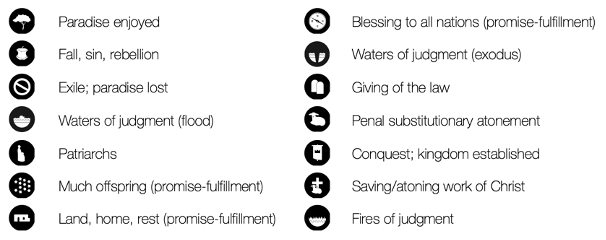
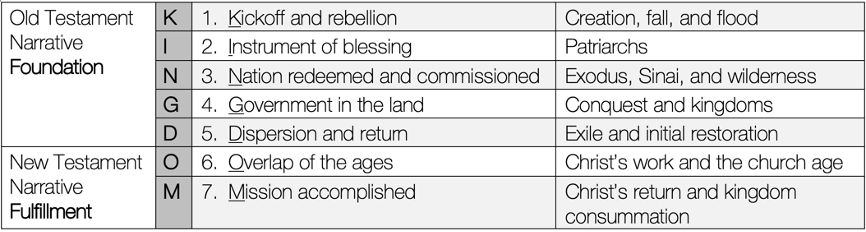
When the Old and New Testaments are read together, at least seven stages are apparent in God’s kingdom program (see table 1). The initial five are the foundation that is ultimately fulfilled in the last two. The acronym KINGDOM allows for easy memorization.

Table 1. God’s KINGDOM Plan

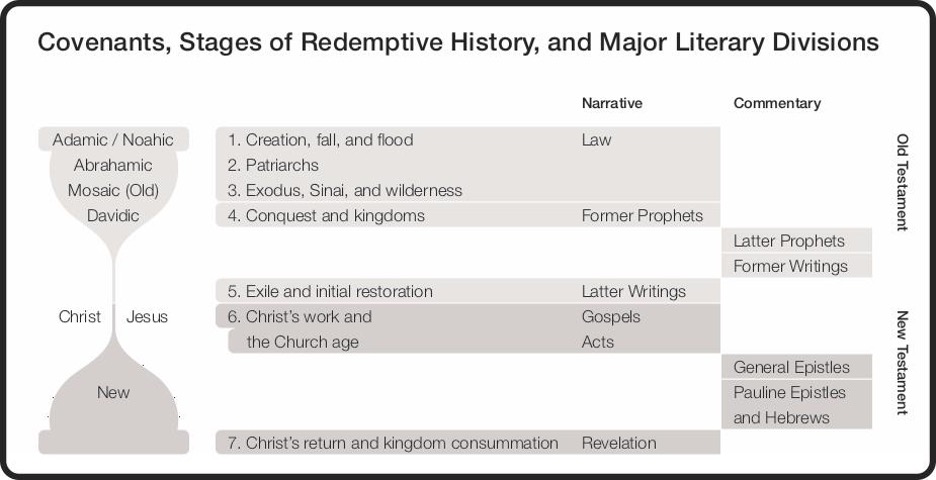
This story is marked by five overlapping covenants (Adamic/Noahic, Abrahamic, Mosaic, Davidic, and new), the progression of which detail God’s purposes for humanity climaxing in Christ. The interrelationship of the covenants is like an hourglass, with the most universal scope occurring at the two ends and the work of Christ at the center (fig. 1). The titles of the initial four covenants relate to their covenant mediator, whereas the title “new covenant” signals how it supersedes the old Mosaic administration (Jer 31:31–34; Heb 8:6–13).

Figure 1. Salvation History within the Flow of the Bible

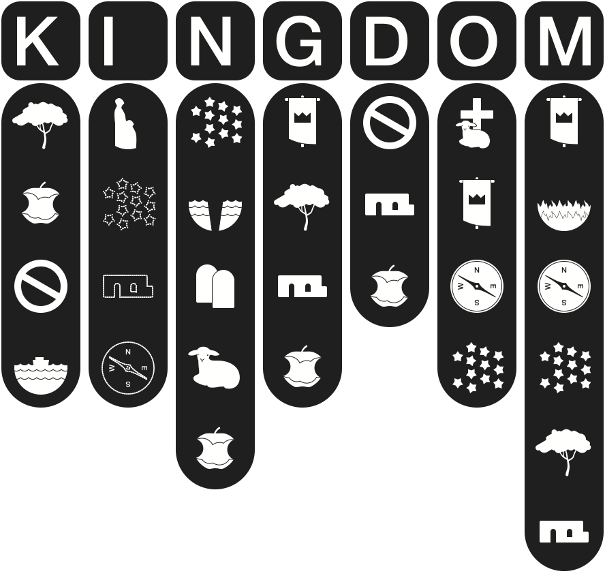
Scripture’s storyline indicates that Yahweh’s definitive goal is to display himself as the supreme Savior, Sovereign, and Satisfier of the world, ultimately through his messianic representative. As such, the Bible tells the story of God’s glory in Christ. Alongside the KINGDOM acronym, a set of images will help clarify the flow of God’s purposes (fig. 2).


Figure 2. God’s KINGDOM Plan through Images

1. Kickoff and Rebellion


God created humans to image him and commissioned them to “fill the earth and subdue it” (Gen 1:28). But they failed to honor him and submitted to the authority of Satan (3:1–6), who in turn became the ruler of this world (cf. 2 Cor 4:4). Because Adam acted as a covenantal head, God now counts the rest of humanity as having sinned in him (Rom 5:12, 18–19). From conception, we are condemned sinners under God’s just wrath (John 3:36; Eph 2:1–3), and the result is that all rebel and fall short of glorifying God (Rom 1:21–23; 3:23).

Before subjecting the world to futility (Gen 3:16–19; Rom 8:20–21), Yahweh promised to reestablish cosmic order through a human deliverer, who would decisively overcome the curse and the power of evil (Gen 3:15). Sustained sin after the fall resulted in the flood (6:7–8), but God preserved a remnant and reaffirmed his covenant with creation (6:18; 8:21–9:1, 9–11). At the Tower of Babel, however, humans exalted themselves over God, resulting in Yahweh’s punishment once again (11:1–9).

2. Instrument of Blessing


On the heels of Babel, Yahweh chose Abraham as the instrument through whom he would reverse the global curse. He commissioned him to “go” to Canaan and to “be a blessing” there (Gen 12:1–3)—commands that indicate two phases in the Abrahamic covenant. First, in going to the land, Abraham would become a great nation (fulfilled in the Mosaic covenant). Second, through one of Abraham’s representatives (i.e., the Messiah), God would restore a relationship of blessing with some from all the earth’s families (fulfilled in the new covenant).

Though Sarah was barren (11:30), Abraham believed God’s promise of offspring, and God counted that as righteousness (15:6). To exalt his faithfulness, Yahweh vowed to fulfill his land promise to Abraham’s offspring (15:17–18). He also reaffirmed that he would bless the nations through a royal representative, now identified from Judah (22:17–18; 24:60; 49:8–10). Through this individual, Abraham would become a father of many nations (17:4–6), and the promised land (17:8) would expand to lands (22:17; 26:3–4). For such ultimate good, God sent Joseph to Egypt to keep the Israelites alive amid famine, while awaiting the promised land (45:7–8; 50:20, 24–25).

3. Nation Redeemed and Commissioned


God fulfilled his promises by sustaining Israel through four hundred years of oppression (Exod 1:7). For the sake of his reputation, he brought the plagues on Egypt and redeemed Israel from slavery (7:5; 9:15–16). He gave Israel the Mosaic law to mediate his presence and display his holiness among the nations (19:5–6). He provided a means of atonement so that they could be near him (Lev 9:3–6). And he restated his promise of a royal deliverer (Num 24:7–9, 17–19).

Nevertheless, the majority were “rebellious” and “unbelieving” (Deut 9:23–24). Yahweh did not overcome their hard-heartedness (29:4) but foretold how they would continue to rebel and suffer exile (4:25–29; 31:16–17). Nevertheless, out of his compassion (4:31), he would also restore them to the land (30:3–5), raise up a prophet like Moses (18:15–19), punish their enemies (30:7; 32:35), incorporate some from the nations (32:21; 33:19), and cause all his people to love him and obey his voice (30:6, 8–14).

4. Government in the Land


In Israel’s conquest of the land, Yahweh kept his promises (Josh 21:43–45) and exalted himself before the nations as the only true God (2:11). Nevertheless, without a faithful king, the people did what was right in their own eyes (Judg 21:25), and God’s word became rare (1 Sam 3:1). They sought a king, which God granted, but they wanted him to replace Yahweh (8:7). Because they refused to heed the covenant and listen to the prophets, the united empire was divided (1 Kgs 11:11, 13), and the northern and southern kingdoms came to a ruinous end—exile and a destroyed temple (2 Kgs 17:6–23; 25:1–21).

Despite their rebellion, Yahweh graciously declared that he would fulfill his purposes through King David (2 Sam 7:12, 16). One of David’s offspring would be God’s royal “Son,” who would bless the nations and destroy God’s enemies (Pss 2:7–9; 72:17). This Servant-King would also “bring back the preserved of Israel” and be “a light to the nations,” extending Yahweh’s reign to the ends of the earth (Isa 49:3, 6). While guiltless (50:9; 53:9), he would satisfy God’s wrath against sinners through a substitutionary death and, by his righteousness, “make many to be accounted righteous” (53:5, 10–11).

5. Dispersion and Return


Yahweh cast Israel from the land because the people failed to heed his voice (2 Kgs 17:7; 2 Chr 36:16). But from the depths of exile, Daniel pled for forgiveness and restoration (Dan 9:18–19). Out of his boundless kindness (Lam 3:22–23), God promised that he would establish “a kingdom that shall never be destroyed,” that “one like a son of man” would receive “dominion and glory,” and that all peoples “should serve him” (Dan 2:44; 7:13–14).

In the end, Yahweh prevented the Jews from being annihilated (Esther) and restored them to the land (Ezra-Nehemiah). He commanded them to rebuild the temple (Hag 1:8) and to honor him as the “great King” (Mal 1:6, 14). Yet the story of God’s glory still awaited its consummation. The royal Servant had yet to arrive, and Yahweh had not yet fully realized his kingdom purposes.

6. Overlap of the Ages


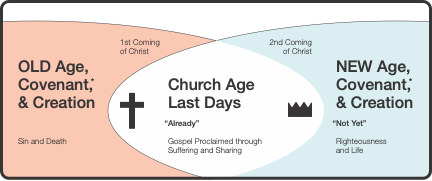
Moving into the NT era, one of the mysteries of God’s program was that Jesus would first come as suffering Servant and only in his second coming as conquering King (Heb 9:28). He proclaimed “the year of the LORD’s favor,” but only later would he bring “the day of vengeance” (Isa 61:2; Luke 4:19). Today we live in an overlap of the ages: Christ has delivered us from “the present evil age” (Gal 1:4), yet only in a way that lets us taste “the powers of the age to come” (Heb 6:5). Figure 3 visualizes the aspects of the kingdom that are already fully initiated but not yet finally consummated.

Figure 3. The Overlap of the Ages

In the fullness of time, “God sent forth his Son” (Gal 4:4) as the very Word that was God in the flesh (John 1:1, 14). He is the Christ, the promised royal Deliver, “the Lamb of God, who takes away the sins of the world” (1:29). By his life, death, and resurrection, he inaugurated the new covenant (Luke 22:20; Heb 9:15) and new creation (2 Cor 5:17). In the “great exchange” of the ages, God counts every believer’s sin to Christ and Christ’s righteousness to every believer (Isa 53:11; 2 Cor 5:21).

Jesus and his apostles proclaimed the gospel of God’s kingdom (Luke 4:43; Acts 1:3; 28:23), the good news “that Christ died for our sins in accordance with the Scriptures, that he was buried, that he was raised on the third day in accordance with the Scriptures, and that he appeared to Cephas, then to the twelve” (1 Cor 15:3–5). By means of Spirit-empowered disciples bearing witness to Christ, God’s reign has spread from Jerusalem to the ends of the earth (Acts 1:8). Under Christ’s authority, the church must continue to make disciples of all nations for the sake of his name (Matt 28:18–20; Rom 1:5).

7. Mission Accomplished


The reigning King’s return will be glorious (Matt 16:27; 25:31), for we will see him “coming on the clouds of heaven with power and great glory” (24:30). Only those who “fear God and give him glory” will escape divine wrath when the Son of Man returns to be glorified (2 Thess 1:9–10; Rev 14:7).

Even now, those around the throne of the conquering Lion-Lamb are declaring him worthy to carry out God’s purposes (Rev 5:9–10). And the redeemed multitude will one day cry together, “Salvation belongs to our God … and to the Lamb!” (7:10). In that day, God’s glory—localized in none other than the Lamb—will give his city light (21:23). His servants “will need no light or lamp or sun, for the Lord God will be their light, and they will reign forever and ever” (22:5), thus fulfilling their original calling to represent God on earth (Gen 1:26–28).

In view of these realities, Jesus proclaims, “I am the root and the descendant of David, the bright morning star…. Surely I am coming soon” (Rev 22:16, 20). And we say with John, “Amen. Come, Lord Jesus!” (22:20).

Summary

From creation to consummation, God is guiding a kingdom program that culminates in Jesus. Both the Old and New Testaments are framed by his-story—a story of God’s glory in Christ. In the OT, God identifies the key players and problems and makes kingdom promises; in the NT, he supplies the solution and fulfills the promises, ultimately through King Jesus. All salvation history points to Christ, and through him God fulfills all earlier hopes, to the praise of his glorious grace (Eph 1:6, 12).

1. What follows updates material that originally appeared in Jason S. DeRouchie, “Jesus’ Bible: An Overview,” in What the Old Testament Authors Really Cared About: A Survey of Jesus’ Bible, ed. Jason S. DeRouchie (Grand Rapids: Kregel, 2013), 30–41. Used with permission.

This blog series summarizes Jason S. DeRouchie’s forthcoming book, Delighting in the Old Testament: Through Christ and for Christ (Wheaton, IL: Crossway, 2024). You can pre-order your copy here.


William Carey—A Plodder, Pioneer, and Proclaimer Who Kept the Grand End in View

Four years after having sent William Carey (1761-1834) to India, the Baptist Missionary Society sent John Fountain to aid Carey and send a report of what he found. Here’s part of his report, dated November 1796:

    • [Carey] labours in the translation of the Scriptures, and has nearly finished the New Testament, being somewhere around the middle of Revelations. [sic] He keeps the grand end in view, which first induced him to leave his country, and those Christian friends he still dearly loves.

1

William Carey, a modern missionary pioneer who endured much hardship, persevered in faithfulness until the age of 73. His life and ministry would change the modern world.

How did he manage faithfulness in the Christian life in challenging times—and at a time when few had crossed-cultures to reach the unreached?

From his earliest days of missionary activity until the end of his life Carey kept the grand end in view. So, what is this grand end?

The Grand End

While it is right to say that the entire Bible points to and reveals the grand end, I believe there is one verse that sums it up well.

In Galatians 3:8, the apostle Paul says, “And the Scripture, foreseeing that God would justify the Gentiles by faith, preached the gospel beforehand to Abraham, saying, ‘In you shall all the nations be blessed.’”

Here, Paul explains that God has always had the salvation of the nations in mind. From the beginning, he conveyed to Abraham his plan.

In what is often called the centerpiece of the first five books of the Bible, God says to Abraham,

    Go from your country and your kindred and your father’s house to the land that I will show you. And I will make of you a great nation, and I will bless you and make your name great, so that you will be a blessing. I will bless those who bless you, and him who dishonors you I will curse, and in you all the families of the earth shall be blessed. (Genesis 12:1-3 ESV)

At the age of 75, Abraham obeyed God, and he and his wife left their country.

After a period of travel and time, God met with Abraham, took him outside and said, “Look toward heaven, and number the stars, if you are able to number them.” Then he said to him, “So shall your offspring be.” And [Abraham] believed the LORD, and he counted it to him as After a period of travel and time, God met with Abraham, took him outside and said, “Look toward heaven, and number the stars, if you are able to number them.” Then he said to him, “So shall your offspring be.” And [Abraham] believed the LORD, and he counted it to him as righteousness (Genesis 15:5-6). God then made a covenant with him promising that he would be “the father of a multitude of nations” (Genesis 17:5).

In this event, Paul tells us in Galatians 3:8, the gospel was preached to Abraham.

Yet, we might think, “How is this possible, as the name of Jesus Christ is not mentioned?” In short, the gospel preached to Abraham was God’s promise to him that through Abraham and his offspring, all the nations would be blessed. Or, simply that Gentiles, non-Israelites, will be justified by faith.

In Romans 4, Paul explains that “the purpose was to make him [Abraham] the father of all who believe” and that “the words ‘it was counted to him’ were not written for his sake alone, but for ours also. It will be counted to us who believe in him who raised from the dead Jesus our Lord, who was delivered up for our trespasses and raised for our justification” (Romans 4:11, 23-25). And, again, Paul explains that the gospel was “promised beforehand through his prophets in the holy Scriptures, concerning his Son” (Romans 1:2-3).

The gospel has always had the doctrine of justification at its center. Reconciliation of sinful humanity to a holy God, and the removal of his just condemnation, is the core of gospel truth.

Yet, to be gospel-centered is to recognize that the gospel was intended for Abraham in the Old Testament-past as a forward looking, faith requiring message, revealed with the miraculous advent, perfect law-abiding life, atoning death, and victorious resurrection of Jesus Christ, that we are also to receive now as a backward-looking, faith requiring message, and we are to take that message to the nations of earth.

The gospel preached to Abraham, though not revealed in full, was nevertheless received with justifying faith and pointed to a future fulfillment among peoples, including us, from every tribe, tongue, and nation. This future fulfillment is the “grand end” William Carey kept in view.

A Plodder, Pioneer, and Proclaimer

Carey spent just over 40 years in India. As he kept the grand end in view, three virtues describe well his ministry.

A Plodder

Carey’s virtue as a plodder allowed him to see God’s faithfulness strengthen him when there was every reason to give up.

Carey and his family arrived in Bengal and endured immediate hardship. They lived in unhealthy conditions in a shack outside of Calcutta, and they suffered from hunger and dysentery.

In the first year, the Careys lost their 5-year-old son, Peter, to illness. This tragedy, along with other trials, wreaked havoc on both Careys, especially his wife. Understandably, Dorothy Carey struggled, and this led to her retreating from reality and that led to many more trials until her death in 1807.

How did Carey persevere? He trusted in God, and he went forward, plodding by faith.

Carey wrote to his sisters, “I am very fruitless and almost useless, but the Word and the attributes of God are my hope, my confidence, and my joy, and I trust that his glorious designs will undoubtedly be answered.” 2

One of his biographers recounted, “[I]nvinicible patience in labour, and uninterrupted constancy, secured his triumph over every obstruction. He once said … ‘[I]f anyone should think it worth his while to write my life … If he will give me credit for being a plodder, he will describe me justly. Anything beyond this will be too much. I can plod. I can persevere in any definite pursuit. To this I owe everything.” 3

A Pioneer

Carey’s virtue as a pioneer allowed him to see God’s faithfulness sustain him when he was doing things no one had done before.

The first 7 years brought little spiritual fruit. Writing to his sister in 1798, Carey said, “I have however no news to send … at best we scarcely expect to be anything more than Pioneers to prepare the way for those who coming after us may be more useful than we have been. I know success depends entirely upon the blessing of God, and there in him I will trust and not be afraid. The principle thing we see is the translation of the Bible into the Bengal language.” 4

Seeing the translation of the Bible into the native languages was a primary plank in Carey’s platform for evangelizing India. As Timothy George notes, in a country of syncretistic religions—Isalm and Hinduism plus folk expressions of both, Carey held fast to his conviction that “only the Bible could show the uniqueness of Christ.” 5

In 1797, he would see the first draft of his translation of the NT into Bengali, which he would revise 8 times before he died. By 1807 he published a Sanskrit NT.

A Proclaimer

Carey’s virtue as a proclaimer allowed him to see God’s faithfulness as sufficient to bear fruit according to God’s plan.

While focused on translation, once he learned the language, Carey would regularly preach in open-air markets. He took encouragement from the fact that even though there was no response, the name of Jesus is “no longer strange in this neighborhood.” 6

In 1799 Carey moved his family to Serampore to join with two other missionaries, Joshua Marshman and William Ward. Known as the Serampore Trio, these three established a new base called the Serampore Mission—and their friendship and joint missionary service was a key to their survival and success in proclaiming the gospel.

From this home base, Carey also impacted the Indian culture. Early he observed with horror the practice of suttee, where following her husband’s death, the wife was expected to throw herself on top of her husband’s funeral pyre. Carey advocated against this practice until he saw, in 1829, the Governor outlawed the practice. He also contributed several other advancements to Indian understanding of science, engineering, medicine, publishing, agriculture, education, and astronomy.

The Blessing of the Nations

By keeping the grand end in view, William Carey changed the evangelical world and launched the modern missions movement. At his death, as an indication of his sole focus, he requested only a line for his tombstone from one of his favorite hymns by Isaac Watts, “A wretched, poor, and helpless worm, on thy kind arms I fall.”

Despite earthly fame and historic legacy, Carey departed in faithfulness, keeping Jesus in view, the greater Grand End, and the blessing of the nations was the result.

*This article is adapted from Jason G. Duesing’s recent chapel message: “Keeping the Grand End in View: The Life and Ministry of William Carey for the Blessing of the Nations,” a “Great Lives” lecture at Midwestern Seminary and Spurgeon College. You can watch the full lecture below.

1. “From Mr. Fountain to Mr. Fuller,” November 8, 1796, in Eustace Carey, Memoir of William Carey, D.D. (Jackson and Walford, 1836), 286, italics added.
2. William Carey to Mary Carey and Ann Hobson, December 22, 1796 in Terry G. Carter, ed., The Journal and Selected Letters of William Carey (Smyth & Helwys, 2000), 249.
3. Eustace Carey, Memoir, 623.
4. William Carey to Ann Hobson,” November 27, 1798 in Timothy D. Whelan, Baptist Autographs in the John Rylands University Library of Manchester, 1741-1845 (Mercer, 2009), 91-92.
5. Timothy George, Faithful Witness (New Hope, 1991), 111.
6. Timothy George, Faithful Witness,113.


03: Christ as Light and Lens for Reading the Old Testament Well

“God’s Mystery, which is Christ” (Col 2:2)

While the Old Testament prophets appear to have understood most of what they declared, God did not allow the majority of those in the old covenant to understand the prophets’ words (e.g., Isa 6:9–10). And as a judgment, the people’s blindness continued into the days of Christ (Matt 13:13–15)1. Nevertheless, fulfilling Old Testament predictions (e.g., Deut 30:8), Jesus’s teaching and work began disclosing to his disciples truths that remained distant from the crowds: “To you has been given the secret [Greek mystērion] of the kingdom of God, but for those outside everything is in parables” (Mark 4:11–12).

The New Testament’s “mystery” language appears to come from the book of Daniel, where the Greek translation uses the term mystērion (“mystery”) to render the Aramaic rāz (2:18–19, 27–30, 47). King Nebuchadnezzar has a troubling dream and then looks to Daniel for the full interpretive revelation. The “mystery” that God revealed to Daniel (v. 19) included both the initial dream and its interpretation, as the God in heaven “who reveals mysteries … made known to King Nebuchadnezzar what will be in the latter days” (v. 28). When Jesus alludes to this text by speaking about the “secret of the kingdom” (Mark 4:11–12), he indicates that the Old Testament’s message would remain permanently hidden for some but temporarily hidden for others.

Mystery in the New Testament

The New Testament employs the Greek word mystērion twenty-eight times, all as a technical term for an end-time reality largely hidden in the Old Testament but now disclosed more fully through Christ. All the New Testament occurrences deal with the end-times and are in some way linked to the Old Testament.

What was this “mystery”? In the Synoptic Gospels, the “mystery” relates to the unexpected, gradual, already-but-not-yet fulfillment of God’s end-time reign (e.g., Mark 4:11). In Paul’s epistles, which comprise twenty-one of the term’s New Testament occurrences, the revealed “mystery” or “mysteries” refer to insight into God’s end-times purposes (e.g., 1 Cor 4:1) most directly associated with more fully understanding Christ and the gospel (e.g., Rom 16:25). In Revelation, “mystery” relates to the nature of the church (Rev 1:20) and the self-destructive nature of Babylon (17:5, 7).

What Mystery Implies for Interpreting the Old Testament

Jesus, Paul, and John speak of God revealing a “mystery” to communicate how, in Christ, we gain full disclosure of things that God significantly hid from most in the old-covenant era. Strikingly, as Romans 16:25–27 teaches, the very “mystery” that is now revealed in and through Christ is also now made known to all nations through the Old Testament itself. In the coming of Christ, an era of understanding replaces an era of ignorance as light overcomes darkness and as God grants a fresh perspective on old truths (cf. Eph 3:4–5).

Still, G. K. Beale and Benjamin Gladd rightly affirm that “full or ‘complete’ meaning is actually ‘there’ in the Old Testament text; it is simply partially ‘hidden’ or latent, awaiting a later revelation, whereby the complete meaning of the text is revealed to the interpreter.”2 These parallel truths bear at least three implications for interpreting the Old Testament as the Christian Scripture it is: (a) Only those with spiritual sight can interpret the Old Testament correctly. (b) Jesus’s life, death, and resurrection provide a necessary lens for fully understanding the Old Testament’s meaning. (c) There is an organic relationship between the Old Testament’s testimony and the meaning the New Testament authors attribute to it.

A Relationship with Christ Is Necessary to Understand the Old Testament Rightly

Regarding many of his Jewish contemporaries, Paul declared, “For to this day, when they read the old covenant, that same veil remains unlifted, because only through Christ is it taken away” (2 Cor 3:14). Those who understand “God’s mystery, which is Christ” (Col 2:2), are those to whom God has given “the light of the knowledge of the glory of God in the face of Jesus Christ” (2 Cor 4:6). Indeed, Christ is “the radiance of the glory of God” (Heb 1:3), and by his Spirit, he enlightens the eyes to see what the Old Testament revealed all along (Eph 1:17–18).

To have the “mystery” of God’s kingdom purposes revealed means, in part, that one’s spiritual eyes have been opened to properly understand the Old Testament. Through rebirth, we become spiritual people who can spiritually discern and rightly understand spiritual truths (1 Cor 2:13–14). True Christians are the only ones who can rightly grasp all that God intends to communicate through the Old Testament.

Christ’s Person and Work Clarify More Fully the Old Testament’s Meaning

The Old Testament is filled with declarations, characters, events, and institutions that bear meaning in themselves but also find that meaning enhanced and clarified in Christ’s person and work. For example, the meaning of events like the exodus or of objects like the sacrificial lamb are amplified when the New Testament treats Christ’s saving work as an “exodus” (Luke 9:31) and calls him “the Lamb of God, who takes away the sin of the world” (John 1:29). Jesus’s triumph validated him as the ultimate object of all Old Testament hopes, and this, in turn, transformed the apostles’ reading of the Old Testament (John 2:22; 12:16).

Once Paul met the resurrected Christ, he, too, never read the Old Testament the same way. Indeed, as an Old Testament preacher, he “decided to know nothing … except Jesus Christ and him crucified” (1 Cor 2:2). At no stage in interpreting the Old Testament should Christians act as if Jesus has not come. Reading from the beginning through Scripture gets us to Christ, but once we find him, we must interpret all the Old Testament through him.

The Way God Discloses the Mystery of Christ Signals Organic Connections between the Old and New

Passages such as Roman 16:25–26, 1 Peter 1:10–11, and 2 Peter 1:20–21 imply that the New Testament’s use of the Old Testament is natural and unforced, aligning with the Old Testament’s own innate meaning, contours, structures, language, and flow. The New Testament authors are making organic connections with the whole of Scripture on its own terms, in alignment with God’s original intentions.

Other passages, such as Colossians 2:16–17, testify that the prophets often envisioned the very form we now enjoy, not only seeing the shadow but also embracing the substance that is Christ, though perhaps more like an acorn or sapling anticipates a great oak. Even if the Old Testament authors were not fully aware of all God was speaking through them, they would have affirmed retrospectively the trajectories that later biblical authors identify.

Christ as Light and Lens

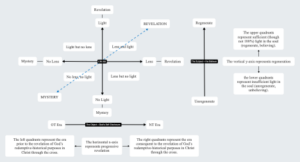
Scripture calls us to see both an organic unity and a progressive development between the Old and New Testaments. There is a natural connection between what the Old Testament human authors intended and what the New Testament human authors saw fulfilled in Jesus, but the Old Testament meaning is now often fuller, expanded, or deepened because through Christ God reveals the mystery. Jesus’s saving work supplies the spiritual light that enables one’s spiritual senses to see and savor rightly, and his person and work provide the interpretive lens for properly understanding and applying the Old Testament itself in a way that most completely magnifies God in Christ. Figure 1 unpacks what is happening with respect to Scripture’s progressive revealing of Old Testament meaning, and figure 2 elucidates further the way Christ operates as a lens, supplying us a developed understanding of the Old Testament’s meaning.


Figure 1. The Progressive Revelation of Old Testament Mystery


Figure 2. Interpreting the Old Testament through the Lens of Christ


Conclusion

The Old Testament is Christian Scripture, and God intends that we interpret it as such, not as if Christ has not come. We must read the Scripture forward, backward, and forward again. The Old Testament prophets knew they were writing for new-covenant saints living in the days of the Christ. Bound up in the gospel of Jesus Christ is the revelation of a “mystery that was kept secret for long ages but … through the prophetic writings has been made known to all nations” (Rom 16:25–26).

A relationship with Jesus is essential for rightly interpreting the Old Testament, for through him God enables understanding. By turning to Christ, “the veil is removed” (2 Cor 3:16). The light of Christ supplies us the needed spiritual sight for understanding the things of God, and the lens of Christ’s life, death, and resurrection provides the needed perspective for fully grasping the Old Testament’s meaning. God wrote the Old Testament for Christians, and he enables believing interpreters to grasp more fully than others both the meaning and the intended effect of the initial three-fourths of the Christian Scriptures.

1: See G. K. Beale and Benjamin L. Gladd, Hidden but Now Revealed: A Biblical Theology of Mystery (Downers Grove, IL: InterVarsity Press, 2014), 29–46.
2: Beale and Gladd, Hidden but Now Revealed, 330.

This blog series summarizes Jason S. DeRouchie’s forthcoming book, Delighting in the Old Testament: Through Christ and for Christ (Wheaton, IL: Crossway, 2024). You can pre-order your copy here.


What is Divine Aseity?

Editor’s Note: The Theology in the Everyday series seeks to introduce and explain theological concepts in 500 words or less, with a 200-word section helping explain the doctrine to kids. At For The Church, we believe that theology should not be designated to the academy alone but lived out by faith in everyday life. We hope this series will present theology in such a way as to make it enjoyable, connecting theological ideas to everyday experience and encouraging believers to study theology for the glory of God and the good of the Church. This week, divine aseity.


You and I live in a world full of contingency and dependence. We require food for sustenance, water for hydration, rest for productivity, and the list goes on. To be human is to have needs, to be dependent is the lot of mankind, and we will never attain the independence and self-sufficiency we so often desire. If we did, we would no longer be human. The glories of independence and self-sufficiency are reserved for only one Being – namely, God. In Him all of our needs and dependencies find their rest, their true home and fulfillment in the only One who is self-existent, self-sufficient, free from all need or want, the source and plentitude of all life.

All of these are ways in which we can describe the aseity of God, a word that simply means that God is life in and of Himself. The term aseity comes from the Latin phrase “a se,” which means “from oneself.” When theologians speak of God being a se, they are trying to put words to the glorious reality that God does not derive His being or existence from anything outside of Himself. He is self-existent, meaning that He just simply is in the truest sense of the word.

In Psalm 36, David confesses that God is “the fountain of life,” the ever full and overflowing well of being from which we derive our life and breath (Psalm 36:9). All creation finds its true source and final end in the God who is uncreated, giving life and being to the world because He is life and being itself. This is why Augustine, in Confessions, speaks of God as “being in a supreme degree.” For God, it is “not one thing to be and another to live,” for in Him “the supreme degree of being and the supreme degree of life are one and the same thing.”[1]

Even God’s covenant name is a testimony to the reality of His self-existence. In Exodus 3 when God meets Moses in the burning bush to reveal His plan of salvation for the enslaved nation of Israel, He instructs Moses to tell Israel that “I AM” has sent him and will deliver Israel from their slavery (Exodus 3:14). And so He does. The God who hears Israel’s cry and delivers her from her bondage does so out of an immeasurable well of grace that finds its source in I AM, the God who simply is, just as His name declares.

For the Kids:

In the book of Genesis, the Bible tells us that God created the world and everything in it. The light you see shining every morning through your bedroom window, the clouds you see sailing through the sky on a sunny day, the stars you see beaming with light on a clear night, and much, much more, all came from God. God even created you, and He loves you and knows everything about you.

However, unlike you, me, and the world all around us, God was not created by anyone or anything. In the book of Psalms, the Bible teaches us that God is “the fountain of life,” which means that God is always alive, and He does not need anyone to create Him or give Him life. This also means that you and I are alive because God gave us life, and every breath we breathe and step we take comes from Him. He is always watching over us and caring for the world He created. Because He is always alive, we can trust Him to give us all that we need.


[1] St. Augustine, Confessions (Oxford: Oxford University Press, 2008), 8.


02: Old Testament Reflections on Grasping the Old Testament’s Message

“You Will Understand This” (Jer 30:24)

Our last post noted that the New Testament authors recognize that the Old Testament is Christian Scripture and that the Old Testament authors themselves knew full understanding of their words would come only in the messianic era. This post shows that the Old Testament itself affirms these views.

The seers, sages, and songwriters who gave us the Old Testament testify that they were speaking and writing not merely for old-covenant saints but also for new-covenant believers—those who would enjoy a relationship with God in the days of the Messiah and the new creation after Israel’s exile. This post demonstrates this through four examples: Moses, Isaiah, Jeremiah, and Daniel. At the conclusion, we’ll consider some implications of this fact for Christians approaching the Old Testament today.

Moses Anticipates an Age When Those Yahweh Restores Will Heed Moses’s Law

Moses’s three most frequently used words to characterize Israel were “stubborn” (Deut 9:6, 13; 10:16; 31:27), “unbelieving” (1:32; 9:23), and “rebellious” (9:7, 24; 31:27). His immediate audience was wicked (9:4–6, 27), and he affirmed that “even today while I am yet alive with you, you have been rebellious against the LORD. How much more after my death!” (31:27). Thus, Yahweh promised that the people’s defiance would result in his pouring out his curses upon them (31:16–17).

Deuteronomy 29 tells the ultimate reason why Moses’s immediate audience would not heed his words: Israel was spiritually ignorant of God’s ways, blind to his glories, and deaf to his word (vv. 2, 4). They had been rebellious from the day Moses first met them (9:24), and their stubbornness was still present and would continue into the future (9:6; 31:27, 29). In Moses’s day, Yahweh had not overcome the resistance of the majority’s hearts, and in alignment with his sovereign purposes for salvation history, he created the old covenant to bear a “ministry of death” and “condemnation” so that through Christ a superior new covenant might bear a “ministry of righteousness” (2 Cor 3:7, 9).

Yahweh determined that he would not overcome Israel’s crookedness and twistedness (Deut 32:5; Acts 2:40; Phil 2:15) until the prophet like Moses would rise (Deut 18:15; 30:8; cf. Matt 17:5). In the age of restoration, Yahweh would change the remnant’s hearts and enable their love (Deut 30:6). In this end-times period, the age we now identify with the new covenant and the church (cf. Rom 2:29; 2 Cor 3:6), Moses’s message would finally be heeded (Deut 30:8). Moses believed that his instruction would serve those in the age of heart circumcision far more than the rebels of his day.

Isaiah Anticipates a Day When Those Once Spiritually Deaf Will Hear His Words

Israel’s threefold spiritual disability (heart, eyes, ears) continued in the days of Isaiah, whom Yahweh called to “make the heart of this people dull, and their ears heavy, and blind their eyes” (Isa 6:10). This would be the prophet’s judgment cry until his land was laid waste, his people were destroyed, and all that remained was a “stump” or “holy seed” (6:11–13). Yahweh purposed that Israel’s history would be characterized by “deep sleep” and the inability to “read” the Word. It was as if the Scriptures were sealed for the bulk of Isaiah’s contemporaries (Isa 29:9–11).

Nevertheless, God promised that one day there would be a broad acceptance of the prophet’s message (52:6; 54:13). Yahweh’s law would go forth in “the latter days,” and its recipients would include many from the “nations/peoples” (2:3; 51:4–5). That is, God would one day disclose himself to many who never sought him (Isa 65:1; Rom 10:20), and kings from many nations would see “that which had not been told them” (Isa 52:15; Rom 15:21). Isaiah associates the proclamation of this end-times instruction with the royal Servant (Isa 42:1, 4).

Jesus indicated that through his own teaching God was fulfilling these promises by drawing a multiethnic people to himself (John 6:44–45; cf. Isa 52:13). Christ’s sheep would include some not from the Jewish fold (John 10:16; 11:51–52), yet all his sheep would “believe,” “hear,” and follow (10:27). To these awakened and responsive believers, the Lord would supply “the secret of the kingdom of God, but for those outside everything [would be] in parables, so that ‘they may indeed see but not perceive, and may indeed hear but not understand, lest they should turn and be forgiven’” (Mark 4:11–12; citing Isa 6:9–10). Isaiah himself saw that his writings would benefit a future generation more than they would the spiritually disabled of his day.

Jeremiah Anticipates Days When His Book Will Guide Those Who Know Yahweh

As with Isaiah, Yahweh told Jeremiah that his writing was intended for a post-exilic, restored community of God (Jer 30:2–3). While some of Jeremiah’s contemporaries would repent (36:2–3), most would not, for they retained the same stubbornness that characterized previous generations (7:23–28). Moreover, Jeremiah noted that only in the latter days would full understanding of his writings come. “The fierce anger of the LORD will not turn back until he has executed and accomplished the intentions of his mind. In the latter days you will understand this” (30:24–31:1). The “you” in this passage is plural, referring to the members of the new-covenant community.

Jeremiah’s “latter days” of “understanding” are connected to (a) Israel/Judah’s restoration from exile and reconciliation with God (30:10–11, 17–22; 31:1–40), (b) God’s punishment of enemy nations (30:11, 16), (c) the rise of a ruler from the people’s midst (30:21), and (d) the incorporation of foreigners into the one people of God (30:8–9). Christ and his church are now fulfilling Jeremiah’s new-covenant hopes (Luke 22:20; 2 Cor 3:6; Heb 8:13; 9:15), which include every covenant member enjoying new knowledge and forgiveness of sins (31:34; cf. Heb 10:12–18; 1 John 2:20–21). This new knowledge aligns with the earlier promise of “understanding” (Jer 30:24) and recalls Isaiah’s promise that, following the work of the Servant, “all your children shall be taught by the LORD” (Isa 54:13). God has “taught” all who have come to Christ, so that every Christian “knows” God in a personal way (John 6:45; cf. Matt 11:27).

Daniel Anticipates the Time of the End When the Wise Will Understand His Prophecies

The book of Daniel is filled with symbolic dreams, visions, and declarations—“mysteries” (Dan 2:18–19, 27–30, 47; 4:9) that God partially reveals to Daniel, so that “he understood the word and had understanding of the vision” (10:1; cf. 10:11–14). Indeed, Daniel grasped something of both the person and time of the Messiah’s ministry (9:24–25; cf. 1 Pet 1:10–11). Nevertheless, there are elaborations on these latter-day prophecies such that Daniel asserts, “I heard, but I did not understand” (Dan 12:8) and that the Lord tells his prophet to “shut up the words and seal the book, until the time of the end” (12:4). The “end” is God’s appointed period in salvation history when he would fully disclose his purposes to the wise.

Daniel envisioned that only at “the time of the end” would some people grasp the full meaning of his revelations. That is, the hiddenness of the Old Testament’s meaning would be temporary for the remnant but permanent for the rebels. From a New Testament perspective, the first coming of Christ has inaugurated the promised days of realization, when the wise can both hear and understand God’s words in this book. We see this in Matthew’s Gospel, where, after speaking of “the abomination of desolation spoken of by the prophet Daniel” (Matt 24:15; cf. 11:31; 12:11), an intrusive parenthetical comment appears: “Let the reader understand” (24:15). Matthew believes his readers can grasp the mysteries of Daniel.

Conclusion

The texts above from Deuteronomy, Isaiah, Jeremiah, and Daniel all suggest that Yahweh’s prophets knew “that they were serving not themselves” but us (1 Pet 1:12), believers upon whom the end of the ages has come (1 Cor 10:11). The various passages indicate that God withheld the full meaning of his messages in at least two ways.

First, the prophets were convinced that the unbelieving majority could not (due to God’s punishment) and would not (due to their sinfulness) heed any of their words. Nevertheless, they also envisioned a day when Yahweh would overcome spiritual disability, thus enabling a life-changing encounter with him. At the rise of the child-king (Isa 9:6–7), “the people who walked in darkness” would see “a great light” (9:2; cf. Matt 4:15–16). “In that day the deaf shall hear the words of a book, and out of their gloom and darkness the eyes of the blind shall see” (Isa 29:18).

Second, Yahweh’s prophets themselves did not always fully grasp the meaning of their predictions and declarations. Accordingly, Daniel could “understand” some visions (Dan 10:1) while not “understanding” others (12:8). The faithful remnant would only fully comprehend God’s intended meaning in “the latter days” (Jer 30:24), “the time of the end” (Dan 12:4, 9–10). Thus, Jesus could say, “Many prophets and kings desired to see what you see, and did not see it, and to hear what you hear, and did not hear it” (Luke 10:24). A supernatural healing and revelation would be required to create fresh responsiveness to the Lord, thus awakening the heart to God’s intended meaning of the Scriptures.

This blog series summarizes Jason S. DeRouchie’s forthcoming book, Delighting in the Old Testament: Through Christ and for Christ (Wheaton, IL: Crossway, 2024). You can pre-order your copy here.