Encourage Discouraged Pastors

There are plenty of pastors with generous smiles on their faces each Sunday who, deep down, are very disheartened.

Pastoring a church is hard work. For one thing, it is usually thankless. I know there are some churches that seem to remember their pastors with such fanfare, but most do not ever esteem them. They don’t work for just the members ultimately, so they can get over it, but never hearing those words, “Thanks for what you do, pastor,” is discouraging. But you can remedy this one, can’t you? Perhaps right now is the best time to write that email or note, or to make a phone call.

Some pastors get discouraged because their people expect a Dr. Internationally Known Mountain, when what they really are stuck with is only Brother Molehill. Expectations are at an all time high in these days of exceptional media coverage. Every pastor is happy when a member listens to sermons every day, but he knows he doesn’t measure up to the gifted pastors these people hear most of the time.

Some are discouraged because they are physically worn out. It just takes a few sensitive members to help him remedy this problem by pulling him away from normal tasks for a break. A member who makes special efforts to show love to his or her pastors will never be forgotten. I used to have a man who took me to lunch each week just to talk. He would usually say something to encourage me and even slip me a $20 bill. He helped me immensely to keep perspective. Perhaps you can pull your pastor away for that fishing trip or golf outing. Such things are like a drink of cool water on a dry, dusty day. Paul said of Philemon, “You’ve often refreshed me.” Be like that.

Some are discouraged because they cannot resolve long-standing conflicts in the church. Churches have conflicts because they have people. Even the early churches had them. But pastors take these very hard, and long for conflict resolution.

Well, there may be other reasons pastors are discouraged. They aren’t perfect and can even bring more on themselves than is dealt to them by the church’s health.

What can you do? Perhaps more than anything else, just become your pastor’s friend. Friendship has a healing aspect to it. Open your home and care for them. Think of the pastor’s wife and kids. They need you also. I doubt that you could possible know what intentional love can do for those God has, in his providence, put over you in the Lord. Do what friends do—take them extra vegetables from the garden, invite them along for your trip to the Mexican restaurant in town, buy that scarf that you think the pastor’s wife will like. You’re not buying friendship, but nourishing it.

“Let them do this [the management of the church] with joy and not with grief, for this would be unprofitable to you,” the writer of Hebrews said. But I know you church members pretty well. When you get to thinking about it, you can do some amazing things for the pastors God has given you. Get started right now.

“Esteem them highly in love.”

Editor’s note: This article was originally published at ccwtoday.org


To My Friends Who Are No Longer Friends With Jesus

To my friends who are no longer friends with Jesus: I want you to know that if I am aware of you walking away from Jesus, I have prayed for you and even cried for you. A couple of years ago I was reading The Last Battle from C.S. Lewis’s “The Chronicles of Narnia” to our kids. I came across a passage that took my breath away and filled my eyes with tears. Tirian, the last king of Narnia, is meeting the former kings and queens of Narnia:

    ‘Sir,’ said Tirian, when he had greeted all these. ‘If I have read the chronicle aright, there should be another. Has not your Majesty two sisters? Where is Queen Susan?’

    ‘My sister Susan,’ answered Peter shortly and gravely, ‘is no longer a friend of Narnia.’

    ‘Yes,’ said Eustace, ‘and whenever you’ve tried to get her to come and talk about Narnia or do anything about Narnia, she says, ‘What wonderful memories you have! Fancy your still thinking about all those funny games we used to play when we were children.’

The reason I got a lump in my throat and then looked at my wife Melanie and saw that we were both tearing up is because we were thinking of you, friends. Walking away from Jesus is not child’s play. At the end of The Last Battle, it is revealed that there has been a crash and the kings and queens are in heaven. They are safe, eternally. Susan is not. But there is still time.

It seemed that you used to be friends with Jesus. You sang to him, you read his Word, you prayed to him, you talked about him with me.

Only God, and maybe you, know if that faith was genuine. But I do know this: the Jesus you used to confess with your lips is the same Jesus who can save you today. It doesn’t matter if it has been years or months of walking away from him, Jesus died and rose again not to make it possible for us to earn our way back to God, but to bring us to God. He will still do that for you if you will come to him.

You are not the first disciples of Jesus to deny Jesus. Do you remember Peter, one of Jesus’s closest disciples and friends? He denied Jesus three times, when Jesus most needed someone to come alongside of him and stand up for him.

Decades later Peter wrote in 1 Peter 5:8-9, “Be sober-minded; be watchful. Your adversary the devil prowls around like a roaring lion, seeking someone to devour. Resist him, firm in your faith, knowing that the same kinds of suffering are being experienced by your brotherhood throughout the world.” It has never been easy to be a Christian. What stood true two thousand years ago stands true today: there is a great enemy of your soul.

Peter knew that Satan is active in the world today, and he didn’t just think of the devil like a roaring lion. It’s like Peter was remembering how he had felt that enemy breathing down his neck on the night that he denied Jesus.

But there is someone else described like a lion in the Bible, the Lion of the Tribe of Judah. Jesus is the One who was promised to come and save us. He came and represented God to us as holy and righteous and yet as willing and ready and able to forgive for when we have failed him.

Precious Words of Promise

Some of the most precious words in the Bible are at the end of the Gospel of Mark. After Jesus has risen from the dead, the angel tells the women at the tomb, “…go, tell his disciples and Peter…” (Mark 16:7)

The other disciples had failed too. They had also said they would follow Jesus all of the way. But only one of them, John, stood at the cross at the end. God made sure they all received the message of Jesus’s resurrection— “Go tell the disciples…” But he also put this nugget of grace on the angel’s lips: “…AND Peter.” Peter was a disciple. But God was already moving towards Peter specifically in his specific sin, preparing his heart for restoration.

I don’t know what God has been doing in your lives recently. But reading this article is a start. There is some reason you clicked on it.

When Peter denied Jesus, Jesus looked at him. If you sense the Lord looking at you right now, you have two choices.

You can try to run from the gaze of Jesus just like Adam and Eve tried to run from the eyes of God. Or you can run to the gaze of Jesus and see that there is forgiveness and acceptance and restoration in his eyes.

This is what Peter experienced when the resurrected Jesus came to them later, when Peter had gone back to fishing. When Jesus appeared on the shore, Peter didn’t hold back. Peter couldn’t wait to be near Jesus again. He couldn’t wait for the boat to get to the shore. Peter jumped into the water to go towards Jesus.

He didn’t walk on the water this time; he simply threw himself into the water to get to Jesus. That may be what repentance looks like for you, what coming back to God looks like for you. Just throwing yourself towards Jesus.

If you do that, I know that Jesus will be waiting for you. Jesus himself promised it and sealed it with his redeeming blood: “All that the Father gives me will come to me, and whoever comes to me I will never cast out.” (John 6:37)

Friends, if you come back to Jesus, he will welcome you home as his friends, now and for eternity. I hope to see you there.


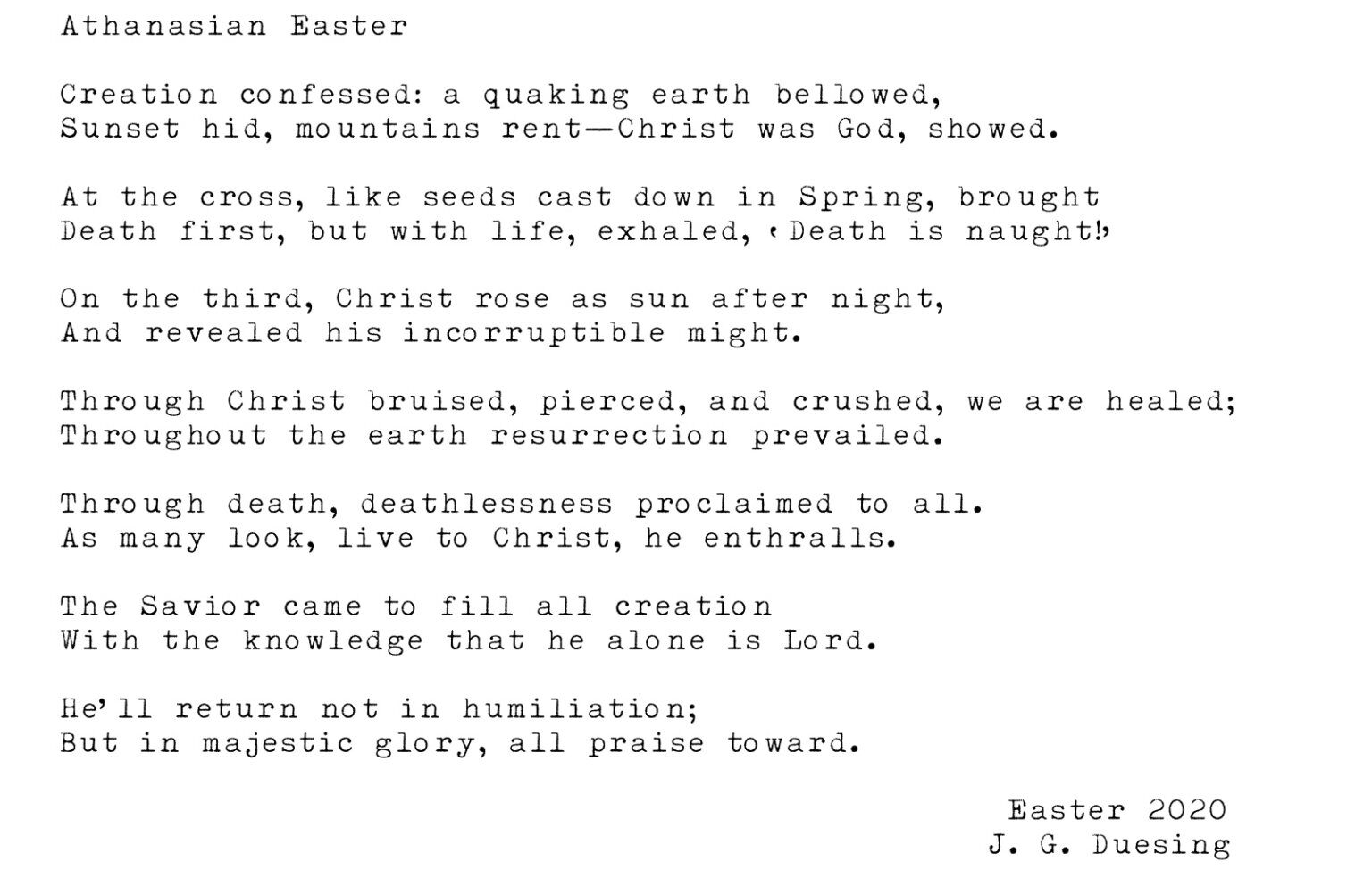
On the third day He rose again — A Sonnet for Easter

In the mornings this year I’ve been re-reading a fourth century masterpiece.

While Athanasius’s On the Incarnation is remarkable, it was C. S. Lewis who termed it a ‘masterpiece’ in his famous introduction to a new English translation of Athanasius’s work.

As I read through the chapters of De Incarnatione Verbi Dei, I started summarizing each of the fifty-seven sections in my own words and soon realized the helpfulness of this exercise.

Reading this old book has served to accomplish for me what C. S. Lewis hoped it would. Lewis advised, then in 1944, that in an era of modern controversies and division within Christianity “the only palliative is to keep the clean sea breeze of the centuries blowing through our minds, and this can be done only by reading old books.”

In specific, Lewis had in mind books that put forth a “standard of plain, central Christianity which puts the controversies of the moment in their proper perspective.” Even though it is now 2020 and we are not facing the same controversies of 1944, Lewis’s commending the reading of On the Incarnation does, indeed, put our controversies in perspective.

My reflection led me to another thought: could I condense and conform my thoughts on Athanasius’s work into a poem to summarize what I had gained? As only a poetry-appreciator, not a poet, I set out to learn more about form and structure and settled on a simple sonnet.

The sonnet, I learned, allows for poems with musicality but also to be read in silence. The 14-line structure and rhyming patterns function “like a box” and since sonnets are often meant to focus on a person, I thought it a good form to follow for a poem on the incarnation of Christ.

The result of my reflections on this “old book” was, first, a sonnet for Advent, and now the following sonnet for Easter.** Thanks to C. S. Lewis, it has helped me to keep this remarkable year in proper perspective.


**Working from my summaries of Athanasius’s last five chapters, I sought to structure the three quatrains around each chapter, with the last focusing on the last three. I created a spreadsheet to aid in building each of the 14 lines in iambic pentameter and around a specific rhyming sequence and then edited to final form.

For further reading:

  • Athanasius, On the Incarnation: the treatise De incarnatione Verbi Dei, translated and edited by a religious of C.S.M.V. (Centenary Press, 1944).
  • C. S. Lewis, “Introduction,” in Athanasius, On the Incarnation (St. Vladimir’s Seminary Press, 1996).
  • Peter Barnes, Athanasius of Alexandria: His Life & Impact (Christian Focus, 2019).
  • Rachel Richardson, “Learning the Sonnet,” Poetry Foundation, August 29, 2013.


* This article was originally published at jgduesing.com


What You Need to Know About the Seder Meal and Passover

As Holy Week approaches, many Christians and churches will begin thinking more intently about Passover. The final days of Jesus’ life coincide with the Jewish festival, and the New Testament unabashedly describes him as the “the Lamb of God, who takes away the sin of the world.” (John 1:29). It is no mistake to associate the crucifixion with this festival established long ago, but how do we teach and preach about Passover? The most ready answer would seem to focus on Exodus 12, where the Lord gives Moses the commands regarding Passover. In fact, this is the longest and most descript passage regarding the Passover in the Bible. However, in recent times, many have found this passage to be insufficient for understanding the festival, turning to the Jewish tradition of the Seder meal as the source for understanding the Passover.

What is the Seder Meal?

For those unfamiliar with the term, the Passover Seder (from the Hebrew word for “order”) is a traditional Jewish meal that function as the centerpiece of the Jewish celebration of Passover. The meal is comprised of a complex series of steps with symbolic significance retelling the Jewish departure from Egypt. The famous Seder plate includes multiple items:

– a cooked egg symbolizing new life and associated with the festival in ancient times
– a green vegetable signifying Israel’s growth in Egypt
– a fruit paste symbolizing the mortar for building projects while in Egypt
– bitter herbs symbolizing the suffering of slavery
– a lamb bone symbolizing the sacrificial lamb

The lengthy liturgy (Haggadah) and symbolic meal (Seder) rehearsed in the Seder served to illustrate and teach the Jewish people about their heritage from ancient times. The instructions include a time where the sons ask their father questions about what makes the Passover night different, succeeding in carrying out the Old Testament instruction for fathers to teach their children about the exodus (Ex. 12:26, 13:6, 14; Deut. 6:12). But where did the tradition originate?

The Origins of the Seder Meal

The first recorded instruction regarding the Passover Seder is found in Mishnah Pesachim 10, a Rabbinical Jewish text likely composed during the 2nd or 3rd century AD. While there is little doubt that the Rabbinic Mishnah tractate reveals a tradition that goes back earlier than the 2nd or 3rd century, reconstructing the Mishnah’s place in early Judaism in fraught with challenges. Taking the Old Testament at face value, the Jews had been celebrating the feast of Passover for centuries (based upon the description found in Exodus 12). This conclusion is supported by the lack of reference to the Seder by early sources like the Book of Jubilees, Philo, and Josephus. In his decisive work on the topic, Jewish scholar Baruch Bokser argues that the Seder tradition is older than the Mishnah tractate but not earlier than the destruction of the temple in AD 70 (The Origins of the Seder [Berkeley, CA: University of California Press, 1984]). Commenting on Bokser’s conclusion, Jonathan Klawan writes, “It’s not that rabbinic literature cannot be trusted to tell us about history in the first century of the Common Era. It’s that rabbinic literature—in the case of the Seder—does not even claim to be telling us how the Seder was performed before the destruction of the Temple” (“Was Jesus’ Last Supper a Seder?” Biblical History Daily, Biblical Archaeology Society). The Seder meal was an important part of Diaspora Judaism at an early date, but it is highly debated as to whether or not it reflects a pre-destruction era of Jewish tradition.

Was the Last Supper a Seder Meal?

Given the later development of the Seder meal, it is unlikely that Jesus’ last meal with his disciples was a Seder meal. Some have highlighted a few parallels between the Gospel accounts and the Seder tradition, but none prove the case. They are brief textual allusions, not recitations of the tradition encountered in the Mishnah. If we read the Gospel accounts of the last week of Christ harmoniously, it is evident that the final meal, crucifixion, and resurrection of Jesus occur around the celebration of Passover—a historical and theological reality that highlights the nature and design of the atonement. Regardless of whether the Last Supper was indeed a Passover meal or a normal meal on an earlier day, the origin of the Seder tradition makes it historically unlikely that this meal was carried out in the Rabbinic tradition laid out in the Mishnah.

As we think about the final week of Jesus, the significance of his death, and the role Passover plays in the Gospel narrative, these historical realities should shape the way we think and teach. While the Seder meal was an instructive ritual illustrating the Jewish story of liberation from Egypt, it was likely not the way our Lord celebrated Passover. It is quite possible that by the time of the New Testament, traditions and additions to the text of Exodus 12 had grown up around the festival. However, if we want to understand the divine design of Passover, we are better off looking to the words of Moses. The biblical foundation of the Passover tradition begins in Exodus and finds its fulfillment in a new exodus established for God’s people by a final Passover lamb. Our reflections upon Passover should never stray from the New Testament truth stated so powerfully by the Apostle Paul, “For Christ, our Passover lamb, has been sacrificed” (1 Cor. 5:7). We cherish Israel’s Passover because, by it, we come to know our own.


A Reflection on “The Sower’s Song” by Andrew Peterson

As you celebrate Holy Week and prepare for Easter Sunday, I pray this reflection on “The Sower’s Song” by Andrew Peterson helps you cherish the beauty of the resurrection and the immeasurable hope we have in Christ.

Have you ever summited a mountain at sunrise? Felt your heart swell with longing and hope at the appearance of green after a long winter? Been overwhelmed with love?

That is how I feel listening to “The Sower’s Song” by Andrew Peterson. 

Peterson is a well-known wordsmith in Christianity. The Lord has gifted him a passion for sharing the power of truth, beauty, and goodness in Scripture and the arts. Thousands of believers will listen to Peterson’s Resurrection Letters albums in preparation for Easter this year, and his song “Is He Worthy?” is enjoyed globally by congregations every week.  Though he has authored multiple award-winning books, teaches classes on writing, and founded a nonprofit ministry for Christians in the arts, my first exposure to Peterson was his 2015 album The Burning Edge of Dawn.

Listening through the album, I was immediately captivated by how beautifully he weaves together truth-filled words of praise, lament, thanksgiving, and prayer. (And sometimes all within the same piece.) As it always is with the best songwriters, Peterson does not simply sing songs. He is a storyteller who paints worlds with his words. 

Amidst my early years of college and Christianity, Peterson’s lyrics provided a safe place to feel and reflect with the Lord. Enjoying that music while spending time in God’s Word became a regular rhythm of grace during that season. Then, one day, what had become just another part of my routine yielded a remarkable moment with the Lord that still impacts me today.

When I arrived at the last song on The Burning Edge of Dawn, I was not paying much attention. My mind was swirling with lingering guilt from an argument earlier in the week. I was trying to figure out how to afford the next semester of school, battling depression, and struggling to stay on top of all my relational and logistical responsibilities.

Suddenly, the first verses cut through the chaos:

Oh God, I am furrowed like the field
Torn open like the dirt
And I know that to be healed
That I must be broken first
I am aching for the yield
That You will harvest from this hurt

The words disarmed me. This gentle acknowledgment of brokenness and ache stilled my internal spiral, calming my mind as my soul listened to the truth of God’s sovereignty over pain. As I continued to listen, the prayer shaped by John 15:1-10 became my own:

Abide in me
Let these branches bear Your fruit
Abide in me, Lord
Let Your Word take root
Remove in me
The branch that bears no fruit
And move in me, Lord
As I abide in You

Tears began to spill from my closed eyes. Suddenly, I was there—staring “at the bright edge of the garden, at the golden edge of dawn, at the glowing edge of spring.” Even surrounded by the darkness of this present world, hope that every sad thing will come untrue blossomed in my chest.

Two minutes in, I was on my knees. The Lord saved me by opening my eyes to the beauty of the gospel through reading the Book of Isaiah. As Peterson sang the promises written in Isaiah 55:10-13, I felt the joy of my salvation renewed: 

As the rain and the snow fall
Down from the sky
And they don’t return but they water the earth and bring they forth life
Giving seed to the sower, bread for the hunger
So shall the word of the Lord be with a sound like thunder
And it will not return, it will not return void
We shall be led in peace
And go out with joy
And the hills before us
Will raise their voices
And the trees of the field will clap their hands as the land rejoices

Truth warmed my soul like a fire illumining the room of a weary traveler. I already believed, but the Lord helped my unbelief. The surpassing worth of knowing Jesus overwhelmed me, and there was no doubt:

The tomb that once held the body of Christ broken on my behalf is empty.

The dawn of spring shouted a tangible reminder that the King who brings life from death rose and will return. The crescendoing melody wrapped around me:

And instead of the thorn now
The cypress towers
And instead of the briar the myrtle blooms with a thousand flowers
And it will make a name
Make a name for our God
A sign everlasting that will never be cut off
As the earth brings forth sprouts from the seed
What is sown in the garden grows into a mighty tree
So the Lord plants justice, justice and praise
To rise before the nations till the end of days

Listening to “The Sower’s Song” brought a powerful moment of clarity to my spiritual life. God’s Word proclaimed in Peterson’s song washed cobwebs from my walk with Jesus and refocused my desire to be a faithful ambassador of this coming Kingdom. Every April since then, as I watch the frost melt from new buds of life, the lyrics play through my mind: 

It [God’s Word] will not return void
We shall be led in peace
And go out with joy

Whatever season you are in, I encourage you to reflect on these words in Isaiah. Marvel at God’s holiness in the throneroom of Isaiah 6. Be emboldened by the promise of God’s presence to the repentant in Isaiah 43. Behold the suffering Messiah foretold in Isaiah 53—the Lamb who was “pierced for our transgressions” and “crushed for our iniquities.” Sing with joy at Christ’s accomplishment of present justification and that you are sealed by the promised Holy Spirit for future glory.

Yes, the pain is real. But the promises are true.

Beloved, the face of Jesus will shine with such glory we will no longer need sunlight. His nail-pierced hand will wipe every tear from the eyes of his Bride. Our redeemed bodies will stand in the presence of the Prince of Peace, delighting in His majesty as death dies. Then the Sower of every flourishing promise will dwell with us for all eternity.

As you walk through the darkness, know the dawn will come. As you bear the thorn, remember the branches will bear fruit. As you feel the ache, trust that God is sowing seeds of grace even in your pain.

And the Sower leads us.


How to Respond to Deconstructionist Social Media

Last week, a young adult I pastor came into my office to ask about something he’d seen. It was a video of a deconstructionist influencer on TikTok “proving” that the Gospels are unreliable. He wanted to know what I thought. The video had shaken his faith. Videos on social media like these have millions to hundreds of millions of views. If you pastor younger generations, you’re likely already aware of this new reality. If you’re not, welcome.

The thought of those in our ministries being drawn away by a stranger through a screen is gut-wrenching. As I’ve talked with friends who pastor junior high through college-age students, many feel daunted by this new trend. “We’re only with them a few hours a week, these accounts are available to them all day every day!” “Should we start accounts where we combat these videos?”

What is a pastor to do? How do we who’ve been charged with shepherding younger generations respond to this new reality and the threat it poses to those in our care? Before I try to answer that, let me first tell you what the answer is not.

As much as we might feel the need to, the response is not to go on TikTok or Instagram and watch every video we can find to know all the gauntlets being thrown. One reason is because the sheer amount of content out there is just too much for any pastor to try and get a hand on. To try to do so will only exhaust and discourage us. While some familiarity with the posts is wise, too much focus on them will distract us from who truly needs it—our students and young adults. Rather than the trend, they must command our attention.

Moreover, focusing on the content isn’t the right response because the questions being asked aren’t new. Sure, there are new angles and implications because of the new realities of our day–like LGBTQ+ issues; but the foundational questions underneath every point being raised by Exvangelical, deconstructionist, or atheist influencers are ones the Church has been asked and answered for nearly 2,000 years. It’s the medium that’s new, not the questions. The Church has a treasure trove of answers in its attic. We just need to open it up and familiarize ourselves with them.

At the same time, while old answers are what we have, new ways of putting them are what we need. Pastors should seek fresh presentations of old answers to fresh spins on old questions. Thankfully, we have contemporary resources just for that. There are plenty out there that you can find via YouTube or TikTok. These resources are a great help to both pastors and students because they answer the questions being raised in ways that most resonate with our context.

All of that being said, I strongly believe that familiarizing ourselves with the available resources is only secondary work. Worth a measured dose of our time? Absolutely! The most vital response we should have? Not by a long shot.

A Tried and True Response

So, what should we do? I want to propose the blueprint Paul gives in 1 Thessalonians 2:8:

“We cared so much for you that we were pleased to share with you not only the gospel of God but also our own lives, because you had become dear to us.”

This latest Christian-adverse social media trend is tricky to deal with, but I am convinced that the primary response must be life-on-life discipleship. What this moment demands of pastors of younger generations is that we keep doing what pastors have done since the dawn of the church. In our teaching, across coffee tables, at In-N-Out, by hospital beds, on drives home from youth group, we give the gospel and we give our own selves. The “answer,” as it has always been, is life-on-life discipleship.

Why is this the particular solution to deconstructionist social media? Because we have something the influencer on a device doesn’t: physical proximity. This means we have the unique opportunity to validate the truth of our words by our lives, to offer a front row seat to the gospel enfleshed in us. Through intentional, life-on-life discipleship, we let our lives verify the gospel.

This was Paul’s strategy. Multiple times in his letters he appeals to his in-person life among those he ministered to as the validating criteria of the gospel he shared with them (Acts 20:18; 1 Corinthians 2:1-5, 2 Corinthians 1-12, 2 Thessalonians 3:7-10). That’s exactly what he does next in 1 Thessalonians 2. Right before and right after he tells them he loved them so much he shared not only the gospel but his very self with them (v.8), he says:

“For we never used flattering speech, as you know, or had greedy motives  — God is our witness  —  and we didn’t seek glory from people, either from you or from others. Although we could have been a burden as Christ’s apostles, instead we were gentle among you, as a nurse nurtures her own children…For you remember our labor and hardship, brothers and sisters. Working night and day so that we would not burden any of you, we preached God’s gospel to you. You are witnesses, and so is God, of how devoutly, righteously, and blamelessly we conducted ourselves with you believers. As you know, like a father with his own children, we encouraged, comforted, and implored each one of you to walk worthy of God, who calls you into his own kingdom and glory.” (‭‭1 Thessalonians‬ ‭2‬:5-7, ‭9‬-‭12‬)‬‬‬‬‬

Paul viewed and pointed to his tangible, in-person living among the Thessalonians as the case-in-point evidence for the genuineness of his love for them and the reliability of the gospel he had shared with him.

The same is true for pastors today. Life-on-life discipleship remains our authenticating witness to the gospel–and the effects are salvific. That’s exactly why Paul exhorts Timothy to “pay close attention to your life and your teaching.” Because, “in doing this you will save both yourself and your hearers” (1 Timothy 4:16). A pastor’s life among his people is the greatest apologetic he has for the Word he teaches, and by it people are brought to and kept in the faith. But in order for that to happen we must step off the stage and out of the office and get around our people so that our lives can be seen.

What is needed of pastors today amidst a rising tide of anti-gospel social media content? Answer our students’/young adults’ questions. Resource them. Train them to defend the faith. But above all else, share with them the glorious gospel of the grace of God and your very own self through run-of-the-mill, every day, your life on their life discipleship. That is the primary way pastors must respond to this latest challenge to our students’ and young adults’ faith.

Our More Compelling Witness

Here are just a couple of ways of doing this that my wife and I have tried and seen fruit from that you could easily start doing this this week:

1. Make space for students/young adults to pose the questions they and others have. This could be in a teaching series, but I think the most fertile ground for this is less from a stage and more so while sitting at a table. Here’s how I’ve tried to practice this: After our Sunday night gatherings, our young adults ministry goes, without fail, to In-N-Out. While we’re there, I will occasionally ask what TikToks they’ve seen lately that run counter to Christian teaching or what’s a question their friends have about Christianity. After they tell me, I ask them what they make of it, how they would respond, and then I give my own response or affirm theirs. These conversations assure them it’s ok to ask good questions, while also opening a door for good answers to be given to the questions they’ve come across.

2. Invite your students/young adults into your home/family life. Not only is this an incredibly vulnerable practice in our privatized culture in the West which is compelling in itself, but it also lets them see that the life you lead doesn’t vary depending on the turf you’re on. By demonstrating you are the same person everywhere, you adorn the gospel (Titus 2:10) with a validity the influencer on their phone simply can’t. What’s more, this act of vulnerability may give them the courage to ask questions they might feel less confident to ask in a group setting. But maybe most importantly, what better way to give yourself to them than to make space for them in your home/family life? This can look a million different ways. You can invite a student to help you get the heavy thing your wife bought off Facebook Marketplace. Your wife can invite a young lady over to help with the kids or in the garden. You can invite students to come watch your daughter’s soccer game with your family. The possibilities for opening our home/family life to students and young adults and the fruit that will come from doing so are endless.

So pastor, be encouraged. As your young people watch you handle the word and live it out by the Spirit’s power; as you invite them into your home where they see how you care for your wife and kids; as you show up at soccer matches and swim meets and dance recitals; as you do late night TacoBell runs after small group; as you make space across coffee tables for honest questions; as you invite them to go on a grocery run with you; as you hold them in hospital ICU rooms as their worst nightmare is unfolding before them, the validity of the gospel they’ve heard from you will be confirmed. Your life-on-life discipleship of those in your charge is the more compelling witness the Spirit will use to save and grow and keep them. You don’t need a social media presence. You don’t need a clever strategy. You just need to be around them. That will be your greatest and most Spirit-laden apologetic against which no question can stand.


When There is Pain in Childbearing

After too many hours of labor and multiple complications, I finally heard the most beautiful sound of my newborn boy’s cries for the first time. After the doctor, my husband was the first to hold our son, as I was sewn back together post cesarean section. As many new mothers, my heart was exploding with worship and gratitude over the gift of a safe delivery and healthy child. Yet there was a thought that I have not been able to escape from that day on: It wasn’t supposed to happen like this.

When Eve, the Mother of All Living, was cursed as a result of sin in Genesis 3, God said to her:

“I will surely multiply your pain in childbearing;
in pain you shall bring forth children.”

Biological mothers everywhere know a version of this pain, even if they were spared some of it through medication. Labor hurts. Not to mention, hundreds of thousands of women around the globe still die every year in childbirth. Physically bringing a baby into the world involves pain. We know this. Yet while “pain in childbearing” is not less than labor pains and life-threatening births, it is more than that.

Every woman, young or old, biological mother or not, experiences the curse of pain in childbearing.

Infertility. Miscarriage. Debilitating pregnancy symptoms. Complications during pregnancy. Contractions. Painful breastfeeding efforts. Failed adoptions. Menstrual pain. Menopausal pain. Disobedient toddlers. Wayward teenage and adult children. These examples just scratch the surface of the sufferings of women that can be categorized as “pain in childbearing.”

When we experience this pain in childbearing (and if you’re a woman, you have and you will), what do we do with it? Let’s allow the grief to drive us to these truths:

1) It’s not supposed to be this way.

While my unplanned c-section was a very minor suffering compared to others, my sense of it being somehow “wrong” was not unfounded. God designed women to be able to deliver children in a particular way. Because of the fall, sometimes women’s bodies don’t work the way they should. Mine didn’t, and that’s something to be grieved.

It is not only okay to acknowledge when things aren’t the way they should be– it is good and right. Doing so orients us to the beauty of God’s original design and to the hideous brokenness that sin has wrought. When we experience pain in childbearing, we ought to remember the curse and grieve the sin that caused it.

2) Our pain points us to Christ, the serpent-crusher.

The good news is that the story doesn’t end with grief. In this very same passage of Genesis 3, we see what scholars call the protoevangelium– the first gospel proclamation. Just before the curse of the woman we see it in the curse of the serpent:

“I will put enmity between you and the woman,
and between your offspring and her offspring;
he shall bruise your head,
and you shall bruise his heel.”

In God’s kindness, though it is through much pain, women do still bear children. More than that, we see in this curse a promise that one day a woman would have an offspring that would bruise (in other translations, crush) the head of the serpent. The Christian’s New Covenant lens allows us to see that this woman was Mary, daughter of Eve, who brought forth Jesus, the Serpent-Crusher himself, through much pain in her childbearing.

Our pain in childbearing is tied to the gospel. As we grieve things not being the way they are supposed to be, we can remember the hope that Jesus gives. Even in the moment of cursing it was promised that he, the seed of the woman, would come to deliver us. He has come, and he will come again.

3) It is worth it.

This is something mothers hear and say often, rightly so. But it’s not only worth it for the woman who successfully conceives and delivers a healthy baby. It’s not only worth it for the mom who is fortunate enough to see all her grown children happy, healthy, and walking with the Lord. We must believe the suffering is worth it for the mom who lost her baby in the third trimester. We must believe the suffering is worth it for the woman who always desperately wanted to be an earthly mother but was never married as she wished, or was infertile, or who had too many miscarriages for her heart to handle. We must believe the suffering is worth it because Christ is our prize.

While in our suffering we may not get clear answers to our “why” questions in this life, we can trust that God has good purposes for us in it. As Paul says in Romans 5, “suffering produces endurance, and endurance produces character, and character produces hope, and hope does not put us to shame.” Our suffering, whether we get the earthly blessing of a healthy, God-fearing child or not, is never wasted.

Pain in childbearing will continue to be felt by all women everywhere until the Kingdom comes. Let’s grieve sin when this pain comes, put our hope in Christ, and remember that for the believer, no suffering is ever wasted.


There is Something Better than Never Suffering

“And after you have suffered a little while, the God of all grace, who has called you to his eternal glory in Christ, will himself . . . strengthen [you].” — 1 Peter 5:10

To suffer, with Christ, is a vastly superior to a life of comfort without him.

And if he has saved you through his death, manifesting all his divine power in his own human weakness unto death, do you not think he can be your power in your suffering?

He will be your strength in the eternal life he gives you. Eternal life means just that—“eternal.” This means however much you suffer, even if it be all of your life, and even if your life is long, it will still be nothing but a blip on the radar of eternity. “After you have suffered a little while,” says Peter. It is the context of eternity, which is the length of our union with Christ and therefore the un-expiring duration of our security, which colors our suffering. So that Paul could refer to his missional life of suffering, “a light momentary affliction” (2 Cor. 4:17). It’s not even worth comparing to the eternal weight of glory.

It is the sustaining vision of eternal life in Christ that fixes even a lifetime of suffering to a fine point — a fine point that in the last day will be eclipsed by the glory of the radiant Christ, perhaps even distilled down to a jewel placed amidst your treasures, or placed in the crown of Christ himself as we offer our suffering up to him, finally in our fully sanctified state, truly not loving our own lives even unto death.

But the apostle here is not simply promising the escape of suffering –- he is promising the sustenance through it.

He will be your strength in the midst of your suffering, with sustaining grace to persevere. He is there, with you and around you and beneath you and over you and in you and beside you, and you are in him, and there is no furnace so hot that Christ will not walk into it with you.

I’m reminded of the passage in The Hiding Place, as Corrie ten Boom, with her father, contemplates the prospect of torture and death ahead of her:

I burst into tears, “I need you!” I sobbed. “You can’t die! You can’t!”
“Corrie,” he began gently. “When you and I go to Amsterdam, when do I give you your ticket?”
“Why, just before we get on the train.”
“Exactly. And our wise Father in heaven knows when we’re going to need things, too. Don’t run out ahead of him, Corrie. When the time comes that some of us will have to die, you will look into your heart and find the strength you need – just in time.”

When you must go through the furnace, you will not be alone.

In the weakness of suffering, Christ will be your strength.


50 Thoughts on Preaching

1. Without a clear, discernible, and simple structure, your sermon will feel longer than it actually is.

2. Don’t short-shrift the exposition, but the quicker you move from point 1 to point 2, the shorter your sermon will feel, even if it’s not a short sermon. Ideally, your exposition should be a bit longer under each successive point. This will also lend the feel of a narrative arc to your sermon, a sense of build and climax.

3. An exegetical outline is not a homiletical outline. When it comes to the outline, remember to think in terms of proclamation, not just in terms of structure/data. Sometimes the difference in composition is just a well-placed verb.

4. Your homiletical outline should reflect a sense of symmetry (think alliteration, repetitive form, etc.), not because it helps people remember your sermon points – as a rule, sadly, they won’t – but because it forces you to think more compositionally, substantively, and even artfully about your sermon.

5. If you’re not a great extemporaneous speaker, a manuscript can keep you from crutch words and phrases (um, uh, er, “you know”) and make your preaching more polished and thus more listenable.

6. If you are a pretty good extemporaneous speaker, a manuscript may keep you from making eye contact and compassionate connection and make your preaching feel more robotic and thus more lecture-like.

7. A sermon is not a lecture.

8. If you manuscript your sermons, remember that you’re not writing for the page, but for speech. Adjust language, construction, development of arguments, etc. accordingly.

9. The sermon preparation process should be as much devotional as exegetical.

10. Sermon prep works best when it is prayerful.

11. Engaging introductions are important, but if you take too long to get to the text, you may give the impression the text is not setting the agenda for the sermon.

12. Preaching Christ as moral exemplar is fine and biblical, but it is not the same as preaching Christ.

13. The word “gospel” is not magic. Don’t mistake using the words “the gospel” for actually preaching the gospel. To steward the Spiritual power of the good news well, you must actually articulate the news – cross and resurrection, at a minimum.

14. Verse-by-verse is a perfectly fine mode of exposition, but it’s not the only one.

15. Sometimes verse-by-verse exposition falls short of biblical preaching, like when it misses the text’s context, and especially when it misses the text’s Christ.

16. A well-worn cliché worth remembering: A text without a context is the pretext for a prooftext.

17. There are generally three contexts for every text: the immediate, the biblical, the Christological.

18. Remember, the verse numbers are not inspired.

19. The most common point of application in the apostolic preaching is “Repent and believe.”

20. Don’t underestimate what good illustrations can do, but don’t overestimate them either. The power in your sermon is not in a well-turned phrase or a well-told anecdote but in a well-preached gospel.

21. Illustrations make your exposition “visible” to the mind’s eye of your hearers. Furthermore, they help hearers rest from exposition and engage a different portion of their brain. Good illustrative content makes a sermon feel more substantive, more full, and more aimed at the whole person.

22. Some of you should remember to smile.

23. Some of you should remember to cry.

24. Some of you think preaching just means yelling, and you’re way beyond the age of knowing better.

25. A succession of cutesy stories is just a hokey standup routine masquerading as a sermon. (Looking at you, older preachers.)

26. A succession of intellectual ruminations is just a theology lecture masquerading as a sermon. (Looking at you, younger preachers.)

27. Both of the above approaches are just opposite ways of “preaching ourselves.”

28. If you disdain creativity, you could probably stand to be more creative.

29. If you prize creativity, you could probably stand to be less creative.

30. Pay attention to what you’re doing with your hands. Pay attention to your tone of voice. Varying your gestures and modulating your voice suppress a “monotone effect.”

31. The sermon length sweet spot for the vast majority of us is probably 35 minutes, give or take a few minutes. This is not so much a capitulation to the short attention span of modern audiences as it is a preacher’s ability to economize in his presentation and be merciful to his audience. Most of us are not as listenable as we think we are.

32. Too-long sermons are sometimes the result of overcooking, the preacher trying to say everything about a text that is possible to say, which is not the point of a sermon. Too-short sermons are usually the result of superficial preparation. Beware both extremes, but for the favorer of short sermons, remember that, unfortunately, the sermon is the most Bible most of your congregation will get each week. They need a good, deep look, not a quick glance.

33. Law-heavy sermons please the flesh, but cannot save or sanctify a heart.

34. Law-heavy sermons are excellent at provoking conviction, but grace-heavy sermons both convict and comfort.

35. Grace-heavy sermons console, but they also empower.

36. Mind the imperatives and the indicatives and learn to distinguish them well. A stubborn distinction between law and gospel is part of what makes Christian preaching Christian.

37. When you are done with your sermon prep – ideally, before you have preached your sermon – ask whether there is anything distinctly Christian about it. Could your informational Old Testament sermon be preached in a Jewish synagogue? Could your inspirational New Testament sermon be preached in a Mormon setting?

38. Every text of Scripture has a road that leads to “the great metropolis of the Scriptures,” which is Christ (Spurgeon). The preacher’s job is to find that road.

39. If, after as much toil as time and energy allows, you cannot find that road, “make one” (Spurgeon). It is better to clunkily preach Christ than not to preach him at all.

40. Topical sermons are fine in theory, but in execution, topical sermons should entail the exposition of a central text on that topic.

41. Good expositional preaching passively trains churches how to study their Bibles.

42. Preaching through whole books of the Bible should be the normative diet in congregational worship.

43. Preaching through whole books of the Bible exposes the congregation to texts they might not encounter of their own volition and challenges the preacher to present texts he might otherwise wish to avoid.

44. Preaching through whole books of the Bible nurtures a deeper love of God’s word among the congregation, as well as a sense of endurance (Rom. 15:4).

45. At first, congregations will listen to your good preaching. Over time, however, if they do not experience you as a caring shepherd, even your good preaching will have little effect. They will wonder if you even believe it. But: “If they believe you love them, they will bear anything from you” (Baxter). Even a bad sermon now and again.

46. If you listen to the same preacher or two, you’re going to end up sounding like them – for better or worse. If you cannot listen widely, choose wisely.

47. As in writing, in preaching it takes a while to find your voice. In the beginning, you will (even unwittingly) sound like your favorite preacher(s). Over time, however, your true voice will begin to emerge. It will be a neat discovery.

48. A preaching of Christ that feels formulaic and one-note is not always a failure of hermeneutic but often a failure of spirituality. A preaching of Christ that feels formulaic and one-note is frequently the result of a personal relationship with Christ that is formulaic and one-note.

49. The preacher must take personal care during the week that he is not simply engaging in a relationship with the idea of Jesus rather than with Jesus himself.

50. A feeble, flawed preacher preaching a fallible sermon can nevertheless deliver a powerful Savior that scares devils, shakes strongholds, and saves sinners from death and hell. Many might preach the gospel better than you, but nobody can preach a better gospel.


Do You Love the People of God?

Have you ever known a married couple who confessed they didn’t love each other? I have, and trust me, there is nothing more painful. As a husband, I can’t imagine waking up every morning beside a woman I didn’t love. I pity such a person.

On a couple of occasions, I’ve had such couples meet with me. Their stories tend to be similar. Life is rote. Their relationship is boring. They are married, but they feel more like individuals sharing a home and splitting the bills. For these people, romance left town long ago. They feel trapped because they understand divorce isn’t an option.

I can’t imagine the boredom, frustration, and disappointment that type of life must entail, especially for those who, like me, believe that marriage is between one man and one woman for life.

This is what one who enters the ministry without a love for the church will feel. In many ways, ministry is like marriage; you sacrifice for, love, and serve the body of Christ. You cannot do this—you will not do this—unless you serve out of a heart of love.

Perhaps you’ve seen pastors like this. They look for every opportunity to be away from their congregation. They erect barriers between themselves and their church. They view other activities, ministerial or otherwise, as more important and more satisfying than just serving God’s people. They seem to view God’s people as an interruption to their ministry, when the people are supposed to be their ministry.

Imagine giving your life to a task you do not love—or worse, to a people you don’t love. Ministry service is glorious, but it can also be uniquely taxing, and only those propelled by a love for Christ and His church survive the long haul.

THE NEW TESTAMENT IS ALL ABOUT THE CHURCH

It is impossible to read the New Testament without being struck by the centrality of the church. In the Gospels, Jesus dies for His church, charges Christians to expand His church, and promises to build His church. In the book of Acts, the church is birthed at Pentecost and explodes into unstoppable expansion and powerful ministry. The Epistles were all written to congregations or individuals about what the church should believe, how it should function, and how it should be led. When we come to the book of Revelation, we see Christ writing seven letters to seven churches and promising to one day return for His bride, the church.

This all speaks to the importance of the church—indeed, of Jesus’ love for it. In fact, Christ so identified Himself with the church that He famously challenged Saul on the Damascus Road, “Saul, Saul, why do you persecute me?” (Acts 9:5, emphasis mine). Saul’s occupation was to persecute the church, but to Christ, that was tantamount to persecuting His very self.

So we must right off dispel the notion that you can serve Christ without serving the church, or that you can love Christ without loving the church. Such an argument is harmful, goes directly against the grain of the New Testament, undermines the local church and the call to ministry, and will shipwreck your pursuit of Christ and Christian service. You may not serve it directly as a pastor or minister, but you should plan on serving the church at least indirectly in a ministry supportive of, or supervised by, the church. That is fitting and right because the New Testament defines ministry in the context of the local church. In whatever capacity you minister, to serve faithfully is to serve from a heart of love.

_____________________________________________

Editor’s Note: This originally published at JasonKAllen.com

*This article is an excerpt from Discerning Your Call to Ministry: How to Know For Sure and What to Do About It, by Jason K. Allen. If you are considering the ministry, there are two mistakes you must avoid. The first is taking up a calling that isn’t yours. The second is neglecting one that is.*

Available to purchase online at Amazon.com, Moody Publishers, and in LifeWay Christian Stores. Learn more at jasonkallen.com/calltoministrybook.