In the book of Psalms, the reader finds that by mixing poetry with lyricism, the psalmist seems to have a line for everything. The first psalm is my personal favorite. This text is rich and the vivid imagery helps the reader understand the point the psalmist is making. Psalm One lays out what the ideal reader of the Bible is like through each of the six verses. This ideal Bible reader is one we can aspire to be like.
The book opens in Psalm 1:1-2 by stating that the blessed man is the one who does not walk with the wicked, stand with sinners, or sit in the place of scoffers. Here we see three actions that the psalmist exhorts the reader to avoid. First, avoid behaving based on the advice of the wicked. Second, avoid giving too much honor and respect to the journey of the sinner. Third, avoid dwelling in the habitation of the scoffer. Overall, the believer is called to avoid living as the world does and avoid the influences of those who are wicked, living in sin, or scoffers.
The blessed person instead delights in God’s law and in following God. The result is found in verse three and the psalmist states that it is like being a tree planted by streams of water. The imagery here tells of a tree that is right near its source of nourishment. For the believer, our main source of nourishment must be scripture. The person who is rejoicing and delighting in God’s way is planted right by the very nourishment that they need which means that this person will never run dry. This also means they will never have to wonder from where their satisfaction will come. Furthermore, this person yields fruit at the appointed time. Not only is this individual right by the nourishment they need, but they are also fruitful in their life.
Contrasting this person in verse four is the wicked who are described as being like chaff that the wind drives away. I think of a tumbleweed here. While the tree is immovable because of its roots, the tumbleweed floats wherever the wind takes it. Not only is the wicked person moving from place to place by the movements of the wind, they also do not share the same future as the righteous person. Verses 5-6 state that the wicked will not stand in the same place as the righteous and that the Lord knows the way of the righteous. The question that arises from the text is “Which person am I?”
Do you rejoice in God’s Word or is it a burden to you? Do you enjoy following God or is it sometimes a hindrance? Christian, we must rejoice in the Word. This is the way the sovereign God has chosen to reveal Himself to us and we must take full advantage of this medium.
I think that’s been the prominent descriptor for what I have felt since we all went into quarantine almost 6 months ago. It is hard to fathom how quickly my life changed in the blink of an eye.
The outside world was now closed off to all of our family apart from absolute essentials. I went from dropping my kids off at school to trying to wrap my head around what instant homeschooling looks like. The job I deeply love – speaking and preaching to others – slammed to a halt as crowds of more than 10 were now forbidden. I became worried for my parents and my in-laws – all of whom fall in the “at risk” category for Coronavirus.
Worries amplified. Income dried up. Rhythms of life were disrupted. It all came so fast and so strong. It felt like a wave of darkness and fear came rushing over me before I could process it all. The darkness, for a time at least, had overwhelmed me and had left me staggered, silent and swallowed by isolation.
My heart – divided by worry, insecurity, uncertainty – was at a loss. It felt like I was emotionally and spiritually paralyzed. There was no means by which I was going to pull myself up by the bootstraps and get out of this one.
All I could do was pray. I prayed that all of this COVID mess would go away. That the sick would be healed. Business free to operate again. Normalcy restored. But I also asked to see a glimmer of hope in all of this. I wanted to see the light in the midst of all my darkness.
It was that prayer that God kindly and quickly answered by bringing a sermon to mind I had preached a few months before. It was a sermon rooted in Hebrews 12:1-2:
“Therefore, since we are surrounded by so great a cloud of witnesses, let us also lay aside every weight, and sin which clings so closely, and let us run with endurance the race that is set before us, looking to Jesus, the founder and perfecter of our faith, who for the joy that was set before him endured the cross, despising the shame, and is seated at the right hand of the throne of God.”
These verses follow the famous chapter dubbed “The Hall of Fame of Faith,” a chapter centered on the faith of people that God used in amazing ways. Yet, it also a chapter detailing the faithfulness of God towards those who doubt, disobey, wander and worry. Abraham was impatient. David chose his flesh over his faith. Noah drowned his problems in alcohol, even after the flood receded.
All were men of faith and all of them had a war going on inside their hearts. It is this war that echoes the words of the serpent in Eden, “Did God really say?” The doubts and the desperation for a better life drug these men away from their true love. But even at their worst, the founder and author of their faith has a promise for the serpent who spoke that Edenic lie.
“I’m coming.”
From Genesis 3 onward, there’s a gospel thread that marches through Scripture even as every person along the way stumbles into sin – the promise marches forward. Even as the promise is conceived in a scared, unwed teenager and is born in a barn, God in flesh gladly embraced the work of His Father.
He grew in stature and His public ministry ensued. His hometown gossiped about Him. The Pharisees opposed Him. The crowd killed Him. The disciples left Him. All of this? For what?
For the joy set before Him. For the glory of His Father. For the chance to be the firstborn among many for whom His life and death was now the saving grace. His work on Golgotha becomes the central focus for those of us who call Him Lord.
We cast off a multitude of weights and sins that divide our heart and rob us of our hope. We fix our eyes on our only hope. We look to the only one who has been faithful to us, even as we find ourselves full of faults. We look to the One who authors our life and our hope. Even as darkness chokes out every bit of happiness around us, we look to the One glimmer of light we have.
We look to Him who died so we could live. Who absorbed wrath so that we don’t have to taste the full force of it. We look to Him who loves us even as we leave over and over and over again. We fix our eyes on a promise that we can’t purchase and that we can’t push away. When there’s nowhere else to look, we look to Him.
The clarity of Christian Scripture has long been affirmed in church history. Yet, as substantial a theme perspicuity has been in Protestant evangelicalism, it is a “sorely overlooked doctrine in the Christian world today.”[1] This two-part series of articles is dedicated to giving a brief biblical defense of Scripture’s perspicuity.[2]
Explicit and implicit references to the clarity of Scripture abound in number. From the beginning, God’s speech has been understood, by creation (Gn 1:3, 6, 9) and the pinnacle of creation, humans (Gn 3:2, 9–10). When God speaks to the serpent (3:14–15), the woman (3:16), Adam (3:17–19), Cain (4:6), Noah (6:13), and Abraham (12:1), his communication is understood. As John Frame expresses, “When God speaks, he at the same time assures us that he is speaking.”[3]
In the biblical storyline, God’s word is eventually written down (Ex 31:18) and God means for it to be spoken to others. In Deuteronomy 6:6–7, God spoke to Israel and said: “these words that I command you today shall be on your heart. You shall teach them diligently to your children, and shall talk of them when you sit in your house, and when you walk by the way, and when you lie down, and when you rise.” This text is significant for our doctrine of Scripture’s clarity because it establishes the truth that God’s word is understandable to the degree that it can be passed on—even to children. Proverbs 6 outlines a father fulfilling Deuteronomy 6. He pleads with his son to trust God’s word and promises to him that “when you walk, they will lead you; when you lie down, they will watch over you; and when you awake, they will talk with you” (v. 22). “Simple” people—those that are inexperienced and naïve in life—are also said to be capable of understanding Scripture and benefitting from its content (Ps 19:7; 119:130; cf. Prv 1:4; 7:7; 8:5; 9:6; 14:15, 18; 22:3; 27:12). Scripture is far from being applicable to only the elites of religious society; its message has implications for simple people and small children.
Scripture’s intelligibility to young persons is echoed again in Deuteronomy 31. Moses instructs the priests (31:9) that “at the end of every seven years…at the Feast of Booths” (v. 10), they are to assemble the people, men, women, and little ones, and the sojourner within your towns, that they may hear and learn to fear the LORD your God, and be careful to do all the words of this law, and that their children, who have not known it, may hear and learn to fear the LORD your God, as long as you live in the land that you are going over the Jordan to possess (12–13).
God’s assembled people are to “hear and learn…and be careful to do all the words (v. 12). The declared words of Yahweh are given for the purpose of obedience—lifelong obedience (v 13) for all the people in Israel, including “men, women, and little ones, and the sojourner” (v. 12). When Ezra read the “Book of the Law of Moses that the LORD had commanded Israel” (Neh 8:1), those in assembly were “men and women and all who could understand what they heard” (v. 2). The word of God was to be read to all who had basic skills in comprehension because it was clear enough to be understood. “The Book of the Law” was not to depart from the mouth of Israel, but they were to “meditate on it day and night, so that you may be careful to do according to all that is written in it” (Jo 1:8). The blessed man of Proverbs is the one who delights “in the law of the LORD, and on his law he meditates day and night” (Ps 1:2). Meditation presupposes understanding so verses that call for meditation are implicit arguments for the clarity of Scripture.
God assures Israel in Deuteronomy 30 of the clearness of his commands. Its message is attainable upon delivery. God’s word is near the reader.
For this commandment that I command you today is not too had for you, neither is it far off. It is not in heaven, that you should say, ‘Who will ascend to heaven for us and bring it to us, that we may hear it and do it? Neither is it beyond the sea, that you should say, ‘Who will go over the sea for us and bring it to us, that we may hear it and do it? But the word is very near you. It is in your mouth and in your heart, so that you can do it (vv. 11–14).
Scripture is understandable, near, and obeyable. The author emphasizes throughout Deuteronomy that God’s law is for all who are able to understand and given so that all would obey and live.
The effects of Scripture recorded in the Old Testament are numerous. In Psalm 19 alone, the perfect law of the LORD is said to “revive the soul” (v. 7), “make wise the simple” (v. 7), “rejoice the heart” (v. 8), and “enlighten the eyes” (v. 8). God’s word is a light and lamp that provides guidance for the present (Ps 119:105) and the future (Ps 119:81). God’s word provides strength for the sorrowful soul (v. 28) and encouragement of heart for those who “run in the way of your commandments” (v. 32). The psalmist expresses his delight in the Scripture (v. 16), dependence on the Scripture (v. 34), trust in the Scripture (v. 42), and love for the Scripture (v. 47). Altogether, the depictions of Scripture given by the psalmist illustrate Scripture’s clarity—it can be understood, it grants direction, it enthralls the saint. Various lines of support in the Old Testament provide strong support for Scripture’s perspicuity. No sense could be made out of the psalmist’s declaration of Scripture as “more to be desired than gold, even much fine gold; sweeter also than honey and drippings of the honeycomb” (Ps 19:10) if Scripture could not be understood.
[1] Gregg R. Allison, Historical Theology: An Introduction to Christian Doctrine (Grand Rapids: Zondervan, 2011), 141.
[2] Perspicuity is an older word for clarity.
[3] John Frame, The Doctrine of the Word of God (Phillipsburg: P&R, 2010), 136.
On this episode of the For The Church Podcast, Jared Wilson and Ronni Kurtz introduce a new regular feature — discussing headlines. Listen in as they share some thoughts on the findings of the 2020 State of Theology Survey from Ligonier and Lifeway, the crisis facing Christian higher education, and the newest allegations against recently departed apologist Ravi Zacharias.
Christians love to tell seemingly instant stories of redemption. The alcoholic that gets saved and never goes back to the bar. The husband that after an affair, immediately comes to his senses and rebuilds a beautiful life-long union with his family. The woman with chronic pain that wakes up one morning healed.
These stories are inspiring and they fill us with the wonder of what God can do. We invite these stories into our worship services, and they go viral on social media. God can do these things, and He often does. And it ought to inspire worship.
But, they don’t tell the whole story of how God works in his church. And I think we do the body a disservice when we don’t celebrate slow sanctification.
How should a wife live in a difficult marriage when it seems like God isn’t answering her prayers?
How should the infertile couple think about God when we know that giving life is easy for Him?
What about the faithful single man that is waiting for a wife?
How do we respond when it feels like God doesn’t choose us for a miracle?
First, remember that He is good, and He sees us.
He is not indifferent to our pain. Scripture describes the heart of Christ as gentle and lowly. Your struggle is not a surprise to Him, and He has not left you.
Second, remind yourself of what God actually promises.
It can be tempting as a Christian to think that if you spend a certain amount of time obeying God, then He will reward you with a changed circumstance. This is an insidious lie, that can take root in even the most devout believer’s heart. Root out any whisper of this. It will turn to ash in your mouth, and harden you towards the good gifts that God does promise us.
He has the words of eternal life, where else would we go? His ultimate promise to us is eternity with Him. It is worth following Him no matter the outcome because He is Lord. (John 6:60-71)
We talk about life being a vapor, which it is. But seasons also come and go. Don’t react out of fear or impatience. You don’t know what God holds in your future. There may never be the healing that you hope and pray for, but God will be faithful in his promise to sanctify you and bring you peace despite your circumstances. A way out of your particular circumstance may not come, but He will deliver a way through, day-by-day and hour-by-hour.
Lastly, create pathways to press in to the Lord in profound ways.
This should be true for every Christian, but this will be especially live-giving for those that feel they are bearing a disproportionately heavy burden.
Take practical steps to draw from the words of scripture and pray deeply. Make sacrifices to pay for Christian therapy. He won’t compete with the noise and business of life. Take care of the physical limitations on your body by going to bed early, and waking up before the stresses of the day consume you. Implement a sabbath day. Commit to getting in nature regularly. Get around other Christians that are walking out a long obedience in the same direction. Don’t be tempted to surround yourself with others that will commiserate with you.
Let God create a redemptive road map in your life. Be an example of long suffering to a future generation (maybe your own children!).
Even the above list of items can be a temptation to check off, and hold expectations for getting what you want. Continually check your motives.
It can be easy to assume stories of redemption were easy for others. The Instagram square and caption just looks so tidy. But don’t be fooled. Change isn’t magic. You will fail. And God will be faithful to complete the good work that He began in you (Philippians 1:6).
How to Understand and Apply the Old Testament: Step 1—Genre
When my oldest daughter was younger, she was a master of “genre” analysis. I saw it most clearly after her daily trip to the mailbox, when she would push aside the bills and advertisements to select the letters from friends or family. With every new piece of literary composition, we almost always identify its genre. We decide (consciously or unconsciously) whether a text is a research paper or poem, a factual history or a fairy tale. We look for clues in format, presentation, introductory or closing statements, and content. We seek the author’s signals as to whether something is satire, fiction, or non-fiction. These markers point to a document’s genre.
Genre: Goal, Definition, and Purpose
The first step of exegesis is to understand genre, which is also the initial step in determining the text’s makeup (i.e., establishing the Text). When assessing genre, the goal is to determine the literary form, subject matter, and function of your focus passage, to compare it to similar genres, and to consider the implications for interpretation. Genre refers to an identifiable category of literary composition that usually demands its own exegetical rules. In addition, different genres have different functions, with some existing to convey information or stir thoughts (e.g., laws and historical narratives) and others affecting and effecting certain behaviors, beliefs, and feelings (e.g., psalms and love songs). Accordingly, a misunderstanding of a work’s genre can lead to skewed interpretation. Our decisions at this point will color the rest of the interpretive process.
For king David, the prophet Nathan’s words about the robbed lamb switched from an historical narrative about someone else’s injustice to a narrative parable about his own injustice through the single statement, “You are the man!” (2 Sam 12:1–7). The context guided his genre analysis, and the result was the recognition of his horrific sin.
A Sampling of Old Testament Genres
The Bible contains many genres, the most frequent of which are historical narratives, covenant stipulations (i.e., laws), prophecies, psalms, and proverbs. All of these primary genres contain multiple sub-genres. Historical narratives, for example, can include biographies (Gen 38), songs (Exod 15:1–18), riddles (Judg 14:14), genealogies (Ruth 4:18–22), birth and death accounts (1 Sam 1, 31), and the like. Most of the covenant stipulations themselves are built within historical narrative accounts and come in two forms––base principles (apodictic law, Exod 20:3) and situational guidelines (case law, Exod 21:28). The stipulations themselves address all spheres of life including criminal offenses (Deut 24:7), civil disputes (Exod 22:2–3), family laws (Deut 25:5–6), cultic or ceremonial legislation (Exod 20:24–26), and guidelines for compassion (Deut 14:28–29). Prophecies appear as indictments (Mic 3:8), instructions (Zeph 2:3), warnings or predictions of punishment (Amos 4:1–3), and hopeful promises of salvation (Zech 8:7–8). According to 1 Chronicles 16:5, the most basic sub-genres of psalms are invocation or lament (Ps 3), thanksgiving (Ps 30), and praise (Ps 117), though scholars often delimit more categories. While the Book of Proverbs includes both general instruction and predictions, the most dominant genre is the proverb, which is a succinct, memorable saying in common use that states a general truth or piece of advice. Many proverbs are for specific occasions and address ultimate truths about the future and not immediate truths for the present age (cf. Prov 10:27; 11:20; 13:21).
Putting Genre within Its Biblical Context
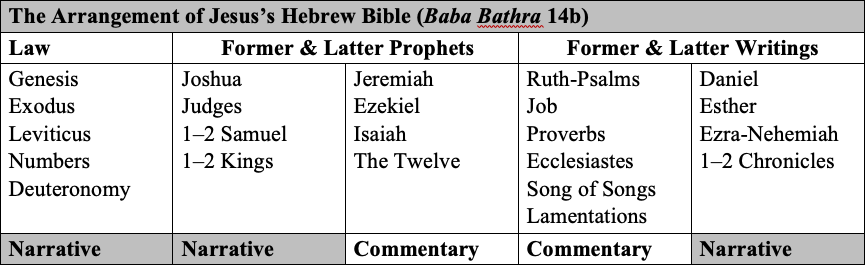
The Jewish Bible that Jesus and the apostles had included the same books as our English Old Testament (OT) but arranged some elements differently. Not only did it pair some books into single volumes that our English Bible’s separate (Samuel, Kings, the Twelve [minor prophets], Ezra-Nehemiah, Chronicles),[1] it also arranged the whole in a different order and in three main divisions: the Law (tôrâ), the Prophets (něbîʾîm), and the Writings (or “the other Scriptures,” kětûbîm).[2] The biblical evidence also suggests that Jesus’ Bible began with Genesis and ended with Chronicles.[3]
The canonical arrangement I am following here is not that of the standard critical edition of the Hebrew Bible but is found in the most ancient listing of the Jewish canonical books dated to around the days of Christ and located in Baba Bathra 14b. As is evident in the figure below, the biblical historical narrative runs chronologically from Genesis to Kings, pauses from Jeremiah to Lamentations, and then resumes from Daniel to Ezra-Nehemiah. Chronicles then recalls the story from Adam to Cyrus’s decree that Israel can return. As for the commentary, the Latter Prophets structure the four books largest to smallest, and the Former Writings follow the same pattern, except that Ruth prefaces the Psalter and the longer Lamentations follows Song of Songs. I could say much more about the ordering of Jesus’ Bible,[4] but two things are important to recognize here: (1) Historical narrative frames the entire OT, which means that the (true) story of God’s work to bring about the Messiah to save the world provides the lens for understanding everything else. (2) The OT also includes non-narrative prophetic and poetic commentary books that color, clarify, and control our reading of the narrative itself.
An Exercise in Genre Analysis: Historical Narrative
For our exercise in genre analysis, we will consider the historical narrative of Jonah. We are analyzing historical narrative since it constitutes 65% of the OT. To rightly interpret historical narrative, the interpreter must follow five guidelines.
1. Distinguish the episode and its scenes.
The term “episode” in OT exegesis is related to its use in a TV series like 24. In 24, each season consists of twenty-four one-hour long episodes that build upon each other and carry the storyline forward. Within each episode, there might be six-twelve individual scenes that take us through the equivalent of 60 minutes in the lives of the characters. To understand 24 and shows like it, one must be able to grasp how each scene contributes to the message of each episode, and how each episode contributes to the overall storyline of the season. Likewise, we should break each biblical book of historical narrative into its episodes and then identify how the scenes of that episode work together to communicate the main point of the episode.
Within the book of Jonah, 1:1–2:10 is the first “episode” and 3:1–4:11 is the second “episode.” We can identify these portions of Scripture as episodes because they both begin with, “Now the word of the LORD came to Jonah” (Jon 1:1; 3:1). Noting shifts in participant, context, and grammar, the first episode appears to consist of four “scenes.” These scenes are (1) Yahweh’s call to go on mission (1:1–2), (2) Jonah’s rebellion (1:3–16), (3) Yahweh’s response to Jonah’s rebellion (1:17), and (4) Jonah’s response to Yahweh’s mercy (2:1–10). Where does the text suggest the scene-breaks are in episode 2 (3:1–4:11)?
2. Consider literary features.
Having identified the scenes from the episodes, we now consider literary features. This involves examining the literary context, plot development and characterization, and editorial comments. To understand the literary context, examine what comes before and after your passage, seeking to grasp how your episode’s literary placement fits within the narrative’s flow. Track the plot development and characterization of a historical narrative by discerning the nature of the conflict and its resolution, God’s role in the narrative, and how humans’ words and deeds relate to their covenant with God.
The book of Jonah lacks any significant editorial comments, but there are a number of other literary features that are significant. With respect to literary context, the first episode ends with Jonah celebrating his own experience of God’s steadfast love (2:8–9), but the second episode shows Jonah detesting that his enemies experience God’s steadfast love (3:9–4:2). As for plot development and characterization, in episode one, Yahweh is clearly the main character, with Jonah appearing only as a foil to exalt God’s sovereignty and steadfast love. Yahweh calls Jonah to Nineveh; Yahweh sends the storm, and Yahweh intensifies it to keep the sailors from rescuing the prophet; Yahweh provides the fish to rescue Jonah; and Yahweh is the object of Jonah’s praise from the fish’s belly. Jonah is grateful that Yahweh saves him from the fish, but in episode two he will be angry that Yahweh saves Nineveh from punishment. The prophet of Yahweh does not like Yahweh’s character, and this is real irony. What literary features can you identify in episode 2?
3. State in a single sentence the narrative episode’s main idea.
The main idea of a historical narrative episode is usually found within a speech and almost always tells us something about God or how we relate to him. In Jonah’s prayer at the end of episode one, he links Yahweh’s saving acts with people’s hope in his steadfast love: “Those who pay regard to vain idols forsake their hope of steadfast love…. Salvation belongs to the LORD!” (2:8–9). Then, toward the end of episode two, the prophet prays again, highlighting why he never wanted to go to Nineveh in the first place: “I knew that you are a gracious God and merciful, slow to anger and abounding in steadfast love, and relenting from disaster” (4:2; cf. Exod 34:6). The book seems to be highlighting the Lord’s loving character and saving action, and we must interpret the scenes and episodes in light of it. Doing this yields the following single sentence main idea for Jonah’s first episode (Jon 1:1–2:10): God desires that people personally hope in and experience his saving, steadfast love! How would you craft the main idea of episode two?
4. Draft an exegetical outline of the narrative episode that aligns with the passage’s purpose.
Having paid close attention to the preceding three historical narrative guidelines, we are now able to draft a message-driven outline that demonstrates how the various scenes work together to create a unified episode. This outline could in turn serve as the very structure for a sermon or lesson. Keeping in mind episode one’s scene divisions and main idea, I propose the following outline, which attempts to show how the idea of steadfast love holds the whole message together:
Jonah’s first experience of Yahweh’s steadfast love (1:1–2:10)
Yahweh’s initial call to a mission of steadfast love (1:1–2)
Jonah’s personal need for steadfast love (1:3–16)
Yahweh’s demonstration of steadfast love (1:17)
Jonah’s positive response to Yahweh’s steadfast love (2:1–10)
Jonah’s second experience of Yahweh’s steadfast love (3:1–4:11)
How would you complete the outline for episode two?
5. Evaluate the passage’s theological trajectories.
Here we ask questions like, Is the passage more about believing or doing? What does it tell us about the unchanging, triune God’s character or actions? And how does it anticipate the person and work of Christ? It is in this step that we will most grasp the passage’s lasting value for Christians today.
Jonah exalts Yahweh as a God whose steadfast love moves him to save all who look to him. The book encourages people to personally hope in his steadfast love by turning from idols, but it also challenges people to guard their hearts from withholding such saving, steadfast love from others. One of the ways the book anticipates Christ is that it reveals God’s deep desire to be gracious and compassionate to sinful humanity, and this desire is most ultimately manifest in the glorious grace (steadfast love) and truth (faithfulness) that come through Jesus (John 1:14, 17; cf. Exod 34:6; Jon 4:2).
*Material adapted from “Chapter 1: Genre” in DeRouchie’s How to Understand and Apply the Old Testament, 21–97.
[1] Note, for example, how Acts 7:42–43 speaks of a single “book of the prophets” and then cites Amos 5:25–27.
[2] Besides evidence from outside the Bible, we see evidence of this three-part structure when Jesus declared after his resurrection, “These are my words that I spoke to you while I was still with you, that everything written about me in the Law of Moses and the Prophets and the Psalms must be fulfilled” (Luke 24:44).
[3] We see this in one of Jesus’s confrontations with the Pharisees, in which he spoke of the martyrdom of the OT prophets “from the blood of Abel to the blood of Zechariah” (Luke 11:51; cf. Matt 23:35). Jesus appears to have been speaking canonically, mentioning the first and last martyr in his Bible’s literary structure. Specifically, just as Genesis records Abel’s murder, the end of Chronicles highlights a certain Zechariah who was killed in the temple court during the reign of Joash (835–796 BC; see 2 Chr 24:20–21).
[4] See Jason S. DeRouchie, “Is the Order of the Canon Significant for Doing Biblical Theology?,” in 40 Questions about Biblical Theology, by Jason S. DeRouchie, Oren R. Martin, and Andrew David Naselli, 40 Questions (Grand Rapids: Kregel, 2020), 157–70.
The Siblinghood of the Saints
By / Sep 21
We are God’s children, bought by the blood of Jesus who secured both our adoption into His kingdom and our inheritance of eternal life with Him. God is our Father, we are His daughters and sons – heirs in the Kingdom of God (Romans 8:14-17).
This gracious gift, our envelopment into the family of God, is no small thing. It changes, or it should change, everything about the way we interact with each other.
If you love the Father, you also love those born into his family (1 John 5:1). There’s no room for favoritism (James 2:1-13), selfishness (Philippians 2:3-4), or isolation (Hebrews 10:25). We are called to love one another as Jesus has loved us – willing to lay aside all our own desires and sacrifice our lives for the good of others.
“I give you a new command: Love one another. Just as I have loved you, you are also to love one another. By this everyone will know that you are my disciples, if you love one another.”
– John 13:34-35
We are brothers and sisters, called to love one another deeply whether we like it or not. Do we think of this when we interact with fellow children of God? Do we ponder the implications of this truth when relationships within the church are difficult? Do we relate in a way that demonstrates God’s love to the watching world?
As a concept, we may understand the need for deep siblinghood in the church. We may even practice it to an extent. I believe the church is proficient in promoting and encouraging siblinghood with those of the same sex.
But do we practice saintly siblinghood when it comes to male and female relationships?
With sexual abuse, objectification, gossip, and “rulebooks” flying in our faces, it seems impossible for male and female friendships to thrive in the church.
Some decide to avoid friendships with the opposite sex altogether. Better safe than sorry, they say.
Some decide to exploit and pursue boundaryless relationships. Better something rather than nothing, they say.
Yet we cannot avoid and we cannot exploit.
Can we interact as brothers and sisters in a way that honors God and one another?
We are tempted to believe all kinds of lies about the opposite sex, and we must address those lies and allow repentance to take place before we can move forward in godly siblinghood.
Women, do you believe your brothers to be more sinful than you, or more susceptible to lust? Do you believe all men have bad motivations when they talk to you? Do you believe all men are violent or prone to violence? Are there other lies you believe about men you need to repent of today?
Men, do you believe your sisters are more easily manipulated than you? Do you believe that all women are naturally temptresses? Do you believe that women are less intelligent or weaker than men? Are there other lies you believe about women you need to repent of today?
Brothers and sisters, we are not objects for each other’s self-gratification. We do not exist to fill voids, to meet needs, to provide ultimate comfort or satisfaction, or to fulfill our desires for attention. We do not exist to be used by one another but rather loved by one another.
How do we love one another in a healthy, God-honoring way? What does the siblinghood of the saints look like practically?
We cannot take our cues from the world and give in to the objectification of men and women. If we do, we risk minimizing the family of God, damaging relationships with fellow believers, and tainting our witness to those who do not believe the gospel.
We can look to Jesus’ life and draw some general conclusions from his interactions with women. To put it briefly, Jesus demonstrated love, care, protection, forgiveness, trust, and deep fellowship with women when He was on earth (Matthew 9:18-26, Mark 5:25-34, Luke 7:36-50, Luke 8:1-3, Luke 13:10-13, John 4:1-24, John 20:11-27).
This kind of siblinghood is foreign to many of us, and there are numerous ways we need to grow in how we encourage deep friendships in the church. As a specific, practical encouragement, group settings should be the primary way we learn. I want to be clear that I believe it is unwise to advocate isolated, deep friendships between men and women who are not married. However, the church is a beautiful context for the siblinghood of the saints to flourish! Small groups, fellowship meals, Sunday morning conversations, and other group settings open up countless opportunities for men and women to practice deep friendships and fellowship with one another.
Surely we all must act with wisdom according to conscience in our relationships with the opposite sex. We ought to have nuance and balance. If we avoid one another, we give in to fear and distrust. If we exploit one another, we give in to selfishness and abuse. If we love one another as Jesus loved us, we demonstrate the magnificent gift of the family of God, and by this, we declare the reason for our love: it is by God alone.
We must remember that we are family members, called to eternal togetherness. We must pursue the siblinghood of the saints if we want the world to know our God.
What The Puritans Taught This Builder About Ministry
You’d think having owned a construction company would be good preparation for serving as a pastor. Construction work is high-stress, project-driven work, full of timelines and schedules, like much church ministry. The Bible itself repeatedly uses language of construction to talk about the life of a local church – terminology taken straight out of a construction site. But for all the correspondence between the two, there is also a major difference, one that has already been a significant challenge to me.
I spent the first months of my pastorate frustrated by the lack of a clear touchdown. In project-driven work, the touchdown is obvious—completing the project on time and on budget, good craftmanship, and happy clients. But church members are not clients and a church is not a “project” that can be completed this side of eternity (2 Corinthians 11:2). Given this, what does a touchdown look like from week to week?
All Things Done for Building Up
On the one hand, the duties of the pastorate are clear. Paul’s charge to Timothy states plainly that a Pastor should “preach the word; be ready in season and out of season; reprove, rebuke, and exhort, with complete patience and teaching” (2 Timothy 4:2). But on the other hand, the pastorate consists of more than just cranking out the duties of the office. For instance, in 1 Corinthians 14:26 — “Let all things be done for building up” — the “all things” is not a choice between what is evil and what is good. It is a choice between lots of goods that can all be means of building up the church. In other words, there is the urgent need to discern from all these goods what will be best for building up the Church. There is a wisdom dimension in pastoral ministry, guiding our precious time and energy toward what is most advantageous for the bride of Christ and, therefore, the glory of Christ.
This wisdom dimension is where I still have much to learn from the Puritans.
The typical Puritan pastor understood more than the duties of ministry.[1] He also understood the “touchdown” of ministry. Probably no one has articulated the Puritan understanding of ministry better than J.I. Packer in his 1990 book A Quest for Godliness. He writes:
“The end to which all church order, on the Puritan view, was a means, and for which everything superstitious, misleading and Spirit-quenching must be rooted out, was the glory of God in and through the salvation of sinners and the building up of lively congregations in which people met God.”[2]
Packer captures the essence of what I find so helpful and compelling about the Puritans. Their ministries had a definite aim, “lively congregations” where the glory of God’s salvation is obvious and the presence of God among His people is palpable. Who doesn’t want to be a part of that! This aim was not formulated in so many words or, to my knowledge, codified in a Puritan handbook. But it is easy to see how Packer arrived at this conclusion. Consider this exposition from Richard Sibbes (1577-1635) of Song of Solomon 5:1:
“Christ’s invitation by the church to come into his garden, with the end thereof, ‘to eat his pleasant fruits.’ . . . shew the church’s further desire of Christ’s presence to delight in the graces of his own Spirit in her. She invites him to come and take delight in the graces of his own Spirit; and she calls him ‘Beloved,’ because all her love is, or should be, imparted and spent on Christ, who gave himself to a cursed death for her. Our love should run in strength no other way, therefore the church calls Christ her ‘Beloved.’ Christ was there before, but she desires a further presence of him, whence we may observe that wheresoever grace is truly begun and stirred up, there is still a further desire of Christ’s presence; and approaching daily more and more near to the soul, the church thinks him never near enough to her until she be in heaven with him. The true spouse and the bride always, unless in desertion and temptation, crieth, ‘Come, Lord Jesus, come quickly,’ Rev. xxii. 20. Now, these degrees of Christ’s approaches to the soul, until his second coming, are, that he may manifest himself more and more in defending, comforting, and enabling his church with grace. Every further manifestation of his presence is a further coming.”[3]
A Further Coming
If you had asked me at the outset of my ministry to describe what a church “touchdown” looks like, I would have leaned heavy on conversions as the mark of vitality. And this is certainly an evidence of grace we ought to seek from God (Matthew 9:37).[4] We long to see Christ coming to sinners at the moment of conversion, breathing new life into dead bones. But do we also realize that, “Every further manifestation of [Christ’s] presence is a further coming”? Jonathan Edwards captures this idea wonderfully in a sermon on Romans 3:19—notice too the emphasis on liveliness, alluded to above in Packer:
“If you would have your comfort continued, and be lively Christians, you must be as earnest still, and as long as you live, as you [were when Christ first comforted you]; and be more and more, if possible, as being sensible that your conversion was but the beginning of your work, and not the finishing of it. If those that have lately been converted amongst us, do generally continue lively in Christianity, there is no danger of the work of God’s ceasing.”[5]
I am going to say something now that runs contrary to the Christianity I inherited from my fathers. Conversion is not the high-point of our Christianity: conversion is “but the beginning” of “further coming[s]”.
Like every warm-blooded Pastor I know, I long for conversions. I will never stop praying for more conversions. But the Puritans help me to also long for something more—ever deepening communion with Jesus in the context of a lively church.
Time and again, through the well-reasoned and careful exegesis of Scripture, the Puritans push me beyond the false limits of my low expectations for how wonderfully and powerfully Jesus can manifest His presence here and now in a “normal” church that is all-in with Him.[6] This is what makes the ministry of the Puritans so compelling to me. They are not so much discovering as rediscovering the Christianity that is really there in the pages of Scripture, the kind of Christianity that gets us past treating church as a project and increases our hunger for the real presence of Christ among His people. That’s the touchdown!
Editor’s Note: This post originally appeared at the blog for Credo Magazine and is used with permission.
Endnotes
[1] Concerning the duties of pastoral ministry, Richard Baxter’s Reformed Pastor humbles the best among us. John Owen’s outline of the “The Especial Duty of Pastors of Churches” is another example of the high bar to which Puritan pastors sought to attain.
[2] Packer, A Quest for Godliness: The Puritan Vision of the Christian Life (Wheaton, IL: Crossway, 2010), 39.
[3] Sibbes, Works of Richard Sibbes (Carlisle, PA: Banner of Truth), 2:13–14. [Italics added]
[4] The Puritans themselves longed for conversions and compelled people to receive Christ in no uncertain terms. E.g., “If you refuse thus to receive Christ , how just is it that Christ should refuse to receive you!” See, Jonathan Edwards, Sermons and Discourses, 1734-1738 (WJE Online Vol. 19) , Ed. M.X. Lesser.
[6] The closest modern parallel to what I have found in the Puritans is by Dane Ortlund, Gentle and Lowly: The Heart of Christ for Sinners and Sufferers (Wheaton, IL: Crossway, 2020).
Good Works Are Not Your Problem
By / Sep 9
Rather than writing off good works, the Apostle Paul considered good works and faith to be the closest of friends.
The Christian life is “faith working through love” (Gal 5:6). In fact, Christ “gave Himself for us to redeem us from every lawless deed, and to purify for Himself a people for his own possession, zealous for good deeds.” Good works are a major reason Christ died for you. Don’t think little of them.
Rather, it is Mosaic Law-works (such as circumcision, feast days, the priesthood, the sacrificial system, food laws and Jew/Gentile separation rules) that Jewish believers are freed from, and religious externalism and superstitious rule-keeping found in all paganism (Gal 8:8-11) that Gentiles are freed from. The Jew, like Paul, is liberated from that system in Christ, and the Gentile, who was never under it, is not to bring himself into that kind of bondage which he once experienced in his pagan worship. “It was for freedom that Christ set us free; therefore keep standing firm and do not be subject again to a yoke of slavery” (Gal 5:1).
It’s God’s eternal purpose for you to bear the fruit of love by serving one another through the indwelling Spirit.
“Therefore, my brethren, you also were made to die to the Law through the body of Christ, so that you might be joined to another, to Him who was raised from the dead, in order that we might bear fruit for God” (Rom 7:4).
What was God doing before he created the world? Perhaps he was lonely. And being lonely, he needed to fill that empty hole in his heart. So he decided to create the world—that way he could have fellowship with others. Now that the world is here, God is not so lonely anymore. Because of us, he feels fulfilled and whole.
This answer is not uncommon. It can be heard in many churches today by well-meaning Christians. Please brace yourself, because I have something shocking to say: God does not need you. He doesn’t need you, he doesn’t need me, and he doesn’t need anyone or anything in this world. In fact, he doesn’t need the world at all. Period.
God is not a needy God. It’s not as if he was bored, twiddling his thumbs, desperately lonely prior to creating the world. God is not dependent on the world for his existence, nor is he dependent on the world for his happiness and self-fulfillment. Instead, he possesses life in and of himself. More precisely, he is the fullness of life in and of himself.
What is aseity? Life in and of himself
What we are describing is the attribute of aseity—a se being Latin, meaning “from himself.” As I argue in None Greater: The Undomesticated Attributes of God, to affirm God’s aseity is to say, first and foremost, that he is life in and of himself, and on that basis he must be self-existent and self-sufficient. It is because God is life in and of himself that there can be no sense in which he is caused by another.
There is, most fundamentally, a difference in nature between the Creator and the creature, the former having life in and of himself, the latter deriving life from the one who is life. We are born into this world totally dependent, finite in every way. Our existence is derived from our mother and father. If we are to continue living, the God of the universe must sustain us. We are dependent on not only our earthly father but our heavenly Father too. Our nature, our very existence, is contingent in every way.
Not so with God. His nature is not at all like our nature. He is incommensurable, incapable of being measured by the same standards of our human existence. Unlike everything in this world, his existence is not grounded in, derived from, or contingent on something or someone else. No one brought him into being, nor is he dependent on something or someone else to continue being. He is underived from and unconditioned by that which is finite, contingent, limited, and changeable. That much is evident in how he created the world. He did not depend upon some preexisting matter to create the universe, but he created ex nihilo, out of nothing.
Furthermore, only one who has no beginning or cause to his own existence can bring the world into existence out of nothing (an unmoved mover). Uncaused, his existence is grounded in himself alone. That means not that he created himself or caused himself to be but that he alone, as Anselm says, “has of himself all that he has, while other things have nothing of themselves. And other things, having nothing of themselves, have their only reality from him.”[1]
That phrase “has of himself all that he has” handsomely summarizes aseity. The same cannot be said of objects in the created order. Placed next to God, observes Augustine, “they are deficient in beauty and goodness and being.”[2] But there is no such deficiency in God’s being. Aseity defines God as a perfect being.
Editor’s Note: This post originally appeared at the blog for Credo Magazine and is used with permission.