Up To Your Neck

Editor’s Note: The weekend can be an incredibly distressing time for many pastors to enter into. The desire to spend quality time with family while juggling the pressures of an unfinished sermon can be an exhausting reality. What many pastors need are not more tips on how to prepare better sermons as much as some encouragement to better prepare their hearts to preach the sermon they have. Join Ronnie Martin every Friday for The Preachers Corner, where he offers some words of comfort and stories of hope to help preachers enter the weekend encouraged by the gentle and lowly heart of Jesus. 


Save me, O God! For the waters have come up to my neck. I sink in deep mire, where there is no foothold; I have come into deep waters, and the flood sweeps over me. Psalm 69:1,2

Oh man. It’s hard to say if part of David’s angst in Psalm 69 was due to an overwhelmingly busy schedule, but I do know that my schedule has me feeling a lot like what David is describing. I can attest that since the beginning of this year, I have had little to no margin to catch my breath or collect my thoughts. I feel like I need to pay royalties to the person who invented the phrase “keeping my head above water” because it’s the only way I know how to illustrate my life some days. The problem is that, as pastors, we can become so bombarded with busyness that preaching feels like a side job we’ve been hired to do when we get around to it. 

So what do we do when the demands of ministry feel like drowning in waters so deep that everything around us, including our preaching, seem to be sinking in the mire? 

Here’s a few questions I’m trying to consider:

What Is God Speaking To You? 

We have the tendency to think that our busiest moments drown out the stillness of God’s voice, and that is certainly true. But let’s not miss that God uses the chaos around us to cut through the noise, too. David acknowledges that You, God, know my folly; my guilt is not hidden from you (Ps. 69:5). As preachers, God uses the sweeping floods that surround us to form the person He has called to preach. Ponder what God is speaking to you, because He is always speaking to those He has called to speak for Him.  

What Does the Deep Mire Reveal? 

When all you seem to be doing is fighting for steady footing, what does this tell you about the places you keep trying to stand? For reasons we only know are good, God gave us 168 hours per week to work, rest, eat…and preach. When we put ourselves in places that offset the balance God created, we create a sense of spiritual vertigo in our minds, which is the sensation that all the important things are spinning uncontrollably around us. Maybe it’s time to sit down and consider the ministry mire you’re sinking in, how you got there, and what it would look like to be rescued from it, as David pleads in Psalm 69:14, Deliver me from sinking in the mire… There might be practical implications here but start with prayer, so that your preaching reveals a more reflective heart to your people, and to the many who are in the same deep waters as you are. 

Are Limitations Your Friend?

David pleads for God’s love and mercy because he is acutely aware of what his life amounts to without them. David knew his limitations, and they weren’t his enemy, but rather the catalyst for entrusting himself to the Lord.  

Answer me, O Lord, for your steadfast love is good; according to your abundant mercy, turn to me. Hide not your face from your servant, for I am in distress; make haste to answer me. Psalm 69:16-17

Are limitations your friend? Because they’ve been given to you by God so that the end of yourself is something you embrace with increasing clarity. Befriend your limitations. See it as a tool in the hands of God that is united to His heart for your preaching and pastoring. 

Your people need a preacher who knows their limitations, because they need to understand theirs and make a beeline to the cross, where limited people find an unlimited God who helps those who are up to their neck in the waters of life find the oxygen of Jesus.


I Will Not Offer the Lord What Costs Me Nothing

There are several Bible verses that drive my commitment to faithful preaching. They are 1 Timothy 4:16, 2 Timothy 2:15, and 2 Timothy 4:2.

I regularly share these verses with young preachers, when I am asked for a passage of scripture to encourage them in the work.

But there is another passage that reminds me of my charge to preach the word. I rarely share this verse. It is not from the Pastorals. For that matter, it is not from the New Testament.

It is 2 Samuel 24:24.

But the king said to Araunah, “No, but I will buy it from you for a price. I will not offer burnt offerings to the Lord my God that cost me nothing.”

David sinned by numbering the fighting men of Israel. It was not wrong that the kind took a census of his army. But there was a subtle but great sin behind this census. Counting the men betrayed the fact that David was not counting on God.

The Lord was displeased with David. And he would punish Israel for David’s sin. But he let David choose the punishment. Three years famine. Three months of persecution from your enemies. Or three days of pestilence.

David responded, “I am in great distress. Let us fall into the hand of the Lord, for his mercy is great; but let me not fall into the hand of man” (2 Samuel 24:14).

For restoration, the Lord commanded David to offer a sacrifice on the threshing floor of Araunah the Jebusite. In obedience, David asked to buy Araunah’s threshing floor, to build an altar on it. Araunah freely offered the land to the king. But David refused. He insisted on paying for the land, because he could not make an offering that cost him nothing.

Of course, this passage has nothing to do with preaching. Yet it does. It addresses anything we do for the Lord. We should follow David’s example and never offer to God something that cost us nothing.

How much more should cost us to preach the word of God and the testimony of Jesus Christ?

There are three costs you should pay to honor the Lord in your preaching

The Cost of Personal Consecration

David prayed, “Let the words of my mouth and the meditation of my heart be acceptable in your sight, O Lord, my rock and my redeemer” (Psalm 19:14).

This is a good prayer for preachers to offer. But for this prayer to work, you must make both petitions. The words of your mouth must be acceptable in God’s sight. God is pleased with preaching that has biblical fidelity, sound doctrine, and a Christ-centered focus. But God is also looking at the meditations of your heart. The Lord is not honored if by true word from a false heart.

We must guard our hearts, so that the words of our mouth will be the overflow of our devotion to Christ. We must guard our life and doctrine. Pay whatever it costs to preach with a clean conscious, pure heart, and godly motivations.

The Cost of Diligent Preparation

Have you heard the one about the preacher who didn’t study? As he stood to preach, he prayed, “Lord, speak to me.” And the Lord did. He said to the preacher, “You should have studied!” Upon hearing that story, I concluded that I don’t want the Lord to talk to me in the pulpit. Get it?

I am convinced that the preachers that make it look easy work hard to do so. They pay the price in the study to be faithful to the text, clear in their presentation, and compelling in their argument.

How long does it take to prepare a sermon? As long as it takes. Get in the seat. Gather your tools. Go to work. And don’t quit until the hard work is done. Think about it. You have left the pulpit feeling bad that you did not prepare better. But you never leave the pulpit feeling you over-prepared. When you offer God your best work, you will sense his smile on you as you preach.

The Cost of Believing Prayer

You have prepared yourself to preach. And you have prepared the message. But there is another cost to pray. It is the cost of believing prayer.

In a real sense, the entire message should be an exercise in prayer. Pray before you begin your study. Pray as you study. Pray after you finish the message. Pray over the message. Pray for faithfulness, clarity, authority, passion, wisdom, humility, and freedom as you preach. Pray that those who hear the message will have receptive hearts and minds. Pray that the Lord would govern the presentation of the message, even as he has guided the preparation of the message. Pray that you and the congregation will encounter the Christ as you study the word.

When I was a boy, I used to hear preachers say, “Preaching and praying go together. When there is preaching in the pulpit there should be praying in the pews.” I fully agree. But there should also be preaching and praying in the pulpit. Powerful preaching comes from praying preachers.

Editor’s Note: This originally published at HBCharlesJr.com


Mark Dever On Leading Change In A Church

We asked Mark Dever, “How do you lead big change in a church without blowing it up?”


How to Understand and Apply the Old Testament:
 Step 5–Clause and Text Grammar

With step 5 of the interpretive process we move from “Text” to “Observation,” and we consider a series of issues related to how a passage is communicated. Our initial goal is to assess the makeup and relationship of words, phrases, clauses, and larger text units. In short, we need to study grammar.

According to His Own Heart He Sought a Man–Illustrating the Importance of Grammar

Why study grammar? Before answering this question, let me first illustrate the difference it can make. In 1993 I spent a semester studying in Israel. As I went, I prayed that God would make me “a man after his heart.” I was echoing 1 Samuel 13:14 where, speaking of Saul’s replacement, the prophet declared, “The LORD has sought for himself a man after his own heart” (NASB). What does this statement mean? For me, it was something like, “God, let my desires, thoughts, and hates be like yours.” Or it could have been, “Help me be a man who pursues after your heart.”

In English, the preposition “after” can mean “in pursuit of” as in, “the cop went after the robber.” I now recognize that the Hebrew preposition ke (כְּ, “like/according to”) that begins the phrase “after his heart” never functions this way. This means the construction “a man after God’s heart” can’t mean “a man who pursues God’s heart.” That cancels out one of the ways I may have interpreted this statement decades ago.

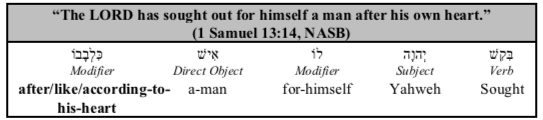
The next thing to recognize is that prepositional phrases are modifiers, characterizing either nouns (functioning adjectivally) or verbs (functioning adverbially). Most prepositional phrases in Hebrew are adverbial, but the traditional interpretation of 1 Samuel 13:14 treats the prepositional phrase “after/like/according to his heart” adjectivally. Let’s look at three possibilities for interpreting 1 Samuel 13:14. Hebrew reads right-to-left, and the following represents an English interlinear with word-for-word translation under the Hebrew.

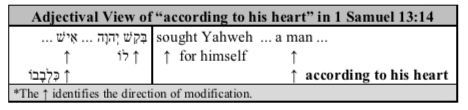
First, if “after/like/according to his heart” is functioning adjectivally modifying the direct object “man,” and if “heart” refers to God’s character or loyalty, then the clause means that “YHWH has sought a man whose character or loyalty in some way corresponded to God’s character or loyalty.” This is the traditional reading, and a number of English translations make this view explicit: “The Lord, searching for a man who is pleasing to him in every way …” (BBE). “The LORD has sought out for himself a man who is loyal to him” (NETB). “The LORD has found a man loyal to him” (HCSB).[1] “The LORD will search for a man following the Lord’s own heart” (CEB). The figure below represents the word-order of the Hebrew.

Second, when reading “according to his heart” adjectivally, another possibility arises if “heart” refers not to God’s character but to his “desire” or “choice.” Here God’s elective purpose corresponds with or finds fulfillment in the “man.” The basic idea would be that “YHWH sought for himself a man who was in accord with his own choosing.” Some contemporary versions employ this reading: “GOD is out looking for your replacement right now. This time he’ll do the choosing” (MSG). “The LORD will search for a man of his own choosing” (CEB).

There is still a third way of reading the passage, and I think it is to be preferred––that the prepositional phrase “according to his heart” functions not adjectivally modifying “man” but adverbially modifying the main verb “he sought.” In this instance, YHWH’s “heart/will” serves as the standard or norm by which he sought a new king: “YHWH sought for himself according to his own will a man.” In this reading, the verse says nothing explicit about the man’s character or loyalty. Instead, it focuses on how YHWH’s act of discretion in selecting David grew out of a previous act of willing––he sought in accordance with a mental image he had in mind.

There are various evidences that support this third reading, all of which I have addressed elsewhere.[1] Now, if the adverbial reading is correct, even though the verse tells us nothing explicit about Saul’s replacement, it may still tell us something implicitly. If Yahweh, in part, selected David because his life aligned more closely to God’s mental ideal for kingship than Saul’s life did (i.e., Deuteronomy 17:14–20), then even with the adverbial reading, we may learn that David’s inner disposition truly did align more with God’s desires than Saul’s. Even more, his life pointed to his greater Son, Jesus, who perfectly matches God’s ideal image of kingship.[2]

My point in this illustration is to stress the value of knowing grammar. Considering how words, phrases, clauses, and larger texts relate can open up new avenues for questions and interpretation. And because our quest is to rightly understand God’s Word, such efforts count!

What is Grammar?

Grammar is what allows communication to make sense. We cease being coherent if we deviate too far from grammatical norms. To be specific, grammar is the whole system and structure that language uses for communicating effectively. It consists of four parts:

  • Orthography: the study of the alphabet and how its letters combine to form sounds;
  • Phonology: the study of a language’s system of sounds (phonemes);
  • Morphology: the study of the formation of words;
  • Syntax: how words combine to form phrases, clauses, sentences (clause grammar or micro-syntax), and even larger structures (text grammar or macro-syntax).


We now turn to clause grammar and text grammar.

Clause Grammar

As mentioned, clause grammar is how words combine to form phrases, clauses, and sentences. The time we just spent considering 1 Samuel 13:14 was an exercise in clause grammar because we were seeking to construe meaning within a sentence. In that instance, we sought to determine if the prepositional phrase “according to his heart” modified a noun or a verb. In order to be able to practice clause grammar, it is helpful to know the following terms:

  • Clause: A grammatical construction made up of a subject and its predicate.
  • Phrase: A group of words that fills a single slot in a clause.
  • Subordinate clause: A clause that serves as a modifier and is embedded in a higher-level clause, as in “who is but a youth” in the sentence “David, who is but a youth, slew Goliath.
  • Main clause: One that is not grammatically subordinate to any other higher-level clause. “David, who is but a youth, slew Goliath.”
  • Sentence: A main clause with all its subordinate clauses.


Besides these terms, you need to know the right questions to ask. Some of the key ones include:

  • Could any clause or groups of clauses be understood differently if the grammar were construed differently?
  • Have I identified the antecedent referent of every pronoun and the subject of every verb?
  • Do I understand the function of every subordinate conjunction?
  • Do I know how every clause relates to its context?
  • Have I grasped the role of every discourse marker?

Text Grammar

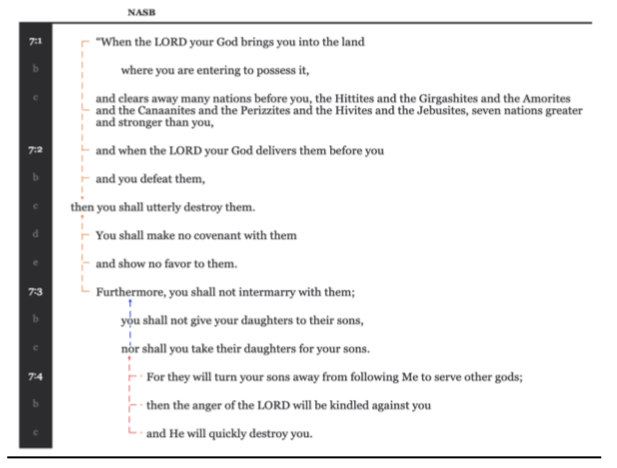
Text grammar consists of the relationship between structures of thought that are equal to or larger than the clause level. The following diagram of Deuteronomy 7:1–4 is a model with an accompanying explanation of how to begin thinking about text grammar.

Each verse reference (i.e., 7:1[a]; 7:1b; 7:1c; 7:2[a]; etc.) is a clause, which means that it has a subject and a predicate (though in some instances the subject is implied from a previous clause). Below is an explanation of what the text grammar diagram above intends to communicate. Working through these notes will be cumbersome, but grasping what I am doing will serve your Bible study. You can learn more about how to lay out a biblical text as I have at www.biblearc.com.


The time when Israel must destroy their enemies (7:1a–2b)

  • 7:1a begins an extended temporal (“when”) unit of four clauses that run from 1a–2b. The entirety of this “when” unit modifies 2c in that it provides the events that must occur for 2c to happen. I have signified that 1a–2b modifies 2c in this way by indenting the unit to the right. Another way to state this relationship is that 2c can grammatically stand on its own (i.e., an independent clause), but the unit in 1a–2b cannot stand on its own since it is dependent upon 2c. While only 1a includes the temporal “when,” the clauses in 2c–2b link to it with “and,” so that the whole of 1a–2b stands as a block of subordinate clauses that together modify 2c. Step one of this unit is that Yahweh will “bring” Israel into the promised land.
  • 7:1b modifies the word “land” in 1a by describing it. Since 1b develops 1a, I have indented it to the right of 1a. The “land” is the one that Israel will possess.
  • 7:1c begins with the conjunction “and.” This conjunction communicates that 1c links back to 1a and continues the subordination begun with the “when” clause. Because 1c connects with 1a, it goes directly beneath 1a. Seeing that 1c links to 1a informs us that the implied subject of 1c is the same subject from 1a (i.e., the LORD you God). When Yahweh brings Israel into the promised land, he will “clear away” the seven nations before them.
  • 7:2a begins with the conjunction “and.” This conjunction communicates that 2a links back to 1c and continues the subordinate unit begun in 1a. Because 2a connects with 1c, it goes directly beneath 1c. In this temporal unit, God’s actions move from “bringing” to “clearing away” and then culminate in his “delivering” all of them over to Israel.
  • 7:2b begins with the conjunction “and.” This conjunction communicates that 2b links back to 2a and continues the subordinate unit begun in 1a. Because 2b connects with 2a, it goes directly beneath 2a. Nevertheless, the switch from Yahweh as subject in 1ac and 2a to “you” as the subject of 2b identifies that 2b communicates the result of God’s previous actions. Once the Lord “brings,” “clears,” and “delivers,” the result will be that Israel will “defeat.” All these events set the temporal context for the main idea that follows.  


The call for Israel to destroy their enemies (7:2c)

  • 7:2c begins with “then,” and it is an independent clause. The “then” marks the primary act the people need to perform after Yahweh “brings … clears away … and delivers” and after Israel “defeats” (1a–2b). The whole temporal unit in 1a–2b modifies 2c. I have signified that 2c is an independent clause by placing it to the far left. Within the hierarchy of clauses, the fact that this clause is furthest left communicates that it is the main grammatical point of the passage. Operating as instruments of God’s wrath, Israel is called to “utterly destroy” the rebellious inhabitants of the Promised Land.


The implications of Israel’s destroying her enemies (7:2d–4c)

  • 7:2d does not begin with a conjunction (i.e., it’s asyndetic). In context, the lack of conjunction suggests that 2d and the other two clauses linked to it (2d,3a) are together providing some of the implications of God’s call to destroy the peoples in 2c. Because 2d explains 2c, I have indented it to the right. To utterly destroy Yahweh’s enemies means that Israel must “make no covenant with them.”
  • 7:2e begins with the conjunction “and,” which signifies that 2e is adding a further implication to 2d. Because 2e connects with 2d, it goes directly beneath 2d. Israel must also “show no favor to them.”
  • 7:3a begins with the conjunctive adverb “furthermore,” which identifies that 3a links back to 2e and adds to the explicatory unit begun in 2d. To destroy all the peoples (2c) implies that Israel must make no covenant with them (2d), show them favor (2e), or intermarry with them (3a). Because the “furthermore” at the head of 3s builds on 2e, it goes directly beneath 2e.
  • 7:3b does not begin with a conjunction, and as at 2d, the context suggests the lack of connection signals that 3b is now clarifying the previous statement in 3a not to intermarry. They must not allow their daughters to marry the sons of the ungodly. Because 3b modifies 3, I have indented it to the right.
  • 7:3c begins with the conjunction “nor,” thus adding one more element to the explication begun in 3b. To not intermarry will mean that the Israelites must neither give their daughters to the pagans’ sons (3b) nor take the pagans’ daughters for the Israelite sons (3c). Because 3c connects with 3b, it goes directly underneath 2e.
  • 7:4a begins with the conjunction “for.” This conjunction signifies that 4a logically supports 3c by providing its rational basis. Indeed, 4a begins a three-clause unit (4abc) that together gives the reason why God forbids inter-faith intermarriage. The first reason why the Israelites must not intermarry with these who do not fear Yahweh is because (“for”) these pagans would move the Israelites to turn from God to idols. Because 4a provides a logical ground for 3c, I have indented it to the right.
  • 7:4b begins with “then,” which connects back to 4a and thus continues to expand the reasons why the Israelites must not intermarry. Israel’s idolatry will “kindle” Yahweh’s just wrath. Since 4b connects back to 4a, the clause goes directly beneath 4 in the diagram. 
  • 7:4c begins with the conjunction “and.” This conjunction signifies that 4c links back to 4b, providing the final reason why Israel must not marry outside the covenant with Yahweh––it will ultimately result in God’s “destroying” them. Since 4c connects back to 4b, it continues to provide the rational basis for 3c, and it goes directly beneath 4b. 


Deuteronomy 7:1–4 is a weighty passage with a detailed argument that effectively motivates people to obey the Lord. God called Israel to remove obstacles to their pursuit of him. Failing to take idolatry seriously would certainly result in their ruin.

By practicing text grammar as I have done above, you can discern that the main point of Deuteronomy 7:1–4 is verse 2c: “then you shall utterly destroy them.” This is the passage’s main idea, and every other part of the passage supports or develops it in some way. 7:1–2b identifies the time when Israel must destroy their enemy neighbors, and 2d–4 explains some of the implications for what it means that they will destroy these objects of God’s just wrath. We have only just begun learning to trace an argument. I will devote all of next month’s post to this step in the interpretive process.


Note: This post adapts material from “Chapter 5: Clause and Text Grammar” in DeRouchie’s How to Understand and Apply the Old Testament, 181–236.


[1] Jason S. DeRouchie, “The Heart of YHWH and His Chosen One in 1 Samuel 13:14,” BBR 24.4 (2013): 467–89.

[2] For my understanding of the Apostle Paul’s use of 1 Samuel 13:14 in Acts 13:22 see ibid., 488–89.


[1] The newer CSB returns to a more traditional rendering: “The LORD has found a man after his own heart.”


Adam McClendon on Why Contentment is Radical

FTC.co asks Adam McClendon, Director of the D.Min. Program at Liberty University, "Why is contentment radical?"


Friendship Costs Considerably But Blesses Infinitely

I’ve thought a lot these days about the costliness of friendship. When conversations are hard or loneliness sets in, we are often tempted to believe that the work required of us to have deep and meaningful friendships is not worth the effort. To have real friendship, we have to pay up. I don’t know anyone who has friends for free. Friends take up your time, energy, memories, money, food, emotional bandwidth, and considerably more. Friends are not cheap. I’ve known my best friend for over a decade. If I were to sit down and write out how much time we’ve spent with each other, I wouldn’t be able to come close to a true estimate.

When we think of our deepest relationships, the people who know us better than we know ourselves, or those we spend the most time around, we know they cost us something. Our best friends typically come with hard conversations, hurtful words, sins committed, sins forgiven, laughter shared, meals prepared, and needs met.

In college, I remember how diligent I was to keep a tally with my roommates. I would be so careful to pay them back or return a favor so that I was not in anyone’s debt. I walked alongside friends, earnestly seeking to balance what I owed. 

Maybe this isn’t your struggle. Maybe you don’t feel pressure to pay back your friends. There are other ways we might avoid the costs that come with friendship. 

We might retreat and cut ourselves off from the world because we do not want to be a burden to anyone. When we feel like a burden or inconvenience, we want to remove ourselves from people so they are not burdened by us. When we have a need, we don’t want to ask others to help. We do not want our friends to go above and beyond us. 

Or, on the other end, we may demand more attention and time from others than is fair to them. We think that because of who we are or what we are given, we are owed a certain kind of treatment. We are offended when someone says no to time with us. We are hurt when our expectations are not met. We want our friends to go above and beyond for us. 

These are distortions of true friendship. We are not called to keep score, to live as an island, or to be a leech to our friends. 

We know that friendship is costly, but how do we have real friendship? 

For starters, we certainly cannot look to ourselves. God, the Creator of friendship and perfecter of it, speaks to us through His Word. Here are three encouragements from the Bible to help us pursue real friendship:

1. Sacrifice Your Life

“This is how we have come to know love: He laid down his life for us. We should also lay down our lives for our brothers and sisters.” – 1 John 3:16

Followers of Christ are not called to balance the budget sheet of our sacrifices for one another. Jesus did not lay down his life with an asterisk at the end. It was not an “I’ll die for you but here’s what you need to do to make it even” type of sacrifice. He just laid down his life for us. Full stop. No fine print. No hidden fees. 

We are called to this kind of sacrifice. We may not ever be in a situation where we can jump in front of a bullet and die for the ones we love, but every day, we have opportunities to lay down our lives for others. 

This sacrifice will cost you comfort, time, and resources. Sacrifice costs considerably. But we have the Spirit of Jesus, who was perfect and sinless in all his ways and willing to die for imperfect and sinful people like us. We are emboldened to follow in Jesus’ path of sacrifice by the power of the Spirit. 

2. Carry Burdens, Let Your Burdens Be Carried

“Carry one another’s burdens; in this way you will fulfill the law of Christ. For if anyone considers himself to be something when he is nothing, he deceives himself.” – Galatians 6:2-3

We are all wounded and burdened with the pains of this world. There is far too much sorrow and brokenness in life for anyone to bear alone. Death, sickness, racism, abuse, greed, selfishness, and so much more shoot daggers at us all day long. Even the ones we love can hurt us and make us feel unable to go on.

Our struggles and suffering are not just for you and me to carry around alone. All the weighty woes of life are alleviated the moment a friend steps in to love us. The church is God’s magnificent gift to us. When we tell our friends about our pain, they can step in and offer another shoulder to distribute the weight. Your sorrows are not just for you to bear, but to be shared with brothers and sisters who can pray, listen, help, serve, and care. 

It costs us to allow others to carry our burdens and to carry the burdens of others. The first requires an admission of weakness, the second requires we put the needs of others above our own. 

3. Think of Yourself Less

“Do nothing out of selfish ambition or conceit, but in humility consider others as more important than yourselves. Everyone should look not to his own interests, but rather to the interests of others.” – Philippians 2:3-4

The easiest thing in the world to think about is yourself. Your needs, wants, desires, plans, hopes, and emotions are always on your mind. I bet you can’t even go one hour without thinking of yourself in some way. Self-centeredness is an understatement. We are hardwired to think about ourselves. 

This may be the most costly part of friendship because it is the most difficult. How do we think of ourselves less? Consider others, consider others, consider others

Consider how you can love a friend who is having a hard week. Consider your roommate’s favorite dessert and make it for no reason other than love. Consider your spouse’s least favorite chore and do it for them. Consider your lost neighbor and share the gospel with her. Consider your pastor and pray for him. Consider someone who has financial need and give anonymously. Consider the displaced college student in your church and offer your home as a place to study or hang out. 

Filling our minds with thoughts of others is costly work. Keep reading in Philippians 2 and you’ll find that Jesus “who, existing in the form of God, did not consider equality with God as something to be exploited. Instead he emptied himself by assuming the form of a servant, taking on the likeness of humanity” (Philippians 2:6-7). 

God himself stepped down to our lowly state and considered our lives above His own. When we think of others more and ourselves less, we follow in the footsteps of the King of Kings and Lord of Lords. 

Infinite Blessing 

These passages point to the sacrificial and eternal nature of our love for one another. We see this example fully in our Savior. He is the one whose love of us cost him his life. But it was the sacrifice, it was the burden, it was the selflessness – it was the cost that provided us with the blessing. This is the blessing of eternal life that cannot go away. It will not diminish because of a changed address, it will not dissipate because of disagreeing viewpoints, it cannot be taken from us and it will not be broken. Our friendship with Jesus will bless us forever. 

Because Jesus blessed us with his friendship, we are now able to receive and be the blessing of a friend to one another. This love is not just a temporary, earth-bound love because we are not just temporary, earth-bound people. Our souls are eternal, purchased by God so that we might love Him and one another. The blessing of friendship on this earth points to the eternal blessing of communion with God and His people forevermore. All the sacrifices, burdens, and selflessness, though costly in this life, fade quickly when we see and experience the love of the church. We may struggle together for a little while, but as believers, we will have infinite fellowship with one another because we have infinite fellowship with God. 

Friendship will cost us considerably, but it can and it will bless us infinitely.


Rejoice Together, Suffer Together, Repeat

Have you ever heard something good that happened to a friend but rather than being excited and celebrating with her, you compare your success or want what she has? It seems pretty common, and unfortunately, it was my mindset this week. It is an ugly place to be. Not much love for a sister. Not much willingness to be for her. Not much thinking about anyone but myself.

Romans 12:15 says, “Rejoice with those who rejoice, weep with those who weep.” Christian friendships should be marked by the fullness of life — climbing into the pit of despair with one another and delighting together when there is good news. These relationships are for-each-other relationships. When my sister hurts, I hurt. When she rejoices, my heart is gladdened. Christian friendships bear the beauty mark of other-centeredness, and this other-centeredness is always the result of finding an identity that isn’t in what you have, accomplish, or do. 

The context of this command in Romans 12 is worship and Paul argues that worship is always a communal act. You present your body as a sacrifice in relationships with real people in everyday life, and this is our spiritual worship. When Paul exhorts believers to celebrate their different giftings (12:3-8), to love one another genuinely (12:9-10), and to live in harmony (12:16) he is hammering in that Christian worship happens in community, not just in personal time with God. So when you find yourself in my situation of not wanting to love your sister genuinely and with affection (12:9-10), you and I have a worship problem. 

Worshipping the Lord together

When a good friend of mine got engaged, I was ecstatic. But I remember after talking through the details of how he proposed and dreaming about a wedding, she turned to me and said, “Thank you for being excited with me.” 

Rejoicing is an act of worship. “Rejoice in the Lord always; again I will say, rejoice!” (Phil 4:4). It is always about God because every good and perfect thing comes from Him (James 1:17), and we get to praise Him for what He has done. When my friend got engaged I didn’t tell her good job for her accomplishment. No, we celebrated what God had done and was doing. 

But if she hadn’t shared her news, she would be preventing me from worshipping with her. She would be withholding joy that God had given her and an opportunity to declare what God was doing. Sometimes we withhold because we think that another person won’t want to rejoice with us. Sometimes it’s because we feel it is selfish to ask people to celebrate with us. But perhaps what is selfish is thinking that our successes are our own and forgetting that God wants to bring Himself glory through the good things He gives us. In gospel communities, we are able to rejoice with one another because our accomplishments and good news are never about us. They are always about what God is doing. 

Being Christ to one another

Sharing our suffering and weeping together is essential to community and worship. My default for difficult things is to not talk about them. Fortunately, my husband is the exact opposite, and he is slowly breaking me of my bad habit. When something hard happens, he reaches out to family, friends, and co-workers asking for prayer, asking for meals, asking for people to be in this with us. He understands gospel community better than I do.

Several years ago I suffered an ectopic pregnancy. My husband was leading a mission trip in Ethiopia so I found out the news alone with no way to contact him. It forced me to depend on community. A friend drove me to the ER, another to appointments, another brought me food, another checked in every single day. I was weeping and my community showed up to weep with me. 

When we don’t share our hardships we prevent the body from worship through cooking meals, being present, and being Christ to us. Furthermore, not letting community into our sorrow prevents them from rejoicing when the Lord uses pain for redemption. It refuses the chance for others to see how God has provided, grown, and even blessed you. God wants all his work and glory to be on full display. Eugene Peterson says that all prayers end in praise. All weeping and sorrow will one day be turned into praise. When we don’t let other people join us in our sorrow, we will keep them from praising God for the work he has chosen to do through it. 

Those months of recovery after my ectopic were painful, but they were the months I felt the most loved and cared for by my church community. They also taught me how to suffer with others. Most of us fear that we will burden others with our problems. But we are called to bear one another’s burdens (Gal 6:2). Jesus bore our burdens for us, and bearing burdens is one way we grow in imitating him. When we weep with those who weep, we participate in the work of Christ, our suffering King who wept with his friends.

Hebrews 12:2 says that it was for the joy set before him that Christ endured the suffering of the cross. It was the joy of knowing that we would be freed to love others more deeply than themselves that led Jesus to suffer. It was the joy of knowing that his Spirit would empower us to worship him rightly. It was the joy of knowing that one day He would wipe every tear and rejoice with his people in perfect worship at the marriage supper of the Lamb (Rev 21:4). But until then, it is for the joy set before us to be conformed into his image, to weep with those who weep and rejoice with those who rejoice for the glory of our king.


Episode 110: 6 Books Every Pastor Should Read

For The Church Podcast

Midwestern Baptist Theological Seminary

On this episode of the FTC Podcast, Jared Wilson and Ronni Kurtz discuss six books they recommend every pastor read to equip them with a deeper theology and greater pastoral sensibility for the rigorous work of ministry.


FTC Preaching Guide: 1 Peter

Introduction

In the span of just a few months, I found myself preaching 1 Peter twice. It was my very first pastorate, and I was eager to walk through books of the Bible with a congregation who had not ever heard expositional preaching (the lack of comparison played in my favor). I was also asked to preach the local youth summer camp. As an inexperienced expositor, I decided to double-up on my study and double-down on 1 Peter. The results were two different outlines, one about half the length of the other, as well as a new appreciation for this short epistle. During a contentious election year, we learned with Peter what it meant to be an “elect exile” in this world, how to suffer with Christ and await the coming glory. It is a joy to me to pass along some of the resources I found helpful in that season and to strongly commend preaching 1 Peter to you. Whether this is your first expositional series or your fiftieth, I pray you will take up Peter’s pattern and follow Peter’s Lord.


Preaching Outlines

Mark Dever (Capitol Hill Baptist Church, Washington, D. C.)

Christians Are…

Elected: 1:1-2

Being Saved: 1:3-9

The Point: 1:10-12

Like God: 1:13-22

The Children of God: 1:23-2:3

Trash & Treasure: 2:4-12

Submissive: 2:13-25

Good Spouses: 3:1-7

Do-Gooders: 3:8-22

Ready for Judgment: 4:1-6

Lovers: 4:7-11

Like Christ: 4:12-19

Good Leaders: 5:1-5

Secure: 5:5-14


Travis Montgomery

Our Father is working in the waiting: 1:1-12

What is God doing?

  • God regenerates believers into hope.
  • God secures believers by His power.
  • God purifies believers through trials.

The Gospel gives us hope.

God is working in the waiting.

Our Father has expectations for us: 1:13-21

What are His expectations?

  • Watch your hope.
  • Work at holiness.
  • Walk in fear.

The Gospel gives us confidence.

Your Father has expectations for you.

Our Father has given us a family: 1:22-2:10

What are our family traits? In God’s family…

  • We love each other like we’re going to live forever.
  • We long for God’s Word like we desperately need it.
  • We live for God like He’s better than anything else.

The Gospel gives us a destiny.

Your Father has given you a family.

Our Father has given us a mission: 2:11-3:12

What is the mission?

  • Glorify God by doing good.
  • Follow the footsteps of Jesus.
  • Be ambitious for God’s blessing.

The Gospel gives us strength.

Our Father has given us a mission.

Our Father has given us a King: 3:13-4:11

Who is the King?

  • Jesus is the King of our hearts, so we honor Him.
  • Jesus is the King of Heaven, so we appeal to Him.
  • Jesus is the Judge of the world, so we side with Him.
  • Jesus is the Joy of His people, so we serve them.

The Gospel gives us a Kingdom.

Our Father has given us a King.

Our Father has given us a name: 4:12-19

What does the name mean?

  • “Christian” means we’re hated like Christ (12)
  • “Christian” means we’re loved like Christ (13-16)
  • “Christian” means we’re secure in Christ (17-18)
  • “Christian” means we endure like Christ (19)

The Gospel gives us joy in suffering.

Our Father has given us a name.

Our Father has given us a defense: 5:1-11

How are we defended from pride?

  • We are defended by our pastors (1-5)
  • We are defended by our problems (6-9)
  • We are defended by God’s promise (10-11)

The Gospel gives us God.

Our Father has given us a defense.

Our Father has given us the truth: 5:12-14

What do we do with it?

  • Trust God’s Word (12a)
  • Obey God’s Word (12b)
  • Share God’s Word (13,14a)

The Gospel gives us peace (14b)

Our Father has given us the truth


Problem Passages

Submitting to Masters and Husbands

Two of the more difficult passages in 1 Peter both command submission. The first is 1 Peter 2:18-20, in which Peter instructs slaves to “submit to [their] masters with all reverence” (v. 18, CSB). This submission should be extended “not only to the good and gentle ones but also to the cruel” (v. 18), even seeming to imply that slaves found doing wrong should be beaten (v. 20). Yes, any preacher or teacher expositing the Scriptures will have to consider how to handle the (rightly) sensitive subject of slavery, Peter’s words are some of the more jarring in the New Testament on the topic. Yes, Paul often commands that slaves be subject to their masters (e.g., Eph 6:5; Col 3:22; Titus 2:9-10), but he also frequently commands masters to elevate slaves to treatment expected of brothers (Eph 6:9; Col 4:1). There is no corresponding command to masters in 1 Peter. The second passage is found in 1 Peter 3:1-6, in which Peter commands wives to submit to their husbands, even those who are not believers. These faithful women should look to Sarah who “obeyed Abraham, calling him lord” (v. 6).

What should believers make of Peter’s instructions? Should we chalk it up to “the way things were back then”? We must note the similarity, distinctions, and context of these two passages in 1 Peter. Both passages encourage submission in “reverence” (from Greek phobos, at least somewhat connoting “fear”). Both passages consider a situation in which a believer is under the authority of an unbeliever. However, the distinctions between the two passages are not to be overlooked. While the command to slaves recognizes the sad but real possibility of being beaten (2:20), Peter says nothing condoning violence toward a woman by her unbelieving husband. In fact, two particular elements of the passage seem to imply the opposite: 1. The reference to Sarah calling Abraham “lord” seems to come from Gen 18:12, which depicts a genuine meekness about Sarah and not a forceful dominance by Abraham. 2. Peter commands believing husbands to recognize their physiological advantage and covenantal headship of their wives and leverage this strength to “[show] them honor as coheirs of the grace of life” (3:7).

Additionally, the calling to “reverence” in both passages seems to tie back to the broader exhortation in 2:13-17: the “elect exiles” to whom Peter writes were prone to experience persecution from unbelievers in authority, and they were called to submit “because of the Lord,” honoring everyone (from the lowest peasant to the Emperor himself)—but only fearing God. The “reverence” that slaves were to show even abusive masters and that wives were to show even unbelieving husbands was a reverence rooted in their worshipful fear of God. They were called to “submit as free people” because they were “God’s slaves” (2:16), to follow Jesus’ example, enduring unjust suffering for God’s glory (2:21). How could this path make any sense? Why should “those who suffer according to God’s will entrust their souls to a faithful Creator while doing what is good” (4:19)? Because He promises to someday establish justice and set all things right: “The God of all grace, who called you to his eternal glory in Christ, will himself restore, establish, strengthen, and support you after you have suffered a little while. To him be dominion forever. Amen” (5:10-11).

The ‘Spirits in Prison,’ Noah’s Ark, and Salvation by Baptism?

One particular passage of 1 Peter combines a number of puzzling concepts: 1 Peter 3:18-22. Martin Luther’s assessment is understandable: “A wonderful text is this, and a more obscure passage perhaps than any other in the New Testament, so that I do not know for a certainty just what Peter means.”[1] The passage starts simply enough, reveling in Christ’s death “for sins once for all, the righteous for the unrighteous” (v. 18). Then things get difficult. Peter says that Jesus was “made alive by the Spirit, in which” he preached to “the spirits in prison” (v. 19). These “spirits” were “in the past… disobedient, when God patiently waited in the days of Noah while the ark was being prepared” (v. 20). This is the ark in which “eight people… were saved through water,” just as baptism “now saves” Christians (v. 21). We will consider the “spirits” first and then the question of baptism.[2]

First, who are these “spirits,” how are they “in prison,” and when and how did Jesus “preach” to them? There are basically three views. The first view, notably held by Augustine, have explained the situation like this: Noah preached to the lost world around him, spiritually “in prison” because of sin, and this preaching was empowered by the Holy Spirit, and in that way the preaching was “Jesus’ preaching.” However, the passage refers to Jesus’ death, resurrection, and ascension, so it makes little sense that Peter would interrupt to talk about something that Jesus “did” before those events. Additionally, a reference to “spirits” (Greek pneumata) in the plural nearly always refers to angelic rather than human beings. One point in favor of this view, however, is that it emphasizes Noah’s patient suffering before his deliverance, which is a major theme of 1 Peter.

The second view sees the “spirits in prison” as either wicked people who died before Christ getting a second chance at repentance, or Old Testament saints who had been faithfully awaiting the Messiah and the coming resurrection. The first variation, a second chance at repentance, makes very little sense in light of the rest of Scripture, especially Hebrews 9:27, which teaches us that judgment comes after death. The second variation is far more plausible. Though held in Sheol (specifically, “Abraham’s Bosom,” c.f. Luke 16:22), these righteous ones were greeted by the crucified and buried Jesus, who descended to the place of the dead to proclaim the Good News of their liberation and bring them with Him to heaven in His ascension. While this idea seems foreign to us, it has been held by many throughout church history and seems to fit with much of the Old Testament’s description of death and the New Testament’s testimony of Jesus’ work.

The third view takes the “spirits in prison” to be fallen angels held in the underworld after committing some sin. This story may seem foreign, but it apparently attested in a number of places in Scripture. These would be the same “sons of God” who had relations with the “daughters of men” in Gen 6:2, which is presumably the same group Peter speaks of in 2 Peter 2:4: “…God didn’t spare the angels who sinned but cast them into hell, and delivered them in chains of utter darkness to be kept for judgment.” Jude also speaks of these fallen angels as “the angels who did not keep their own position but abandoned their proper dwelling, [whom] he has kept in eternal chains in deep darkness for the judgment on the great day” (Jude 6). In this case, Jesus’ preaching is not an altar call but a battle chant, a proclamation of His victory over the powers of darkness as He rescues His own (this is where the second and third views overlap somewhat). This view fits well with Peter’s conclusion: Though He descended to the place of the dead, Jesus is now “at the right hand of God, with angels, authorities, and powers subject to him” (v. 22).

Any of the three views can make some sense, and each exegete will need to discern which is most convincing to him or her. But what about baptism? Does it really “save”?

After all his emphasis on the atoning work of Jesus, can Peter really be saying that the act of baptism saves believers? Yes and no. More clear passages affirm that there are no works or rituals that can justify (e.g., Rom 11:6). However, we should not easily dismiss the plain reading of this text. We need to understand Peter’s intent in his context. He has already said that those on Noah’s ark were “saved through water” (v. 20). We should not that they were saved by the ark from the water. The water is not the instrument of salvation but the danger from which they were saved. Peter draws a comparison to baptism, which saves “through the resurrection of Jesus Christ” (v. 21) from the “flood of wild living” (4:4) that we all once experienced. So, baptism, like the ark, is a symbol of God’s grace, but unlike the ark, is not the instrument of God’s grace. Jesus’ death and resurrection is the instrument, symbolized by baptism. This is precisely what Peter clarifies: baptism is “not… the removal of dirt from the body, but the pledge of a good conscience toward God” through faith in the work of Jesus (v. 21). Like the thief on the cross, who was never baptized, and like many believers who never receive biblical baptism, the grace of God through the work of Christ received by faith is what saves.

Key Themes and Motifs

Suffering then Glory: Peter encourages believers that suffering is normal for them, just as it was for Christ (3:18). However, they are also promised eternal glory with Him: “…rejoice as you share in the sufferings of Christ, so that you may also rejoice with great joy when his glory is revealed” (4:13). This theme of suffering-then-glory empowers endurance and faith, as Peter summarizes in 4:19: “So then, let those who suffer according to God’s will entrust themselves to a faithful Creator while doing what is good.”

Elect Exiles: Closely tied to the theme of suffering-then-glory is the designation of the Church as “elect exiles.” The letter is addressed to “those chosen [elect], living as exiles” (1:1). When ancient Israel was exiled, it was for their unfaithfulness to the Lord. But the faithful also experienced the sufferings of displacement. This letter identifies the Gentile Christians as God’s new covenant people who receive the titles and honors that His old covenant people were given: “a chosen race, a royal priesthood, a holy nation, a people for his possession” (2:9). If their sufferings made them question their status, they should never do so again. Christians follow Christ who “also suffered for [us], leaving [us] an example” (2:21). In fact, God has brought these trials to prove their character, “refined by fire,” leading to “praise, glory, and honor at the revelation of Jesus Christ” (1:7). Thus, Christians, “as strangers and exiles,” should “abstain from sinful desires that wage war against” our souls (2:11).

Elders, Shepherds, and Overseers: Peter provides one of the most poignant passages detailing the roles and rewards of pastoral ministry in 1 Peter 5:1-9. This passage uses the language of “elder,” “shepherd/pastor,” and “oversee” to describe the one pastoral office. These gifted and godly men are to serve as “examples to the flock” (5:3). They are undershepherds, associate pastors to the one Senior Pastor of every church, the Lord Jesus. Pastors and their church members should both “clothe [themselves] with humility toward one another” (5:5), because God will reward them (5:6) and because the devil wants to divide them (5:8). If pastoral ministry brings suffering, pastors should remember the reward promised to them for faithful ministry (5:4) and guaranteed in Christ to all His sheep, undershepherds included (5:10).

Helpful Commentaries and Resources

Thomas Schreiner, 1 & 2 Peter and Jude in The Christian Standard Commentary from B&H Academic:  Dr. Schreiner is a scholar and churchman par excellence. He handles difficult exegetical and technical issues with precision and yet keeps his eye on the ball of Christian living and theology. Schreiner’s work includes more than just 1 Peter (as many commentaries on 1 Peter do), but all three sections are worth having.

Karen Jobes, 1 Peter in The Baker Exegetical Commentary on the New Testament (BECNT) from Baker Academic. Dr. Jobes is a masterful interpreter of Scripture who continually brings Peter’s intentions to mind in light of his audience. Dr. Jobes builds her understanding of 1 Peter around the idea that the “elect exiles” were actually physically displaced in the Roman Empire, which only causes the theme of exile to hit home harder.

Joel Green, 1 Peter in The Two Horizons New Testament Commentary from Eerdmans: Dr. Green’s work is part of the fascinating Two Horizons series, which seeks to first interpret Scripture in its context and then clearly lay out the theological message and motifs of the text in an intelligible way. Because the theological message of the text is so important to the task of preaching (and the purpose of Scripture!), this entry from Dr. Green is a worthy addition to the serious expositor’s shelf.

How to Preach Christ from 1 Peter

The incarnate work of Christ was first suffering, then glory (1 Peter 1:11). This pattern is foundational to all of 1 Peter. We see this pattern of suffering-then-glory applied three particular ways in the book:

  1. This pattern was “testified in advance” by the Old Testament prophets (1:10-11), though they did not see its fulfillment. That fulfillment has dawned in the New Covenant era, the age of the Church. The prophets “were not serving themselves” but Christians, and so the Old Testament ought to be read as if it only makes sense in light of the work of Christ and applied to the Christian life. The “word of the Lord” that “endures forever,” just as Isaiah had promised, “is the gospel that was proclaimed to [us]” (1:25).
  2. This pattern is the general “life plan” for all Christians. We presently “suffer grief” for “a short time” (1:6), but there is “an inheritance… kept in heaven” for us (1:4). So, we follow Jesus, our example in suffering (2:21). This does not mean Jesus’ suffering was a mere example; He “bore our sins” (2:24) and “suffered for sins once for all” (3:18), atoning for us as a substitute. Yet He calls Christians to take up their crosses and “suffer for doing good” (3:17). We will “share in the sufferings of Christ” and “also rejoice with great joy when his glory is revealed” (4:13).
  3. This is the overall pattern of this age between Christ’s first and second comings. Though persecution does not affect all Christians at all times equally in the world and throughout history, it comes for us more often than not. Even when persecution does not come through human institutions (3:13-14, 18, 4:1), in this age we are opposed by “the devil… a roaring lion, looking for anyone he can devour” (4:8). We must “resist him, firm in the faith, knowing tha the same kind of sufferings are being experienced by [our] fellow believers throughout the world” (4:9).

So, sermons from 1 Peter (and all of Scripture) should recognize several realities:

  1. All God’s blessings are already ours in Christ but not yet fully experienced until Christ returns. We should not overpromise blessings in this age, though we do glimpse them by God’s grace.
  2. Jesus’ example empowers us to obedience because His blood provided the Spirit. If we could obey in our strength, Jesus would never have needed to die as “the righteous for the unrighteous” (3:18). So, preaching 1 Peter’s commands must be grounded in the power of God by His Spirit as we reflect on Christ’s unique atoning work.
  3. Even though we have not yet experienced God’s final deliverance at Christ’s return, Jesus is already better than worldly power and pleasure. We do not joylessly deny ourselves ought of mere obligation; we “submit as free people” (2:16). We serve “from the strength God provides, so that God may be glorified through Jesus Christ in everything” (4:11).

Why You Should Consider Preaching or Teaching 1 Peter

Do the believers in your church feel like “elect exiles”? Do they struggle to see the value of submission to unbelieving government officials? Are they discouraged and downtrodden? Are they suffering under the hand of difficult leadership at work or home? Do they view worldly power as the avenue to God’s blessings? Do they idolize those who seem to be ‘doing well for themselves’? Do they resist godly leadership or wish their pastors were more authoritarian? Do they view the “flood of wild living” as a lazy river of delight? Jesus’ glory came on the other side of suffering. This pattern, suffering-then-glory, is the pattern prophesied by the Old Testament, fulfilled in Jesus, and experienced by every Christian until Christ returns. If you want your people to joyfully submit to God and serve those around them with humility, resisting sin and clinging to Christ, encouraged toward endurance all the way to their earthly end, consider preaching or teaching 1 Peter.


[1] Martin Luther, Commentary on Peter & Jude, 166; as quoted by Thomas R. Schreiner, 1, 2 Peter, Jude: An Exegetical and Theological Exposition of Holy Scripture, in The New American Commentary (Nashville, TN: Broadman & Holman Publishers, 2003), 184-5.

[2] For an excellent and understandable overview of the various views here and a sensible solution, see Thomas R. Schreiner, 1, 2 Peter, Jude, 184-90.


In Ministry, Joy and Sorrow Don’t Cancel Each Other Out

For many years, forgiveness and joy were the cornerstones of my faith. My reasoning was pretty straightforward—God had forgiven my sins, so be joyful! I attended a church that followed the same logic. Sunday worship consisted of rousing praise songs exhorting us to sing with joy about God’s grace followed by a sermon that expounded the same ideas. As far as I knew, that was “the gospel.” And for a season, it was very helpful as far as it goes.

But after many years as a professional counselor, I found the singular focus on forgiveness and joy more and more troubling, even painful. My day-to-day life involved long hours with troubled, broken, and suffering people. As a result, I began to suffer much myself—and the disconnect between what I felt and what I saw on Sunday mornings became more and more jarring. I felt like I was being asked to paper over my feelings.

This dissonance made me wonder: do I really get the gospel? I yearned to know that Jesus cared about my suffering, and that it didn’t make me a spiritual failure. Eventually, I realized that joy and sorrow don’t cancel each other out, like values on opposite sides of a spiritual balance sheet, but rather that both can be important expressions of Christ’s love.

UNION WITH CHRIST

We are members of Christ’s body (1 Cor. 12:27). We are to clothe ourselves with Christ (Col 3:12). He dwells in us and we dwell in him (John 15:4). Here and in other passages the Bible teaches us that God has united us to his Son. That’s more than a legal transaction. In a mysterious and very real way, our lives are an expression of his and so increasingly conform to Jesus’ own life. As we mature, his joys and sorrows increasingly become our own.

This is the case for all Christians, and pastors in particular need to remember this. The pastor’s calling is not simply to teach about Christ, but to reflect him as best he can to his people. As Paul wrote, sincere love rejoices with those who rejoice and mourns with those who mourn (Rom 12:15). Rejoicing and mourning are both essential expressions of Christ’s love for his people. The pastor’s task, then, isn’t so much to find a balance between joy and sorrow, but to appropriately embody them as he ministers to others.

If someone is experiencing joy, then I enter into that joy. If someone is experiencing sorrow, I enter into that sorrow. Sometimes, they’re mixed together. Sometimes, we enter into long seasons of each. And sometimes, of course, there will be times when the pastor needs to shepherd the sorrowful toward joy and the joyful toward sorrow depending on the need of the moment. But it’s important not to think of the goal as replacing sorrow with joy.

TAKE UP YOUR CROSS AND FOLLOW ME

The last six years have been a season of suffering for me. During that time, both of my parents have died as well as my brother. Others close to me have suffered from chronic illness, depression, and personal tragedy. I was processing all of this recently with a friend noting surprising moments of compassion and love through it all. As I was reflecting on Jesus’ words, “If anyone would come after me, let him deny himself and take up his cross and follow me” (Matthew 16:24), my friend showed me a small painting of Ignatius of Loyola at La Storta as he beheld a vision of Christ carrying his cross and calling him into that same service. In the background, the artist depicts other clerics carrying a wounded man. My friend explained the significance of the painting, “Ministry isn’t just about carrying your own cross, but helping others to carry theirs. That is the consolation you are finding.”

Bearing with and even carrying others in their sorrows manifests the love of Christ, and it’s an important part of our calling as pastors. Thinking of ministry as helping others to carry their cross has cultivated in me strength, courage, and, somewhat paradoxically, hope. Why am I suffering this? Why are you suffering that? Often it’s impossible to know, but what we do know is that God intends us to walk through it together in love, bearing one another’s sorrows. Our sorrows are contained and seasoned, then, with the love of Christ.

RESURRECTION LIFE

Of course, Jesus crucified is not where the gospel ends! The cross of Christ is a beautiful expression of God’s power and love in itself, but it’s the resurrection of Christ that displays God’s plan of redemption in full bloom. Our hope and our joy is anchored in the promise that Jesus’ resurrection prefigures our own. The victory of sin and death and the presence of suffering are only temporary in light of Jesus’ resurrection. So our joy, even when diminished in this life, is anchored an unshakable promise of future deliverance.

And yet, this victory isn’t entirely in future tense. In a very real way, the work of the resurrection has already begun. Consider what Paul tells the Ephesians. He prays for the church, that they may know Jesus’ “immeasurable greatness of his power toward us who believe, according to the working of his great might that he worked in Christ when he raised him from the dead” (Eph. 1:19–20). In other words, the power of the resurrection is already at work in us.

This is an important source of joy for us especially in seasons of suffering. While we’re always experiencing death to some extent in the present age, we’re also at the very same time experiencing resurrected life. While in some ways we seem to be wasting away, in other ways we’re being renewed day by day (2 Cor. 4:16). When we begin to look for and actually see the ways God is renewing us, we cultivate joy. When we experience joy that’s rooted in God’s presence and activity in our lives, especially in the darker moments of suffering, we’re connecting with a joy that will endure and grow.

NOT BALANCE, BUT LOVE

Paul’s theology is often characterized as the “already, not yet.” Christ has redeemed us, and yet we’re not all that we will be. In other words, our life in Christ is a mixed bag. We experience both the joys of God’s love and salvation while we live with ongoing sin and suffering in a broken world. The goal isn’t so much to balance those realities but to engage them in love. Sorrow will ebb and flow as will joy, but we enter into it all in love so that Christ’s presence and power is made more manifest to all.

Editor's Note: This originally published at 9Marks.org