7 Tips for Social Media Stewardship

Social Media Coordinator: a job I never imagined would exist, let alone belong to me.

Born in the mid-late 90s, I am old enough to remember a world without smartphones but young enough to still be considered a digital native. My childhood is recorded in scrapbooks and on VHS tapes, but (unfortunately) all of my teenage years are documented on Facebook. At some point, hours spent reading books and playing pretend outside seamlessly merged with typing out storylines on my beloved chunky, chatty computer keyboard. I now make a living communicating through social networks, but I believe there will never be a technological substitute for a hot cup of tea and face-to-face conversation.

Even so, social media as a tool of communication seems here to stay. How can we, as individuals and as the Church, best steward this tool unto the glory of God?

Books have been written to help believers answer this question. Even within FTC.co, there are several helpful articles by people I trust on the subject. Everyone has different convictions, approaches, and nuances about social media; but I hope some of these simple tips help you wield this tool with wisdom:

  1. Reflect the glory of God – To reflect the glory of God, we must behold the glory of God. 2 Corinthians 2:18 tells us that by the Spirit of God, “we all, with unveiled face, beholding the glory of the Lord, are being transformed into the same image from one degree of glory to another.” In his book 12 Ways Your Phone Is Changing You, Tony Reinke warns against becoming “desensitized to delight.” Treasuring God protects us from the siren song of the world’s distractions. What are you filling your mind and heart with? If you treasure God and his Word, your life (and online presence) will evidence his beauty, goodness, and truth.
  2. Respect the image of God in others – In his kindness, the Lord of all creation took special care to craft human beings in his image. Each person on earth bears the imago Dei: “the image of God.” Whether someone is a follower of Jesus or not, Christians have a responsibility to acknowledge the innate dignity of others. This does not mean you have to agree with them on everything! It does mean that regardless of ethnicity, age, socioeconomic background, religious background, or any other qualifier, we should evidence the Kingdom of God by treating people with respect.
  3. Remain faithful – Our online presence should align with the character of our personal life. And, whether it is on Twitter or in the pulpit, your personal life with the Lord should take precedence over anything outward-facing. Two questions help me discern whether I am being faithful to God in my social media posts: “Does this make too much of myself?” and “Does this make too little of God?” Sharing an immodest photo of how many bookcases or plants you possess could be just as dishonoring to God as liking a crass post. Though there is freedom in Christ for what we like and share, we should be mindful of demonstrating (in public and in private) that our loyalty belongs to him rather than the world. Take a step back and evaluate if you are stealing glory from the One for whom it is meant.
  4. Let your reasonableness be known to all – One of my pastors recently preached through Philippians 4, noting the importance of Paul’s command to, “Let your reasonableness be known to everyone” (v. 5). He noted the translation of the word “reasonableness” is tricky, but that God’s intention is for his children to be marked by gentleness, peace, and humility. In his examination of the passage, Trevin Wax explains it as “spreading grace in a culture of judgment.”[1] The online arena is a wonderful opportunity for us to proactively “walk in wisdom toward outsiders, making the best use of the time,” and react to people we encounter with gracious, truth-filled speech (Col. 4:5-6).
  5. Do not react quickly – Speaking of reactions… Have you ever felt the repercussions of responding too quickly? I do not know about you, but I wish I were less familiar with that sinking feeling in my stomach and the flush in my cheeks immediately following a careless word. When we are face-to-face with someone and speak without considering them, there is a healthy shame that surfaces in the wake of our words. Facing the consequences of our speech is a grace because it guards us from false religion; from deceiving ourselves and wielding unbridled tongues (James 1:26). One of the dangers of modern communication is this guard is often removed. Beloved friend, resist the temptation to react hastily online and instead heed the wisdom of James to “be quick to hear, slow to speak, slow to anger” (v. 19).
  6. Do not repay evil for evil – Like money, sex, and all other things gifted by God, the existence of the internet is not inherently evil. But few places evidence the evil intent present in the hearts of humanity more than the internet. No matter what evil comes up against you, recall God’s command through 1 Peter 3:9: “Do not repay evil for evil or reviling for reviling, but on the contrary, bless, for to this you were called, that you may obtain a blessing.” Christians have a unique opportunity to honor God through gentleness, respect, tenderness, and humility. In A Gospel Primer, Milton Vincent writes:

“I should expect every day to encounter circumstantial evidence of God’s commitment to my dying; and I must seize upon every God given opportunity to be conformed more fully to Christ’s death, no matter the pain involved.”

It is easier to cut back with words than it is to lay bleeding at the foot of the cross, but that is the very place we find our Savior. In our death, he grants us life and words of life to share with others—even others who hate us as they hated him.

  1. Do not replace “real” relationships – One of the reasons I love my job is because I get to meet people from all over the world who are “for the Church.” Social media makes it possible to connect with others and hear stories we never could have otherwise. Especially in the past decade, the increasing presence of technology has powerfully aided global communication (and, to that end, the Great Commission). But here is the thing: there is no need for any of it without keeping in mind God and neighbor. God does not value you based on how many followers you have, but he does number the hairs on your head. God does judge your church based on how well-designed your graphics are, but he does care about the unity of his body. God commands us to love him and love one another in real, messy, hard ways. Whenever it is within our power, our shirts should be stained with the snot and tears of those we hold crying in hospital rooms and our arms should be open to hug a church member on Sunday morning. Paul wrote letters when necessary, but his heart yearned to dwell with his brothers and sisters in Christ. Should we not feel the same?

The way we use social media communicates what we think about ourselves, others, and God. Let’s steward it wisely.

[1] https://www.thegospelcoalition.org/blogs/trevin-wax/reasonableness-age-outrage/


What We Need is Power

What is needed by the Christian today for the undergoing of all things experienced by the Christian today? Is it a newer model of worship? A new set of instructions? The latest innovation in religious technology? A handbook of tips and skills and troubleshooting flowcharts? Do we need more inspirational pick-me-ups? Do Christians need more classes, more diplomas, more specialized training?

There is something the drudgery of daily living and the sporadic, special failures done by us and done to us have in common, and it is this: they require a vision beyond ourselves. In the age of Christian media saturation and the embarrassment of riches of religious resources, it is not just more information we need.

It is power.

As humans in every age have always needed, we have need of power. Great, enduring, supernatural and alien power. What we need cannot come from ourselves, and that is where most religious inspiration fails.

Should we go into God’s inerrant, infallible, inspired word looking only for things to do, we will come away with God’s good instructions for the good life but without the power to actually do them. The power to obey does not lie in the commandments. The power to get through the day does not come from the instructions on how to get through it. The power to glorify God is in the glorious gospel, which says not “Do” but “Done!”

What Christians need every day is to meditate on the “Done”-ness of God’s work in Christ. Maurice Roberts once wrote, “It is the unhurried meditation on gospel truths and the exposing of our minds to these truths that yields the fruit of sanctified character.” If this is so—and I believe it is—Christians today need more and more reminders to do this, biblical proclamations that take us right to the water of the living well and bid us drink deeply. We need more and more preaching, teaching, writing that show us the gospel in its multitudinous glory. This is what we need, now and ever!

We suffer today from too much mere admiration of the gospel, too much treating of the gospel as a construct, as an idea, and too little understanding not simply of the truth of the gospel but the power of the gospel. We need to see the finished work of Christ is a deep well, beautiful and satisfying and eternally sufficient. Over and over again we must rehearse within ourselves and with each other, page by page through the Scriptures and minute by minute of our lives and ministries, that there is nothing better than to drink of the gospel’s living water. If we have the eyes to see them, in the gospel is revealed things into which even angels long to look (1 Peter 1:12).

We need power, and it is only found in the good news. Let’s drink deeply.


The Divine Supernatural Responsibility of Preaching

In 2 Timothy 4:1-5, Paul gives parting words to Timothy concerning preaching and teaching God’s Word: 

“I charge you in the presence of God and of Christ Jesus, who is to judge the living and the dead, and by his appearing and his kingdom: preach the word; be ready in season and out of season; reprove, rebuke, and exhort, with complete patience and teaching. For the time is coming when people will not endure sound teaching, but having itching ears they will accumulate for themselves teachers to suit their own passions, and will turn away from listening to the truth and wander off into myths. As for you, always be sober-minded, endure suffering, do the work of an evangelist, fulfill your ministry.”

Faithful gospel ministers know this text well. Paul is a “shot in the arm” for ministers to keep pressing on in gospel proclamation and to keep preaching and teaching truth when people do not want to hear it. Thus, Paul’s offered his encouragement to “always be sober-minded, endure suffering, do the work of an evangelist, fulfill your ministry.” Though this text is often quoted and read, I want to draw attention to verses one and two. Often overlooked, theses first two verses teach two truths of which pastors, preachers, missionaries, and evangelists need to be reminded.

1. Preaching Is a Supernatural Event

Preaching is not merely a natural event; preaching is a supernatural event. Paul’s charge is “in the presence of God and of Christ Jesus.” Though not mentioned explicitly, Paul’s apostolic charge to Timothy is a call to war. Elsewhere, Paul reminds churches that “we do not wrestle against flesh and blood, but against the rulers, against the authorities, against the cosmic powers over this present darkness, against the spiritual forces of evil in the heavenly places” (Ephesians 6:12). This passage from Ephesians is true for all believers, but it is especially true for preachers and teachers of God’s Word. To herald the Bible is to make war on false teaching and unholy spiritual forces. Preachers, like military soldiers, should be ready and willing to go to spiritual war. That is why Paul grounds his charge in the very presence of the Triune God. Yahweh is our great general, and he will win the battle on the Last Day!

2. Preaching Prepares for the Last Day

Dear brother preacher, we preach to prepare men and women, boys and girls for the Day of Judgement. We preach with the end in mind. On that Day, you and I shall give an account for how well we have stewarded the privilege of preaching. Are we faithful to proclaim the whole council of Yahweh God? Do we preach faithfully the good news of Christ Jesus? Your faithful preaching, teaching, and evangelism has eternal results. Sinners are saved, and the saints are edified. Be encouraged!

Furthermore, 2 Timothy 4 is a sobering reminder that eternal souls will be judged. False teachers and their teachings do not and cannot prepare souls for Judgement Day. Do you remind yourself that heaven and hell are eternal realities? Again, to engage in the act of Bible proclamation is to declare war on the hosts of hell and fight for eternal souls.

Conclusion

The preaching of the Bible is a supernatural event that prepares eternal souls for the Day of Judgement. Sound preaching matters eternally. Do not lose heart, brother preacher! God is using your faithful labors. Keep on preaching until you see your Savior face-to-face!


Where We Used to and Supposed to Be in Our Twenties

Yesterday, I lost my raincoat where it used to, supposed to be. On a rainy day at my parents’ house, I had hung it up in their coat closet without thinking. I assumed it would be lying on the couch or in the kitchen instead, because that coat closet in that house is no longer its home.

I’ve found the early twenties to be a time caught between where I used to be and where I’m supposed to be. These years fluctuate between housing situations, jobs, degrees, and relationships. Everything feels so impermanent, and yet we’re told these days could determine the rest of our lives.

Whether you have a marriage, family, or full-time job by the green age of twenty or not, the next decade seems to be spent trying to grow roots somewhere, whether in a geographical location, vocation, routine, community, or companions. My peers and I are trying to find “our place.” But more often than not, our roots are transplanted again, and again, and again, for better or worse. There are so many used-to’s and supposed-to-be’s.

I’m a day’s drive from the place I still call home, where my childhood wall drawings are hidden under layers of paint, there are spacious kitchen counters I bent over to learn how to cook, and my favorite flowers are planted beneath the kitchen windows. My parents lived in one place for so long, and I loved it. I’ll often go back and feel at home, but also lost. It’s where I used to, supposed to be.

Where are the early twenties supposed to be? Where do we belong when we find ourselves in transitory seasons?

As a pilgrim through my second decade, I know I belong in heaven, my home—our home. As Christians, we believe the promise that every twist and turn will end at the new heavens and earth (Revelation 21:1). As the oft-quoted C.S. Lewis quote concludes, “We were made for another world.”[1]

We will be in a new place, but also new people. Adopted by the second Adam from heaven, our perishable bodies will become imperishable, resurrected ones, like his (Romans 8: 16-17, 1 Corinthians 15:47-49). Being changed, we will find ourselves at home with the Unchangeable One. Then, nothing will budge us when our roots will be as deep as the tree of life planted in the city where “the dwelling place of God is with man” (Revelation 21:3).

We are supposed to be in the new heavens because our home is there—God himself. Our twenties, shaped by countless different spaces of square feet we inhabit, are not determined by physical spaces any more than heaven is. Rather, it is defined by whom we find our safety and comfort (Psalm 90:1).

We are supposed to be where we won’t have to prove ourselves. In our twenties, we earn our place in the world through jobs, experience, or relationships. We need all these things, but they do not define our worth. Jesus doesn’t condemn us (Romans 8:1). What more approval will we need to work for? He will offer the water of life without price to us, but the price of his own life (Revelation 21:6, 22:17). What more value do we need?

We’re supposed to be where there will be no tears and sorrow (Revelation 21:4). The changes, losses, and impermanence that haunted our nights and stole our joy will be no more. The God who collected every tear and counted every sleepless night will stop his records (Psalm 56:8). He has seen them all, and he will make an end of them.

The twenties are a chapter in the larger narrative of being caught between the already and the not-yet. Until the book has closed, we will always somehow be living in both the world below and the world above, the world now and the world to come (Ephesians 2:6). We are at home in the body with the Spirit, yet away from home with the Lord (2 Corinthians 5:6-8). “So whether we are at home or away, we make it our aim to please him” (2 Corinthians 5:9).

As long as we are in our twenties (or teens, or thirties, or more, for that matter), we will not be where we belong, but we belong somewhere—not where we used to, but supposed to be: in God’s loving care.

[1] C.S. Lewis, Mere Christianity (New York: Harper Collins, 2015), 137.


Christ Our Door

For the kingdom of God is not food and drink but righteousness and peace and joy in the Holy Spirit; he who thus serves Christ is acceptable to God and approved by men. Let us then pursue what makes for peace and for mutual upbuilding. — Romans 14:17-19 

Be merciful, just as your Father is merciful. “Do not judge, and you will not be judged; do not condemn, and you will not be condemned. Forgive, and you will be forgiven. — Luke 6:36-37 

When announcing the Nativity, the heavenly host declared peace on earth. With Christ in our hearts, we rejoice in the forgiveness of our sins. As we anticipate Jesus’ second coming, we hope for the final cessation of mourning, crying, and pain. Let us celebrate in reverence the work of Christ because He has given us freedom from sin. Let us consider with what He comes.

Peace and forgiveness are intimately connected. This is no secret; spiritual gurus and psychologists alike agree that forgiveness generates peace. Fury and peace are, of course, quite incompatible. When the wronged choose rage and not reconciliation, they choose tumult and not tranquility. Less obvious is the circularity of forgiveness and peace. It takes a heart full of, perhaps overflowing with, peace to forgive. Hence, the circle.  Forgiveness brings peace—both to the forgiver and to the relationship—and yet, how could one truly forgive without inner peace already?  After all, forgiveness is tremendously impractical. Fear and hatred are self-preserving, forgiveness is self-sacrificing. It refuses to accept that which one may rightfully demand. Furthermore, to forgive, one must first acknowledge and validate pain. Forgiving is not excusing, tolerating, or ignoring. Forgiveness beholds the offense eye-to-eye. Why turn the other cheek? How could one bear to forgive without already having peace, and enough to share?

The circular relationship of peace and forgiveness seems to be without breach or beginning.  Its walls are too high to climb and too thick to break.  But, therein lies the impregnable Kingdom of God.

Forgiveness from the God of Peace Himself creates a door into this state of tranquility—that is, His kingdom. God demonstrated His perfect love on the cross. Moments before His death, Jesus requested forgiveness for His crucifiers. “Peace be with you,” and “go in peace,” were common phrases from His lips. Jesus’ initial and transformative work compels imitation. When He stills the tempest in the hearts of his followers, He enables them to forgive, as they have been forgiven, to love, as they have been loved. Jesus is our peace. He is our door! Only God, the fountain of all goodness, can initiate—by forgiving—the cycle of peace in His conflicted creation. This is the nature of citizenship in the kingdom of the Prince of Peace. In this kingdom, pride and possession are of no value; all things belong to God. Christians are called to cast their anxieties upon their King. Thus, when properly oriented, their souls enjoy a degree of tranquility and contentment independent of circumstance. The people of God may be disenfranchised, marginalized, or oppressed, but they can experience and perpetuate a sense of peace that comes from a filial bond to an unimaginably powerful and kind being. Out of this peace, we forgive.

Though the walls of the kingdom of God are high indeed, the drawbridge has been brought low.  The King himself stands at the door with open arms, ready to run out and meet the prostitute, the tax collector, and prodigals of every sort—welcoming them into the feast of love, joy, peace, and righteousness. Thank God for Christ our door!

Meditate on the verses above. Think especially about righteousness, peace, and joy as building blocks of the kingdom of God. Recall the specific ways God has forgiven you. Consider the offences you have yet to pardon. Seek to release the hateful image of your offender from your heart. Finally, if you are able, plan on ways to reconcile with that person, that you too may pray with the saints: forgive us our debts, as we forgive our debtors.


The Bible’s Not an Instruction Manual

“Basic Instructions Before Leaving Earth”

Ever heard the Bible explained that way? It’s a handy mnemonic device that certainly has some truth to it. But does it get at the heart of what the Bible really is? The way so many of us treat the Scriptures—as God’s “how to” book—doesn’t seem quite right when we carefully look at what its own pages say. And I fear that the way we use the Bible in this way actually accomplishes the opposite of what we intended.

If the Bible is not essentially an instruction manual for practical application, then, what is it? If it’s not mainly about what we need to do, what is it about? If it’s not about us, who is it about?

The Bible Is about Jesus

About Jesus? Well, duh,” you’re thinking right now. That goes without saying. And I agree. It has been going without saying. But we need to keep saying it. We don’t “go” without saying this. The Bible is about Jesus. Front to back, page to page, Genesis 1:1 to Revelation 22:21, the written Word of God is primarily and essentially about the saving revelation of the divine Word of God.

Jesus himself said so. In Luke 24, we see two of Jesus’s disciples walking on the road to Emmaus and discussing the report they’d gotten of Christ’s resurrection. Suddenly Jesus himself sidles up next to them. He asks them what they’re talking about. They don’t recognize him at first, so they explain that they are discussing the matter of Jesus, expressing their confusion about his having been given up to be crucified when all along they thought he was the one sent to redeem Israel. And they also weren’t sure what to make of this astounding claim about his resurrection. Then Jesus does something very interesting: “And beginning with Moses and all the Prophets, he interpreted to them in all the Scriptures the things concerning himself” (Luke 24:27).

In 2 Corinthians 1:20, Paul tells us that all the biblical promises “find their Yes in him.” The book of Hebrews is a great sustained example of this truth, showing us how all that led up to Christ was preaching Christ from the shadows, as it were, even reminding us that the mighty acts of the great heroes of the Old Testament were not about themselves but about acting “by faith” in the promise of the Christ to come.

Indeed, everything the Bible teaches, whether theological or practical, and everywhere it teaches, whether historical or poetical or applicational or prophetic, is meant to draw us closer to Christ, seeing him with more clarity and loving him with more of our affections. The Bible is about Jesus.

The Primary Message of the Bible Is That the Work Is Already Done

One night on the way home from small group, I listened to the guy on the local Christian radio station give a ten-minute presentation of what he had learned in church the previous day. It all boiled down to an appeal to make Jesus, in his words, our “role model.” It was all very nice and inspirational.

There is indeed no better role model than Jesus. You won’t find me arguing against that. But the problem with this fellow’s recollection of his pastor’s sermon was that it showed no indication of actual gospel content. It could have been delivered by the Dalai Lama. The buddhist actor Richard Gere thinks Jesus is an awesome role model. So do many atheists. The majority of the thinking world acknowledges that Jesus is a good role model, and in fact, most of them wish Christians would act more like Jesus (or at least, more like their perception of Jesus).

This ought to hint at the inherent deficiency in the “Jesus as role model” message: “Be like Jesus,” by itself, is not good news. The gospel is not good advice, it is good news. The emphasis in our churches must be on God’s finished work through Christ. To be clear: We should be exhorting our congregations to live in more Christlike ways. But if the emphasis of our preaching is on being more like Jesus and not on the good news of grace despite our not being able to be like Jesus, we end up actually achieving the opposite of our intent. We inadvertently become legalists, actually, because we are more concerned with works and behavior than with Christ’s work on our hearts. The primary message of the Bible, as it heralds us to Jesus Christ, is that the work is already done.

The Bible’s News Is Much Better Than Its Instructions

The Bible is incredibly practical. We don’t have to make it that way. It’s already that way. There are lots of practical things in it, and we do need to teach them. But we must never teach the practical points as the main points. The practical stuff is always connected to the proclamational stuff. The “dos” can never be detached from the “done” of the finished work of Christ in the gospel, or else we run the risk of preaching the law.

In 2 Corinthians 3:7-11 Paul is recalling the giving of the tablets of the law to Moses on Mount Sinai. As Moses would go up and commune with God, the glory of the Most High was so intense that it would continue to radiate off his face when he came down. The radiant glory was so intense that Moses covered his face with a veil to shield the children of israel from the intensity. But as stark and intense and awe-inspiring as that glory was, Paul says, it is eclipsed by the ministry of the Spirit, the ministry of righteousness, the ministry of the gospel of Jesus.

This helps us to see that the essential message of the Bible is the gospel, and that therefore the gospel needs to be central to all we say and do as a church, whether in the worship service or out. This means many of us need to wrestle with the reality that the gospel is not just for unbelievers. It is for the Christian too.

Perhaps we need to see how versatile and resilient the gospel is, how much deeper and more powerful than the dos and don’ts this message is. Maybe we need to see that the gospel does more than the law could ever do. It goes further than the law could ever go. If the instructions come with glory, Paul says, “will not the ministry of the Spirit have even more glory” (v. 8).

The good news of the gospel is so much better than the instructions! It is better because the news actually saves us. The gospel is the ministry of righteousness because it announces not just the blank slate of sins wiped out but the full credit of Christ’s perfect obedience credited to us!

The Power of Salvation

As we look out at the world and into our churches, we think we know what will fix everything. We’ll just tell them to get their act together. Thus all the instructions.

But what will really save the lost world? Let me tell you: none of our complaints against it.

What will transform the hearts of the people in your church? No amount of your nagging.

What will motivate people to real life change that begins with real heart change? Not all the helpful tips in the universe.

According to the Bible, only the gospel is the power for salvation (Rom. 1:16). We must stop treating the gospel as though it were power enough for a conversion experience but falls short of empowering all the practical matters of faith that come after.


A Glorious Doctrine with a Silly Name: The Extra Calvinisticum and the Gospel

In the incarnation, God reveals his Triune beauty for us in language we can understand. He communicates his astonishing beauty with human language, and with skin and bones, and he does this for our benefit. He does this for our worship. I have devoted a rather significant portion of my life considering this idea of Christ revealing divine beauty for our benefit, but for all my attempts to articulate it, nothing I’ve ever written or said holds a candle to this paragraph from fourth century church father, Athanasius:

For since human beings, having rejected the contemplation of God and as though sunk in an abyss with their eyes held downwards, seeking God in creation and things perceptible, setting up for themselves mortal humans and demons as gods, for this reason the lover of human beings and the common Savior of all, takes to himself a body and dwells as human among humans and draws to himself the perceptible senses of all human beings, so that those who think that God is in things corporeal might, from what the Lord wrought through the actions of the body, know the truth and through him might consider the Father.

What exactly is he saying? He’s saying that God, recognizing our inability to lift our gaze up from the created order to heaven, came down from heaven to the created order to stand at our eye level. He’s saying, “Since human beings couldn’t seem to stop worshiping creation instead of the Creator, the Creator became a creature to accommodate their limitations!” This is what I do when I need to get my son’s attention while he is preoccupied with making a mess all over the floor: I drop down to the ground. I stoop to bring myself to his eye level.

That’s what God does for us in the incarnation: he stoops and makes himself available. In this way, he becomes intelligible enough for us to worship him. We can identify this human being—Jesus Christ, the most beautiful human being ever to exist—as the central object of our worship and offer all of our praise to him without the fear of dishonoring God precisely because he is no mere human: he himself is God. He has become man in order to accommodate our limitations in worship. We couldn’t reach up onto the top shelf to get God, so God places himself on the bottom shelf—right within our reach—in the person of Jesus Christ, the carpenter from Nazareth.

“Without Ceasing to Be God”

It is precisely at this point, however, that many well-meaning evangelicals go astray. For they often miss the very central point that while, in the incarnation, God the Son brings himself down to the bottom shelf in one sense, there is another sense in which he stays right where he is. Every Christian agrees that the incarnation—with its doctrinal emphasis on Christ’s two natures, one human and one divine, united in one person—is one of Christianity’s central mysteries. But often, this mystery is neglected for the sake of rhetorical convenience. “Christ was so generous he left behind his divine attributes,” is how this point typically appears. And to be fair, it sounds attractive on the surface. Isn’t this how Christ “sympathizes with our weaknesses” (cf., Heb. 4:15)? Doesn’t he sympathize with our weakness by giving up his divine strength? As shocking as it may sound, I want to say no.

Some might object with a very important section of Scripture that appears to make the very point I intend to reject, however. This passage is Philippians 2:4-8, which says, among other things, that Christ, “though he was in the form of God, did not count equality with God a thing to be grasped, but emptied himself, by taking on the form of a servant, being born in likeness of men. And being found in human form, he humbled himself by becoming obedient to the point of death, even death on a cross.” There you have it! What else could his “self-emptying” mean but a relinquishing of his divine attributes or divine prerogatives? But the issue is not as simple as that. For one thing, the central phrase of this passage does not provide its own direct object. Christ “empties himself” … of what? To assume that the answer to this question is, “his divine attributes,” or “his divine prerogatives,” is a bridge too far. The passage simply doesn’t make that point. Instead, we see a grammatical tangle, that very intentionally keeps Christ “in the form of God”—wherein he “did not need to grasp for equality with God” because he already had it—and yet, while being in the form of God, he “self-empties.” Paul is very careful with his language precisely to bring us to the very limitations of language itself. Again, we would expect this verb “self-empties” to have a direct object explicitly stated. Instead, we have to look for the direct object from within the context, and the direct object turns out to be a grammatical paradox—which is fitting, given how mysterious the incarnation is. Christ empties himself, not by giving anything up, but specifically by “taking on the form of a servant.” The way Christ “empties himself” is not actually by emptying—how our self-emptying would necessarily work—rather, Christ “empties himself” precisely by adding to himself a human nature: his “self-emptying” is a subtraction by addition!

So, no, Philippians 2:4-8 (and other similar passages) do not teach us that Christ leaves his divine attributes behind when he assumes a human nature. But we can and must reject such a notion not only because it isn’t taught in Scripture, but also because it contradicts important doctrines that are taught in Scripture. Let me conclude this section with two reasons for rejecting the idea that Christ gave up any part of his divine nature or glory in the incarnation.

Chalcedon and the Gospel

First, to say that Christ “gives up his divinity” or “gives up his divine attributes” (or even some of them) in the incarnation is to misunderstand the hypostatic union (i.e., the doctrine that describes how the divine nature and human nature are united in the Person, Jesus Christ). The fifth century statement on Christology from Chalcedon emphasizes the hypostatic union by describing how Christ is “truly God and truly man.” It goes on to say that Christ is “consubstantial with us according to manhood,” and “begotten before all ages of the Father according to the Godhead.” Lest we think that the church fathers at Chalcedon were teaching two Christs—as if there was a man Christ, and a divine Christ—they go on to confess “one and the Same Christ, Son, Lord, Only-begotten,”—and here’s where it gets interesting—“to be acknowledged in two natures, inconfusedly, unchangeably, indivisibly, inseparably; the distinction of the natures being by no means taken away by the union, but rather the property of each nature being preserved, and concurring in one Person and one Subsistence, not parted or divided into two persons, but one and the same Son.”

Now, I know that’s a mouthful, but it’s very important we get this right. There are not two Christs, one divine and one human. And at the same time, it is not as if Christ is trading one nature for another, which is how we treat the incarnation when we describe it as Christ “leaving behind” (at least part of) his divine nature or status. Rather, “each nature” is “preserved… inconfusedly.” The theological phrase that describes this point precisely is “the communication of idioms” (or, if you like in the Latin, communicatio idiomantum). This concept simply means that whatever we can say about either of Christ’s nature, we can say truly about the person of Christ, but not everything we can say about one of Christ’s natures can we say about the other. For example, can we say that God the Son died on the cross? We’d better! The one person—who exists in two natures—died on the cross. But can we say that Christ’s divine nature died on the cross? We’d better not (more on this in the following chapters)! Jesus Christ, who has a divine nature, truly died, but not according to his divine nature. When some say that Christ “gives up” part of his divine nature or divine attributes in the incarnation, they are confusing his two distinct natures. That’s the first reason we should reject such a conception.

Second, if we say that Christ “gave up” his divine attributes or prerogatives, we actually undermine the gospel itself. To make such an assertion is to strip the incarnation of its benefits. I know this is a stark claim, but hear me out. If the point I attempted to make at the beginning of this essay is true, and Christ reveals the divine nature to us in the incarnation, how could he do that if he “leaves behind” his divine nature or divine attributes in the incarnation? 2 Corinthians 8:9 says that Christ “was rich, yet for your sake he became poor, so that by his poverty you might become rich.” Now, if this means that his self-impoverishment” amounts to him “forsaking his heavenly riches,” what riches are left to offer us in salvation? No, this point from 2 Corinthians 8:9 is making the same point of Philippians 2:7—Christ’s “poverty” and “self-emptying” amount to the addition of his human nature. They don’t constitute the renunciation of his divine attributes or divine nature. If they did, he couldn’t show us the glory of the Trinity—because he can’t show us what he has left behind—he couldn’t make us rich in himself—he can’t enrich us with what he no longer has. This is the mystery of the incarnation: Christ, without ceasing to be God, became man, so that in him, we might become reunited to God. Christ, without ceasing to be rich, became poor, so that in his poverty, we might become rich.

A Glorious Doctrine with a Silly Name

This is all a way of affirming a very important doctrine with a very unfortunate name: the extra calvinisticum. It’s named after John Calvin, and it is unfortunately named because John Calvin didn’t come up with it. To Calvin’s credit, he did express it in one of the loveliest ways in all Christian history: “The Son of God descended miraculously from heaven, yet without abandoning heaven; was pleased to be conceived miraculously in the Virgin’s womb, to live on the earth, and hang upon the cross, and yet always filled the world as from the beginning.” But over a millennium before Calvin wrote those beautiful words, the 4th century church father, Athanasius, wrote this:

For he was not enclosed in the body, nor was he in the body but not elsewhere. Nor while he moved that [body] was the universe left void of his activity and providence. But, what is most marvelous, being the Word, he was not contained by anyone, but rather himself contained everything. And, as being in all creation, he is in essence outside of everything by his own power, arranging everything and unfolding his own providence in everything to all things, and giving life to each thing and to all things together, containing the universe and not being contained, but being wholly, in every respect, in his own Father alone. So also, being in the human body, and himself giving it life, he properly gives life to the universe also, and was both in everything and outside of all.

This seems to be a necessary implication from various New Testament passages. For example, in Colossians 1:15–18 and Hebrews 1:1–3, the Son of God is credited not only for the origin of the created universe but also its continual maintenance (“. . . and in him all things hold together” Col 1:17b; “. . . and he upholds the universe by the word of his power” Heb 1:2b). If this is true at any point of creation’s existence, it is true for every point, including those days in which the earth enjoyed the physical presence of Jesus Christ of Nazareth. To be the cosmos is to be upheld by the eternal Son of God.

I know I may be overly redundant here, but let me try to make the point by posing and answering three questions. Question 1: “Who upheld the cosmos before the incarnation?” Question 2: “Who upheld the cosmos during Christ’s earthly pilgrimage two thousand years ago?” Question 3: “Who upholds the cosmos right now?” Astonishingly, the answer to all three of those questions is exactly the same: God the Son. Jesus upheld the cosmos before and after the incarnation in his divine nature. The one Triune God—who subsists eternally as Father, Son, and Holy Spirit—wills and acts and operates inseparably as one God. There is no exception to this rule, even during the incarnation, which means the beautiful human who dwells among us in the incarnation reveals divine Beauty to us precisely because he is divine Beauty. The same person who grew and changed in his human nature remains immutable and timelessly eternal in his divine nature. He can reveal the Trinity’s beauty to us precisely because that beauty is his.

This is why you should feel absolutely no embarrassment or shame in reading through the gospels while worshiping Jesus Christ, the man—son of Mary, brother to James, cousin to John, eater of fish, drinker of wine. The man who said things and felt things and did things with his hands. You should feel absolutely no embarrassment about longing to hug his resurrected body with your resurrected body—and feel no embarrassment about longing for the day when you can look into his human eyes and say “thank you,” and to watch his human lips curl into a human smile. In case you’ve forgotten, the incarnation is an ongoing reality. The Second person of the Trinity is and will forever be the God-man, Jesus Christ, because we will always and forever need that kind of accommodation! In the incarnation, God provides for our needs with the most beautiful man to ever exist.

Editor’s Note: Editor’s Note: This article originally appeared on the blog for Credo Magazine. 


How to Understand and Apply the Old Testament: Step 7–Word and Concept Studies

In God’s wisdom, he chose to give us his Word in a book shaped by words. Words often carry a range of meanings, dependent on the context. If I say “trunk,” many different images may come to mind: (1) the main woody stem of a tree, (2) the torso of a person or animal’s body, (3) the extended nose of an elephant, (4) a large box with hinged lid, or (5) the storage compartment located at the rear of a vehicle. It is important to note that a word will not bear all of its possible meanings each time it occurs.

Because word-meanings can overlap, in any given context an author could choose different words to communicate the same reality. Even when a certain word is not used, the concept may still be present. Because the message of every passage of Scripture is dependent on the meaning of words, phrases, and concepts, knowing how to grasp such meaning is vitally important for interpretation. This post will overview the key tools, principles, and process for doing word and concept studies in the Old Testament for those without knowledge of Hebrew. 

An Overview of Concordance, Lexicons, and Theological Wordbooks

We begin with the tools of the trade for word and conceptstudies. There are three main tools: concordances, lexicons, and theological wordbooks. 

1. Concordances

A Hebrew concordance is the most important tool in a word/concept study toolbox. A concordance lists all instances of a word or phrase within a given Testament, usually followed by a sampling of its use in specific contexts. Concordance searches are most efficient and detailed when done electronically, using tools like Accordance or Logos Bible Software. For those without knowledge of Hebrew preferring print editions, the best option is Kohlenberger and Swanson’s The Hebrew-English Concordance to the Old Testament (Zondervan, 1998). This resource is especially useful, for it is linked to the Hebrew text (and Strong’s numbers) but all the Scriptural translations are from the NIV. You should learn to use a Hebrew word-based concordance like those above because concordances that are based on English word searches will miss all occurrences of the Hebrew word that are translated differently in other passages. 

2. Lexicons

A lexicon is similar to a dictionary. A lexicon lists the words of a language, usually in alphabetical order, and gives their range of meaning through equivalent words in a different language. In Hebrew lexicons, specific biblical references usually accompany the word glosses (i.e., possible meanings), allowing the lexicon to serve both as a dictionary and a sort of concordance. Lexicons save the interpreter time, and they are essential for exegesis. Nevertheless, know that lexicons are fallible resources. They principally aim to list a word’s possible range of meanings, so the interpreter must must evaluate every word use in context in order to decide which meaning best fits. The best lexicon for those without knowledge of Hebrew is Mounce’s Complete Expository Dictionary of Old and New Testament Words (Zondervan, 2006). Unlike the older Vine’s Complete Expository Dictionary of Old and New Testament Words (1939), Mounce’s dictionary builds upon the best of contemporary evangelical scholarship and employs both the Strong’s and Goodrick/Kohlenberger (G/K) numbering systems. The G/K system is supplanting Strong’s as the standard instrument for identifying Hebrew and Greek words, for the system itself is grounded in a better understanding of homonyms (when two different words are spelled the same but have different meanings). If you know the number associated with a Hebrew or Greek word, you can find a definition that includes a word’s range of meaning throughout the given Testament. 

3. Theological Wordbooks

Along with lexicons, you should be aware of some extremely helpful word study dictionaries, also known as theological wordbooks. These multi-volume tools, most of which are available for your electronic Bible software, include articles that survey all major uses of a given term throughout Scripture and also often comment on its use outside the Bible. The best theological wordbook for Old Testament studies is VanGemeren’s five-volume New International Dictionary of Old Testament Theology and Exegesis (Zondervan, 1997). The essays are usually of manageable size for sermon preparation, and all are accessible through G/K numbers (a Strong’s to G/K number index is in the back of volume 5). Each study synthesizes a given Hebrew term’s usage throughout the entire Old Testament, and most entries set theological trajectories into the New Testament. This is a resource well worth having in your library. A similar volume, though older and smaller, is Harris, Archer, and Waltke’s Theological Wordbook of the Old Testament (Moody, 1980). As above, this tool is tied to Strong’s numbers, making it accessible to those who don’t know the biblical languages. All of us need these kinds of tools. However, they are best used to offer initial perspective and/or compare with word and concept studies that we have already done on our own. 

Principles for Doing Word Studies

Certain principles help interpreters responsibly do word studies. Sadly, those studying the Bible often err in establishing a word’s meaning by failing to heed three principles.

1. The history and makeup of a word are not a reliable guide to meaning.

  • Past usage is not necessarily equivalent to current usage: The original meaning (etymology) of a word is an unreliable guide to its contemporary use. For example, “awful” in English previously expressed reverence (i.e., full of awe), but today it most commonly means something that is very bad or unpleasant. Similarly, while the Hebrew zāqān (“beard”) was originally related to the idea of being old (cf. the Qal verb zqn [“grow old”]; the adjective zāqēn [“old”]), this connection is not necessarily apparent in Scripture.
  • Similar roots do not necessarily have similar meanings: Verbs and nouns that share the same root do not always share the same semantic meaning in Hebrew or English. An example in English is the verb “undertake” versus the noun “undertaker.” The latter has a much more limited range of usage. Also, the noun “adult” has no direct link with the noun “adultery.” In Hebrew, the noun miḏbār (“wilderness”) bears no connection in meaning to the Piel verb dibēr (“to speak”).
  • Comparative languages are unreliable guides: Similar vocabulary from a related language (i.e., a cognate) is an unreliable guide to meaning. For example, in English, we cannot determine the meaning of “dynamite” from the Greek cognate dynamis (“power”). There are times when we are forced to look at cognates to assess the possible meaning of a term, but we must recognize any conclusion as tentative.

2. Usage in context determines meaning.

  • Context is king: The historical and literary context is always determinative for a word’s meaning, most significantly when several different meanings exist for a given word. In English, “minutes” can be parts of an hour or notes from a meeting. Context alone clarifies which meaning is in use. Likewise, biblical Hebrew contains many words with multiple meanings. The Hebrew rûaḥ can mean either “wind” or “spirit,” depending on the context, and interpreters are not at liberty to choose whichever meaning they want. The author of Scripture clarifies his intended meaning from the context. 
  • Look out for idioms: One must consider whether combinations of verb + preposition take on special meanings. In English, the idiomatic expression “just a minute” refers to an undefined period and could not be applied to, for example, the statement, “Class will be fifty minutes long.” So too, in the Hebrew phrase “the day of Yahweh,” the term “day” does not refer to a twenty-four hour period, even though this is clearly the meaning of “day” in other contexts. 
  • Assigned meanings must not be too limited: While context is paramount for determining meaning, the interpreter must construe a term’s meaning broadly enough to fit all appropriate contexts (except in cases of idiomatic or technical usage). For example, in English, we should not define the verb “swim” by a particular arm stroke. Numerous arm strokes would qualify for “swimming.” Accordingly, in biblical Hebrew, the Qal verb of the root br’ (“create”) cannot mean “create out of nothing,” for this meaning cannot apply to Genesis 5:1, where we are told that God “created” man (cf. Gen 2:7).

3. Authorial, historical, geographical, and formal correspondences matter when determining meaning.

  • Authorial correspondence: A given author’s use of a term elsewhere should bear greater influence in your assessment than the uses of other authors. Also, the comparative significance increases all the more when an author uses the term in the same book. For example, if you’re considering the meaning of the feminine noun “righteousness” (eḏāqâ) in Genesis 15:6, the eight other occurrences in the Law of Moses should bear a priority in your analysis.
  • Historical correspondence: Because languages evolve over time, comparing word-usage of authors living at the same time is normally more helpful than comparing authors from different historical eras. As such, if you are working through Micah 5:2 and want to better grasp the meaning of the term for “ruler” (Hebrew Qal participle môšēl) , the eleven occurences of the same form in Isaiah would be helpful, seeing as the two prophets were serving at the same time. Importantly, when an author is drawing his language from previous Scripture, the earlier biblical usage often controls the later meaning.
  • Geographical correspondence: As in English, classical Hebrew had its own dialects, and these geographical distinctions could influence not only intonation (e.g., Judg 12:5–6) but also word usage and meanings. As such, considering whether you are reading a northern or southern prophet could influence your word study.
  • Generic or formal correspondence: Genres may prefer certain word meanings over others. For example, if you are working through Psalm 33, a psalm of praise, the term “shout” (trû‘â) is less likely a “war cry” (Jer 4:19) and more likely a “shout of joy”: “Sing to him a new song; play skillfully on the strings, with loud shouts” (Ps 33:3). 

How to Do a Word or Concept Study

Because effective communication depends on the meaning of words, word and conceptstudies are a vital part of the interpretive enterprise. Before turning immediately to secondary sources like a lexicon or theological wordbook that give you the results of word and concept studies that other people have done, you should always consider doing a word study yourself. The process of personal discovery can be both edifying and rewarding. It will also help you better recognize careful research when you find it. 

1. Choose a Hebrew word or phrase to study: Consider words or phrases that are theologically significant, puzzling, figurative in meaning, repeated, or infrequent. In the past, I chose the Hebrew word zera‘ (“seed, offspring”; S 2233; G/K 2446).

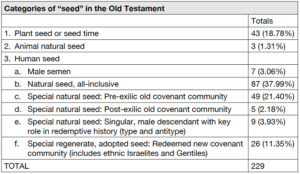
2. Discover the range of meaning for your Hebrew word (external data): Generate a list of texts from a Hebrew-based concordance, categorize the meanings, and catalog and asses the data. For my “seed” word study, I discerned eight separate meanings.


In my study, I noted a number of features like the following:

  • When “seed” refers to humans, some occurrences are not all-inclusive but restrictive, pertaining to a certain group of “offspring” within a greater unit. Hence, while Ishmael was Abraham’s “seed” (Gen 21:13), he was not among the “offspring” who would inherit the promised land (12:7; 17:20). Furthermore, a single, male “seed” of the woman and of Abraham would overcome Adam’s curse and bring blessing to the world (3:15; 22:17–18).
  • When “seed” refers to humans it almost always refers to natural children. Thus, Eliezer of Damascus was Abram’s heir but not his “seed” (Gen 15:2–3), whereas Moab and Bene-ammi were the biological “offspring” of Lot’s daughters (19:32, 34, 37–38). The only exception to human “seed” referring to physical descent comes in Old Testament promise texts that address the makeup of the new covenant community (e.g., Isa 53:10; 54:3; 59:21). 
  • The New Testament refers to Jesus as the “seed” of Abraham (Gal 3:16) and emphasizes that all who identify with him by faith equally become Abraham’s “offspring” and full heirs of the promises (3:29).

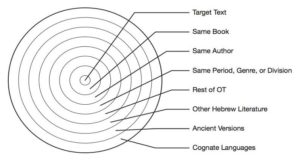
As a final step in your external assessment, it is normally good to expand your assessment to include the concept. As highlighted in “Principles for Doing Word and Concept Studies” above, there are different levels of correspondences or contexts that we need to keep in mind when doing word and concept studies. The chart below reflects these different levels.

As you move out from the center, you increase the number of possible contexts for your word. Because immediate context is always most determinative for meaning, a high number of examples toward the center may allow the busy teacher less of a need to extend the search outward. Nevertheless, a thorough study requires this, and the investment can be massively rewarding. 

3. Determine the meaning of your Hebrew word in the target text (internal data): Do this by asking questions like the following: What does the immediate literary context clarify about your word’s meaning? Does your author use the same term elsewhere in the book? Do other Old Testament authors appropriate the term in similar settings or when addressing similar issues? Does the New Testament quote or allude to your text in a clarifying way? Does your author use the word in a different manner from the way others do?

Once you decide on the meaning of the word in your passage, verify your decision against the most important lexicons and theological wordbooks. Remember: There is no substitute for performing your own word study before seeing what others have said. Only with your own research in hand will you be able to evaluate others’ claims and to evaluate your own decisions against theirs. 


4 Keys to Preaching from a Manuscript

I have long advocated for manuscript preaching, and while I do know it’s not for everyone, as one who switched to this practice about ten years ago after fifteen years of outline preaching, I think more preachers should give it a try. I’ve tried to make a case for the practice in my book Gospel-Driven Ministry, so I won’t rehearse that argument here. But if you are interested in trying this out, I do want to offer some advice for more successful delivery.

1. Differentiate your text for ease of reading.

Some preachers apply a color code for the different components of a sermon, and you may find that helpful. I just use regular black text, but I bold the preaching text, bold and underline my sermon points, and italicize illustrations and other Scripture references I’m bringing in to the exposition. The main portions of my manuscript, the exposition, are all just plain text. Occasionally I will use CAPS to emphasize certain words or sentences. This helps my brain cue up the shifts in emphasis and prepare for transitions to different elements of the sermon as I’m preaching. Your mileage may vary, but using some means of differentiating between sermon components can keep you from getting lost in your manuscript if you’re making good eye contact or preaching some portions from memory or otherwise extemporaneously. (And while I’m at it, make sure you use a good size font for ease of reading.)

2. Re-read and rehearse.

The reason most folks don’t preach from a manuscript is because they don’t want to feel too tethered to their script. They’re afraid the sermon delivery will feel too much like just reading a paper. The best way to avoid this is to become as familiar with your manuscript as possible. If you suspect this may be a problem for you, it’s probably not a great idea to be a late Saturday writer. Give yourself ample time to re-read the manuscript and maybe even to rehearse preaching from it to cultivate enough familiarity to add a natural delivery to the preaching event. Reviewing your manuscript well can also help you identify portions of your sermon that aren’t articulated very well or don’t translate well to oral delivery. And on that note:

3. Remember to write for speech.

The biggest issue I see with many beginning manuscript preachers is that they haven’t developed a good ear for the difference between writing a sermon and a theological article or expositional essay. They write like they’re writing a paper, and then the delivery sounds exactly like reading a paper! But manuscripting a sermon isn’t the same thing. We have to remember to write for speech, not for interior reading. This will affect word choice, certain modes of phrasing, and the like. Make sure you’re using words you can actually pronounce! Make sure you’re constructing sentences that aren’t overly long or complicated. Make sure you’re not writing in overly formal style. Write like you’d preach a sermon. People hear differently than they read, so we have to manuscript differently than we often write.

4. Don’t give up too soon.

As I said, manuscripting isn’t for everyone. But I suspect it’s for more folks than give it ample time to truly find out if it’s for them. A lot of beginning manuscript preachers give up on the practice too soon, before they get better at it. They do it a few times, get frustrated with how much they’re reading, how unnatural it might feel, how little eye contact they’re making, etc. — and then they give up. Like all new practices, manuscript preaching just takes a while to become more one’s own. And if you stick with it, you might discover, as I did, that manuscript preaching actually makes for a more polished, thoughtful, and excellent sermon.


When Prayer Makes Anxiety Worse

Do not be anxious about anything, but in everything by prayer and supplication with thanksgiving let your requests be made known to God. And the peace of God, which surpasses all understanding, will guard your hearts and your minds in Christ Jesus (Philippians 4:6-7).

Year after year, search data on major Bible websites show Philippians 4:6–7 to be one of the most popular passages in Scripture, and with good reason: it shows us God’s proven path from anxiety to peace.

Unfortunately, our desperate hearts easily get off-track seeking a remedy for our stress. We treat this precious passage as a talisman, missing the true meaning and path to peace. A recent situation of mine illustrates this.

As I thought through my stressful situation practically, my anxiety worsened. The same thing happened when I tried to fix my attention on something else—anxiety would boomerang back around in no time.

Then Philippians 4:6-7 came to mind. Prayer is the answer!

So I knelt down to pray.

My prayer started out fine, but soon I felt like I was trapped in a hot car, breathing the same air over and over again. Each line of my prayer gasped for breath and brought a deeper longing for fresh air. Prayer made my anxiety worse.

What happened? Was God’s promise in Philippians 4:6–7 a sham?

As I reflected on this troubling episode, I realized that God’s promise wasn’t a sham but rather I had it all wrong.

A pity party will not lead you to peace.

My anxiety-driven prayer didn’t make things better. That’s because God doesn’t promise any type of prayer to be the silver-bullet anxiety stopper. He prescribes supplication with thanksgiving (Philippians 4:6). A heart lacking gratitude will not encounter the peace of God.

I soon realized my lack. My lame attempts to thank God were not from the heart but were always preceded with a “but,” as if to say, “God, I thank you for this, but you owe me.” Sidestepping true thanksgiving leads to a cocktail of other sins, including self-centered grumbling, cynicism, coveting the situations of others, entitlement, and ultimately unbelief. These are all the opposite of thankfulness.

My self-centered pity party lamented my situation always instead of rejoicing in the Lord always (Philippians 4:4). We are to pray with thanksgiving “in everything” (Philippians 4:6). A thankful heart isn’t just a remedy for anxiety; it’s a part of a healthy spiritual diet for every circumstance (see 1 Thessalonians 5:16–18).

Meditating on your anxieties will not lead you to peace.

A second error of my prayer attempt was misplaced meditation. My prayers repeated the details of my anxious situation before the Lord, pouring gasoline on the fire of my anxiety.

What I was doing was leaning on my own understanding, which we’re taught not to do for a few reasons: first, it’s the opposite of trust in the Lord, and second, it presumes we have the ability to understand our situations—no matter how simple or complex they seem (Proverbs 3:5–6).

The only way to douse the fires of anxiety is to thankfully set our minds on the good stuff of Philippians 4:8 (“whatever is true, whatever is honorable, whatever is just, whatever is pure, whatever is lovely, whatever is commendable, if there is any excellence, if there is anything worthy of praise, think about these things”).

Setting our minds on these things isn’t a one-time action since the fires of anxiety can quickly returnit is a continual mediation.

Paul offers another place to set your mind: his example.

What you have learned and received and heard and seen in me—practice these things, and the God of peace will be with you (Philippians 4:9).

Paul had reason for anxiety; he wrote Philippians and several other of his epistles from prison. But Paul’s approach to combatting anxiety not only adopted God’s perspective but it also was fueled by His power. He could learn contentment in hunger, abundance, or need:

I can do all things through Him who strengthens me (Philippians 4:13).

It’s not just Paul we can learn from. We have a great cloud of witnesses in the Scriptures (Hebrews 11), the examples of faithful men and women from church history, and believers in our churches today who model lives of peace through tribulation.

Following these examples will help you battle.

Peace at all times?

We’re not promised a problem-free life; if anything, the opposite. What sets the Christian life apart is that while we are promised trouble, our Savior has overcome our problems because He has overcome the world (John 16:33).

Even when our understanding of the circumstances go from bad to unimaginably worse like it did for Habakkuk, our peace and joy can rest not in our circumstances themselves, but in our faithful Father who judges evil and saves His people and is sovereign over our circumstances (Habakkuk 3:17–19).

Our anxieties may flow from petty situations, serious ones, or somewhere in between, but we can always be confident of His faithful, comforting presence (Psalm 23:4, Matthew 20:20).

The Way of Peace

As I reflected on my postmortem analysis of my anxious episode, I became less confident in my power to manufacture peace myself and more confident in God’s ability to provide it in the bleakest of circumstances.

What makes His peace special isn’t that a simple prayer zaps all our problems immediately; it is that we can know the One who transcends it all, and we can call Him our sovereign and loving Father. We can trust that He often allows life’s situations to draw us to Himself and grow us more like Christ.

Our emotions are not slaves to our circumstances, rather Christ set them free to enjoy heavenly peace and joy now no matter what. This is peace the world longs for, peace God longs to give, and peace that is ours in Christ.