

How to Understand and Apply the Old Testament: Step 10––Biblical Theology

Text (Genre, Literary units and text hierarchy, Text-criticism)
Observation (Clause and text grammar, Argument-tracing, Word and concept studies)
Context (Historical and Literary context)
Meaning (Biblical and Systematic theology)
Application (Practical theology)

Once you have established your text, made accurate observations, and discerned your passage’s contexts, it is time to determine your text’s meaning. To do this, it is critical to understand biblical theology, the discipline that considers how the whole Bible progresses, integrates, and climaxes in Jesus. Here you ask, “How does my passage connect to the Bible’s overall storyline and point to Christ?”

Four Guiding Presuppositions

The discipline of biblical theology assumes at least four key principles about the Bible:

1. The Bible is the locus of God’s special revelation.

Every line, word, phrase, clause, and paragraph in Scripture is God’s word. No other book is like the Bible, for it alone is God’s special revelation. Therefore, biblical theology is a textual discipline, such that the author’s intent guides the connections we make both backward and forward within every text. Historical context informs and supports the study but never trumps it.

2. The Bible demands that we submit to it and engage it in constructive ways.

We must see God’s word in its final canonical form as our primary and decisive authority in all matters of faith and practice. Furthermore, our interpretation should never deconstruct the biblical text, misinterpret the text, contradict the biblical author’s intentions, or fail to evaluate fairly the claims of the text in accordance with its nature.

3. The Bible is prescriptive.

Because the Bible is God’s word, it has the authority to prescribe a certain lifestyle and worldview for its readers and to confront alternatives. God’s purpose in having us grasp his purposes in salvation history is to move us to worship and surrender to the living God through Christ.

4. The Bible expresses a coherent, unified theology.

God is the ultimate author of Scripture, and he is the ultimate unified and coherent thinker. Thus, we must push to grasp the unified theology of the whole Bible. Every passage contributes in some way to the whole.

Definition and Nature of Biblical Theology

 The whole Bible progresses, integrates, and climaxes in Christ, and every passage contributes in some way to Scripture’s message that God reigns, saves, and satisfies through covenant for his glory in Jesus. Central to determining a passage’s meaning is not only considering what it proclaims but how this message relates to and informs the greater message of Scripture culminating in Christ.

Biblical theology is a way of analyzing and synthesizing what the Bible reveals about God and his relations with the world that makes organic salvation-historical and literary-canonical connections with the whole of Scripture on its own terms, especially with respect to how the Old and New Testaments progress, integrate, and climax in Christ. Let me unpack this extended definition under six headings.

  1. The Task, Part 1: Biblical theology analyzes and synthesizes what the Old and New Testaments reveal about God and his relations with the world.

Biblical theology seeks to interpret the final form of the Christian Bible––to analyze and synthesize God’s special revelation embodied in the Old and New Testaments. That God’s special revelation comes through Old and New Testaments highlights both Scripture’s unity and diversity. The one Bible has two necessary parts, each of which we must read in view of the other. The Old Testament provides foundation for what Jesus fulfills in the New Testament.

  1. The Task, Part 2: Biblical theology makes organic connections with the whole of Scripture on its own terms.

Biblical theology is about making natural, unforced connections within Scripture. In the process, it recognizes growth or progress in a thought or concept and lets the Bible speak in accordance with its own contours, structures, language, and flow.

  1. Salvation-Historical Connections: Biblical theology makes salvation-historical connections with the whole of Scripture on its own terms.

Salvation history is the progressive narrative unfolding of God’s kingdom plan through the various covenants, events, people, and institutions, all climaxing in the person and work of Jesus. Redemptive history moves from creation to the fall to redemption to consummation. It’s the true story of God’s purposes climaxing in Christ that frames all of Scripture from Genesis to Revelation. One way to summarize his-story is through the acronym KINGDOM, as represented in the following chart:
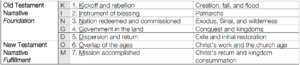
Scripture declares the story of God’s glory in Christ. Within this framework, we can make salvation-historical connections in at least five different ways:

  • Thematic developments: We can trace a theme through the story of salvation, noting how it culminates in Christ. Some of the main themes are kingdom, law, temple, people of God, exile and exodus, atonement, holiness, and missions.
  • Covenantal continuity and discontinuity: We should consider how the progress of the biblical covenants maintains, transforms, alters, or escalates various elements in God’s relations with his people and the world.
  • Type and anti-type: Both Old and New Testament authors regularly identify predictive thematic anticipations or types rooted in the progressive development of Scripture’s historical record (e.g., Rom. 5:14; 1 Cor. 10:6, 11; Col. 2:16–17). By God’s design, specific persons (e.g., Adam, Moses), events (e.g., creation, exodus), and institutions (e.g., temple, sacrifice) establish patterns that culminate in the life and work of Christ Jesus. These types are prophetic and prospective from their inception, even when interpreters only discover them retrospectively.
  • Promise and fulfillment: We must track specific promises and then identify their partial, progressive, and/or ultimate fulfillment at various stages in salvation history, ever remembering Paul’s declaration that “all the promises of God find their Yes in [Christ]” (2 Cor. 1:20). An example here would be how Micah 5:2 declares that the royal deliver would rise out of Bethlehem, and Matthew declares this fulfilled (Matt. 2:5–6).
  • Use of the Old Testament in the Old and New Testaments: Here, we assess how later biblical writers interpret and/or apply earlier canonical revelation, especially with a view to understanding Christ Jesus.

  1. Literary-Canonical Connections: Biblical theology makes organize literary-canonical connections with the whole of Scripture on its own terms.

Biblical theology arises out of the narrative framework of salvation history, but we cannot restrict the discipline to redemptive historical connections because the Bible includes more than the story of God’s glory in Christ. As seen below, Scripture includes groupings of narrative books that frame commentary books. We must consider every passage in light of its placement and role within the canon as a whole, which contains two Testaments, each with corresponding narrative and commentary sections and each with a potentially-corresponding three-part structure. The chart arranges the Old Testament in alignment with the order in Jesus’s Bible (see Luke 24:44) and the New Testament in accordance with the earliest canonical evidence.

Along with final-form composition and structure, literary-canonical connections include the historical details that tie the canon together. Here I refer to information regarding authorship, date, or provenance of a given passage. Where God reveals such information, it is fair and appropriate to use it to consider how books or passages that are united historically address various themes or contribute to our knowledge of a given topic. Because Moses was the substantial author of both Exodus and Leviticus, we can use each book as an interpretive lens for the other. Because Samuel–Kings and Chronicles address similar time-periods from different perspectives, we can compare the two to help clarify the distinctive theology of each corpus.

Finally, literary-canonical connections also include accounting for our passage’s biblical corpus or genre. Studying the teaching in Ecclesiastes should naturally be related to that of Proverbs not only because Solomon is likely the same author but also because both are wisdom books. Similarly, one should interpret Zephaniah in view of its placement in and contribution to both the Book of the Twelve and the Latter Prophets as a whole.

  1. Relationship of the Testaments: Biblical theology wrestles with how the Old and New Testaments progress and integrate.

The relationship of the Testaments is perhaps the biggest question faced in biblical theology. Scripture was not shaped in a day. God produced it over time, progressively disclosing his kingdom purposes climaxing in Christ and pointing ultimately to the consummation. Biblical theology gives significant effort to tracking this progression and to considering how the various covenants and Testaments integrate in God’s overarching kingdom plan.

  1. The Centrality of Christ: Biblical theology wrestles with how the Old and New Testaments climax in Christ.

The ultimate end of biblical theology is Jesus. The salvation history that frames Scripture all points and progresses to Christ, and all fulfillment flows from and through him. All laws, history, laws, prophecy, and promises find their end-times realization in Jesus (Matt 5:17–18; Mark 1:15; Acts 3:18; 2 Cor. 1:20). Therefore, we can rightly assert that the Old Testament is a messianic document written to instill messianic hope (see Rom. 1:1–3; 3:21; 10:4). Indeed, the apostles recognized that Yahweh foretold by the mouth of all the prophets from Moses forward the tribulation and triumph of the Christ and the subsequent glories (Acts 3:18, 24; 10:43; 1 Peter 1:10–11), and God revealed to those prophets that “they were serving not themselves but you” when they wrote their words (1 Peter 1:12). If we fail to appreciate that the Old Testament is Christian Scripture, we do not approach it like Jesus and his apostles, and we have no basis to call our interpretation “Christian.” 

The Bible’s Frame, Form, Focus, and Fulcrum

Thus far, we have learned something about what the Bible is about, how it is transmitted, why it was given, and around whom it is centered. That is, the Bible has a frame, a form, a focus, and a fulcrum.

  1. The Frame = The Content: What?

The Bible is the revelation of God, who reigns over all and who saves and satisfies all who look to him. In short, Scripture is about his kingdom and how he builds it through covenant for his glory in Christ. We could say that Scripture’s content relates to God’s reign over God’s people in God’s land for God’s glory (Luke 4:43; Acts 1:3; 20:25; 28:23, 31).

  1. The Form = The Means: How?

Throughout salvation history, God has maintained his relationship with the world through a series of covenants. The most dominant of these are the Mosaic (old) covenant and the new covenant in Christ. The old covenant bore a ministry of condemnation and brought forth an age of death; the new covenant bore a ministry of righteousness and brought with it life (2 Cor. 3:9). Moses recognized Israel’s stubbornness and predicted the old covenant’s failure (Deut. 9:6–7; 31:16–18, 27–29). But he also envisioned that God would mercifully overcome the curse with restoration blessing (4:30–31) in what we now know as the new covenant (Jer. 31:31). A prophetic, new covenant mediator would facilitate this era of blessing (Deut. 18:15), which would include God’s transforming the hearts of covenant members in a way that would generate love and obedience (30:6, 8–14). God would curse all his enemies (30:7) and broaden the makeup of his people to include some from the nations (32:21, 43; cf. Gen. 17:4–5). Christ is the mediator of the new covenant (Gen. 22:17–18; 1 Tim. 2:5; Heb. 9:15; 12:24), which has superseded the old (Gal. 3:24–25; Rom. 10:4), made every promise “Yes” (2 Cor. 1:20), and secured for us every spiritual blessing (Eph. 1:3) and “an inheritance that is imperishable, undefiled, and unfading” (1 Peter 1:4).

  1. The Focus = The Purpose: Why?

The chief goal of all God’s actions is the preservation and display of his glory, and it is to this end that all Scripture points. Because all things are from him, through him, and to him, God’s glory is exalted over all things (Rom. 11:36) and should be the goal of our lives (1 Cor. 10:31).

  1. The Fulcrum = Sphere: Whom?

Jesus Christ is the one to whom all salvation history points, and the one who fulfills all the Old Testament anticipates. The entire Bible centers on this promised messianic Deliverer who secures reconciliation with God for all who believe in him as the divine, crucified, resurrected Messiah. His ministry produces a universal call to repentance and whole-life surrender to him as King.

We can synthesis Scripture’s as God reigns, saves, and satisfies through covenant for his glory in Christ. Put another way, the Bible calls Jews and Gentiles alike to magnify God as the supreme Sovereign, Savior, and Satisfier of the world through Messiah Jesus. The Old Testament provides the foundation for this message; the New Testament fulfills all Old Testament hopes.[1] 

Conclusion

Scripture is self-interpreting, for the God who never changes is the author of it all. To determine the full meaning of a passage, we must always ponder how your passage contributes and relates to the rest of Scripture culminating in Christ. The whole Bible progresses, integrates, and climaxes in Jesus, so we must consider how every passage in the Old Testament relates to this overarching flow and message.

[1]  For two examples of biblical theology at work, see Jason S. DeRouchie, “Why the Third Day?: The Promise of Resurrection in All of Scripture,” Desiring God, 11 June 2019, https://www.desiringgod.org/articles/why-the-third-day; Jason S. DeRouchie, “God Always Wanted the Whole World: Global Mission from Genesis to Revelation,” Desiring God, 5 December 2019, https://www.desiringgod.org/articles/god-always-wanted-the-whole-world.


How Dangerous Hermeneutics Can Inform False Teachers

One sign of a false prophet is when a religious leader invents novel and fanciful interpretations of Scripture, interpretations completely divorced from the original context. Religious charlatans usually engage in such hermeneutical gymnastics in order to bolster their own power. An example of such scripture-twisting is seen in LDS Church’s slanted take on Isaiah 29:11 – 12, a passage they improperly handle in an attempt to bolster the authenticity of both Joseph Smith and the Book of Mormon. 

To understand why the LDS Church is wrong about Isaiah 29:11 – 12, we first must examine what the passage does mean. In a discussion about theological and ethical error, Isaiah stresses that sin leads to spiritual dullness. When sin takes control, it deadens our ability to think correctly about God and how we should live.  Sin cauterizes the conscience and disables it from working properly. Subsequently, it becomes unusually difficult to understand God’s word or what God would have us to do. That’s the point of Isaiah 29:11 – 12:

The entire vision will be to you like the words of a sealed book, which when they give it to the one who is literate, saying, “Please read this,” he will say, “I cannot, for it is sealed.” Then the book will be given to the one who is illiterate, saying, “Please read this.” And he will say, “I cannot read.”

Because sin dulls the conscience, Isaiah 29:11 – 12 describes a sort of self-inflicted spiritual illiteracy that ensues. People are given God’s word, but they can’t understand it because sin has negatively affected the intellect. In Isaiah 6:9 – 10, God had already warned Isaiah of such a response to his preaching. Isaiah 29:11 – 12 gives forceful and cautionary advice that sin inhibits our ability to think rightly about God and ethics. 

The Book of Mormon is a work of fiction invented from Joseph Smith’s furtive imagination. Smith claimed the Book of Mormon was translated from golden plates buried in upstate New York, an ancient record of a Jewish-Christian civilization which once thrived in the Western Hemisphere prior to European contact. To make his story sound more exotic, Smith claimed the account on the golden plates was written in “reformed Egyptian.” When the Book of Mormon was completed, Smith conveniently claimed to have returned the golden plates to an angelic being. 

A rational question is, “What is reformed Egyptian?” Martin Harris, one of Smith’s scribes and a financial backer, asked the same thing. Though Harris was one of the “three witnesses” to the Book of Mormon, Smith never actually showed Harris the ancient writing he was purportedly translating. Usually, Smith translated by placing a “seer stone” in a hat and then burying his face in the hat and repeating out loud to an amanuensis what God was supposedly telling him. 

Harris was eager for proof Smith was a true prophet, so he asked Smith to reproduce the “reformed Egyptian.” One is left to wonder why Harris could be a witness to the Book of Mormon, and yet not be allowed to look upon the pages. Nonetheless, Smith scribbled out some “reformed Egyptian” characters on a piece of paper. In February 1828, Harris took the sheet of paper containing Smith’s reproduction of the mysterious alphabet to Charles Anthon, a professor of classical literature at Columbia University.  Harris, for some reason, left the meeting thinking to himself, “Joseph Smith is a true prophet!” Meanwhile, Charles Anthon spent the rest of his life saying, “I claimed no such thing!” When Anthon recounted the meeting, he said he tried to warn Harris that he was being tricked by Smith.   

But Martin Harris claimed Anthon’s initial response to the list of characters from Smith was positive, with Harris insisting that Charles Anthon wrote out a brief note affirming the authenticity of the characters and their translation. But, according to Harris, when Anthon asked where Smith got the plates and was told they came from an angel, Anthon ripped up his endorsement and then purportedly told Harris something to the effect, “Bring me the plates and I’ll translate them myself.” Harris responded he could not bring them because they were “sealed.” To which Anthon rejoined, “I cannot read a sealed book.”

What do gullible Martin Harris, the deceptive Joseph Smith, and the frustrated Professor Anthon have to do with Isaiah 29:11 – 12? Joseph Smith seized on Anthon’s purported comment about being unable to read a “sealed” book, and using some fast and loose word association, claimed the entire event was a fulfillment of Isaiah 29:11 – 12, and LDS interpreters to this day insist this prophecy was fulfilled in the Harris / Anthon incident. The claim is that Anthon is the “literate” or educated person in Isaiah 29:11 who can’t read a sealed book. In other words, Anthon couldn’t understand the characters Smith had scrawled out. Then, LDS teachers claim Joseph Smith is the “illiterate” or uneducated person mentioned in Isaiah 29:12 to whom the book is given and who is apparently blessed by God. 

Isaiah 29:11 – 12 cannot mean what the LDS church claims. The point of these verses is not that the literate man cannot read the book while the illiterate man can read it. The point of Isaiah 29:11 – 12 is that no one can read what Isaiah is discussing! No matter to whom you take the book, it is unreadable. Like men running around with a book they could not read, Israel would have God’s words but not understand them. Why? Because their own sin had blunted their ability to grasp the meaning. 

The Community of Christ, a smaller LDS group, owns a sheet of paper they think contains copies of the characters Joseph Smith gave to Martin Harris. Now known as the “Anthon Manuscript,” the artifact was passed down to the Community of Christ by David Whitmer, another witness to the Book of Mormon and a very important person in the early history of the LDS Church. Though some scholars think the Anthon Manuscript may not be the exact document Harris took to Anthon, by any standard, it contains several lines of nonsense; the characters Smith scrawled out are so fanciful that calling them gibberish would be a complement. There is no such thing as reformed Egyptian. It is just one more part of Joseph Smith’s religious scam.  

False teachers abuse God’s word to build their own kingdom, not Christ’s church. A sure sign of trouble is when a preacher abandons careful handling of the text and fails to determine what a passage meant to the original audience. A time-tested rule of biblical interpretation is this: The text can’t mean now what it didn’t mean then. Isaiah 29:11 – 12 was not referring to nonsense like “reformed Egyptian” when Isaiah wrote it and it’s not referring to Joseph Smith today. 


Who are the “Sons of God” in Genesis 6?

In Genesis 6 Moses paints a picture of the human race falling into sin to such a significant degree that God is said to have “regretted” making mankind (Gen 6:6). The depths of sin that God witnessed among those who were created to bear his image (Gen 1:26–27) had “grieved him to his heart” (6:6). This picture of the sinfulness of mankind sets the stage for one of the most well-known stories in the Bible: the flood narrative.

As with most biblical stories, however, the various details are often debated. The particular debate I’m interested in here is concerned with how we identify the “sons of God” in Genesis 6.

Here is the passage:

When man began to multiply on the face of the land and daughters were born to them, the sons of God saw that the daughters of man were attractive. And they took as their wives any they chose. Then the Lord said, “My Spirit shall not abide in man forever, for he is flesh: his days shall be 120 years.” The Nephilim were on the earth in those days, and also afterward, when the sons of God came in to the daughters of man and they bore children to them. These were the mighty men who were of old, the men of renown. (Gen 6:1–4).

In this text Moses describes the multiplication of mankind on the face of the earth. This, after all, was the imperative given to Adam and Eve (cf. Gen 1:28). As humanity increases, there is a strange story of “sons of God” being attracted to the “daughters of man” (6:2). The situation (“sons of God” finding the women “attractive”) results in marriages (“they took as their wives”). But the question is, who are the “sons of God” that find these women “attractive” and then marry them?

There have been several answers provided in the history of interpretation. The two answers that I’m most interested in are the (a) Sethite view and (b) the Fallen Angels view.

The Sethite view understands the “sons of God” to be the descendants of Seth. The women (i.e. “daughters of man”) were not women in general but the offspring of Cain. The overarching point, then, is that the line of Seth is intermarrying with the line of Cain, the murderer of Abel. This, it is argued, helps explain the downfall of the human race into such degrees of sin that God is grieved and eventually unleashes the rains of judgment.

Another view understands the “sons of God” as angelic beings that have become sexually involved with women. These fallen angels are perhaps who Peter and Jude have in mind in various places (cf. 1 Pet 3:18–22; 2 Pet 2:4–10; Jude 5–7). Again, the overarching story aims to show the depth of sin that the human race had fallen into. Here, fallen angels, like their father the Devil before them (cf. Gen 3:1-7), helped lead all of mankind away from their Lord.

Admittedly, this position is not without problems and there are reputable biblical interpreters who take a different view (e.g. John Calvin). However, there are a number of persuasive arguments in favor of the fallen angel view:

  1. Though not determinative, this view seems to be the majority view of Christian history.
  2. Second Temple Judaism writers understood the passage as referring to angels.
  3. “Sons of God” is used to reference angelic beings in other parts of the Bible (Job 1:6; 2:1; 38:7).
  4. The specific phrase “sons of God” is not employed to reference God’s people in the Bible, though God’s people are called God’s sons in various places (e.g. Jer 3:19).
  5. Angelic beings are perhaps in view in Gen 6 according to NT passages (cf. 1 Pet 3:18–22; 2 Pet 2:4–10; Jude 5–7).
  6. In this view, the use of “man” (אָדָם) is employed consistently to reference the totality of mankind.

In my view, the fallen angel position makes the most sense of the flow of the narrative and the grammar of the text. It is the grammar of the text that has caught my eye most recently and is one reason I hesitate to take the Sethite view. Namely, Moses references “man” or “humankind” (אָדָם) eight different times in 6:1–7. The usage consistently aims to describe the entire human race, not one narrow slice of humanity.

Now, why does this present a problem for the Sethite view? Those who understand the “sons of God” to be descendants of Seth believe these men are marrying women who are in the line of Cain (“daughters of man”). Moses, according to this view, is showing what happens when the line of promise mixes with Cain’s line. Furthermore, this view means the usage of אָדָם in 6:2 and 6:4 is not a reference to all of humanity but narrows in on the line of Cain only.

Again, why is that a problem? I believe one reason this is a problematic reading is because Moses consistently used אָדָם (“man”) to refer to universal humanity in Genesis 6. His point is to show the universality of sin and therefore help readers make sense of the universal judgment of God that comes via the flood. To see, then, the use of אָדָם (“man”) in this flow of thought as limited to one slice of humanity (i.e., the descendants of Cain) would introduce an idea that seems out of place. It would require us to read the text this way: 

When [all of humanity] began to multiply on the face of the land and daughters were born to them, 2 the sons of God saw that the [daughters of Cain] were attractive. And they took as their wives any [of the daughters of Cain] they chose. 3 Then the Lord said, “My Spirit shall not abide in [all of humanity] forever, for he is flesh: his days shall be 120 years.” 4 The Nephilim were on the earth in those days, and also afterward, when the sons of God came in to the [daughters of Cain] and they bore children to them. These were the mighty men who were of old, the men of renown. The Lord saw that the wickedness of [all of humanity] was great in the earth, and that every intention of the thoughts of his heart was only evil continually. 6 And the Lord regretted that he had made [all of humanity] on the earth, and it grieved him to his heart. 7 So the Lord said, “I will blot out [all of humanity] whom I have created from the face of the land, [all of humanity] and animals and creeping things and birds of the heavens, for I am sorry that I have made them.” (Gen 6:1–8).

Perhaps Moses is trying to show his readers that the intermarrying of the descendants of Seth and Cain led to a spiral downwards into such levels of sin that warranted the flood of God’s judgement. Yet, what clues would cause us to read אָדָם as narrowing in on the line of Cain when the passage consistently uses אָדָם to paint a picture of universal humanity? And universal human sin is the particular problem Moses is highlighting and the coming flood will deal with. It seems we would need more, or at least clearer, grammatical warrant to adopt a reading that understands two uses of אָדָם (“man”) in the middle of a narrative (6:2, 4) to move from universal (mankind) to a more narrow referent (line of Cain). Despite the biblical-theological reading that argues for the Sethite view, as theologically interesting as that reading may be, we must not jettison commitment to the grammar of a text.

Instead, it seems to me the best reading sees every use of אָדָם (“man”) as a reference to the totality of humankind. Thus, all the families of the earth are multiplying. The “sons of God” found women attractive and married them. These demonic forces (fallen angels) are involved in leading the totality of humanity away from God, just as the Serpent had led Adam and Eve to rebel. The whole human race has spiraled downward. Sin abounds. God is grieved. Judgment is coming. And it is coming to every slice of the human race for all have sinned (cf. Gen 6:7; Rom 3:23). Only God’s mercy allows Noah to escape via the ark he is commanded to prepare.

Admittedly, these questions are complex and the Sethite view is a plausible (and faithful) reading of the Genesis account. In the end, whether you see “sons of God” as descendants of Seth, fallen angels, or you take some other view, the overall point seems clear. Southern Seminary professor, Dr. Bill Cook, states the matter succinctly:

Of course, I may be wrong, and the Sethite interpretation may be correct after all. I certainly grant that the ancient view seems strange to our modern ears. But since Peter and Jude both appear to have held it, it seems to me the best interpretation of Genesis 6:1–4. Regardless of which interpretation is correct, though, the main point is plain: humanity was falling deeper and deeper into sin and running farther and farther away from God.

In light of the pervasiveness of human sin, the text sends us to our knees. We all, like mankind before us, have turned aside and gone our own way (Rom 3:12, 23). Therefore, we are humbled to the dust. 

And yet, Genesis 6 reminds us that though sin abounds, the grace of God abounds all the more. Noah builds an ark that saves all who take refuge within. Thousands of years later, God provides another ark of salvation. That latter ark is not a boat made of wood but a person who carries a wooden cross and dies a substitutionary-atoning death for all those who would turn from sin and trust in him. Thus, like those who found refuge in Noah’s ark and were saved from the waters of judgment, those who come to Jesus are brought through the waters of judgment and saved from wrath of God (cf. 1 Pet 3:18–22). 


A Gospel for the Broken

In the past week, I’ve walked with a friend through a miscarriage, listened to a heroin addict explain that he shoots up because his brother was shot in front of him, and sat with a friend confessing sin and sharing how the consequences will affect their life.

Though I’ve not experienced their specific pain, I also feel the brokenness of the world in my bones. The aches in my heart and body remind me that not all is as it should be in this world. Every broken promise and early goodbye leave another scar, another fear to fight.

The world handles this brokenness in a number of ways: denial, self-help, seeking anything to fill the void or heal the wounds. It’s taken me almost a decade of being a Christian to realize that just because I am a believer doesn’t make me immune to doing these same things with more spiritual language.

For example, being so focused on dwelling with Jesus in heaven that I do not share Jesus with this suffering world. Covering guilt and shame with my attempt at good works rather than looking to the finished work of Christ on the cross. Pretending pain isn’t real instead of embracing what it means to be “sorrowful, yet always rejoicing.”

After four years of walking through a hard season, I’ve discovered the emptiness of my pursuits. My best intentions and “solutions” to brokenness in and around me don’t work. But reading the pages of Scripture has given me a better word:

You can love Jesus with your whole heart and still be sad.
You can love Jesus with your whole heart and still lose people and things you love.
You can love Jesus with your whole heart and still make mistakes.
You can love Jesus with your whole heart and still suffer.
You can love Jesus with your whole heart, and it can still be broken. You can still be broken.

But here is the beautiful thing: Jesus died for the broken. He says, “Come to me, all who labor and are heavy laden, and I will give you rest. Take my yoke upon you, and learn from me, for I am gentle and lowly in heart, and you will find rest for your souls” (Matt. 11:28-29). The pain I see in the eyes of those around me is not unseen by Jesus. The same can be said of the aches and scars you carry.

Not one moment in our lives—not one decision, mistake, change, or loss—happens apart from God’s intention. As difficult as this may be to believe when faced with evil or hardship, we need only look to the gospel to know it is true.

When Jesus died, he was a 33-year-old single man who “had no form or majesty that we should look at him, and no beauty that we should desire him” (Isaiah 53:2b). He was despised, rejected, and mocked. His formal ministry started at 30 and took place over 3 years before ending with him being led like a lamb to slaughter. No worldly eyes would look upon such a life as “successful.” How would we treat such a man if he showed up on a seminary campus?

Yet this is the Lamb of God who takes away the sins of the world. And this was God’s plan all along, prophesied in Isaiah 53:10:

Yet it was the will of the Lord to crush him;
he has put him to grief;
when his soul makes an offering for guilt,
he shall see his offspring; he shall prolong his days.
the will of the Lord shall prosper in his hand.

The worst moment in all of history was ordained by God as part of his plan of redemption. This should be comforting to us as we walk through the worst moments of our lives.

God’s Word says, “This light momentary affliction is preparing for us an eternal weight of glory beyond all comparison, as we look not to the things that are seen but to the things that are unseen. For the things that are seen are transient, but the things that are unseen are eternal” (2 Corinthians 4:17-18). Jesus was displayed on the cross—an instrument of torture, shame, and death—only for a moment, but he will reign on his throne in glory for all eternity.

Believer, God’s plan for your life is better than anything you could have expected because what is broken will not only be restored but redeemed. No matter what you lose in this life, if you have Christ, you have gained all. Take heart: we can acknowledge the sadness of the world without forsaking the beauty of the gospel because ours is a gospel for the broken.


Serve the Lord with Gladness

It was late. My car was quiet. My children had fallen asleep on the drive home from church. Wednesday night church. But it could have been any night; we were there any time the doors were open. I was driving around aimlessly, praying, crying– discouraged. Years later, I can’t even remember what made me so upset other than that I was exhausted. Exhausted from serving. Exhausted from wondering when it was my turn to be served. Honestly? I was ready to quit. 

As I drove around my neighborhood, my car lights hit a church sign with the exact words I needed: “Serve the Lord with gladness.” I read the sign, cried some more, and drove home with a new attitude. My motivation in serving was wrong. In my mind, the people around me were the problem, but in reality, it was my heart. I was working hard but not with gladness, and I hadn’t been glad in a while. My pride was evident; my boundaries were non-existent. I needed to find the right motivation in my service to the church if I was going to continue without burning out.  

The scripture from the church sign had come from Psalm 100: “Make a joyful noise to the Lord, all the earth! Serve the Lord with gladness! Come into his presence with singing! Know that the Lord, he is God! It is he who made us, and we are his; we are his people, and the sheep of his pasture” (‭‭Psalm‬ ‭100:1-3). 

Anyone who knows me knows I am obsessed with Psalm-singing. I sang this Psalm many times without applying the truths from it. Psalm 100 gives us guidance not only in our attitude when we walk into corporate worship each Sunday but into our service to the church as a whole. Because the Lord God made us we should serve him– and not merely out of obligation but out of love and devotion because we are his people who he has chosen!

As the Psalm reminds us, he guides and protects us as a gentle shepherd. Jesus has laid down his very life for us, his sheep. When we look to Jesus we see the standard for both service and humility. When we compare ourselves to others instead of Christ we are quick to think more highly of ourselves than we ought. If Jesus is our standard then we will be much more likely to live a life of loving, joy-filled, self-sacrifice.

Our ambition is to be pleasing to the one we are ultimately serving, King Jesus. Why are you scrubbing toilets? Or painting on a church work day? Why choose to teach Sunday school, preach the Word, or play guitar? It should be an easy answer. To please King Jesus. Everything we do in our service to the local church must be for King Jesus which is impossible when we are prideful. 

Having the right motivation changes our attitude when we aren’t feeling glad about serving. We will be cheerful in even the most mundane tasks when we remember who we are ultimately serving. When we lack joy in service we should check ourselves. Are we truly aiming to please Jesus? Are we thinking more highly of ourselves than we ought? Are we letting comparison kill our joy? Are our desires aligned with the desires of Jesus?

Having the right motivation changes our attitude about results. We no longer need the validation of numerical growth and visible fruit when our aim is simply pleasing King Jesus. Seeing the fruits of your labor can be so encouraging, but a lack of fruit is not necessarily evidence of failure in ministry if your ambition is faithfulness to Jesus. 

Having the right motivation changes our attitude when we are criticized. We no longer need the validation of people when we can be confident we are being obedient to King Jesus. Criticism can be constructive and expose blind spots. We should be open to feedback and consider if that criticism holds truth instead, we often let negative feedback take hold of us, and let it take our eyes away from pleasing Christ. If criticism triggers a feeling of under-appreciation, that’s pride sneaking into your heart. Perhaps criticism makes you decide to quit serving? Pride again. 

Having the right motivation encourages healthy boundaries. We no longer need to say yes to everything because we know Jesus himself rested— and he’s the servant we model ourselves after. We also don’t avoid doing less desirable acts of service because we know Jesus took the form of a servant and washed feet. Whether you’re the type of person who says yes to everything, the kind who avoids serving in less desirable ways, or if you just don’t know where to serve, our goal is the same: aim to please King Jesus. 

There have been plenty of days since that late Wednesday night drive where I’ve had to remind myself of my ambition and refocus back on Christ. Whether you struggle with burnout, criticism, or laziness in your service to the church we all need to get our motivation right in order to work heartily for the Lord and not men. We can rest in the finished work of Christ and work hard until he returns. 


Acts: The Christian Standard Commentary: An Interview with Patrick Schreiner

Patrick Schreiner serves as Associate Professor of New Testament and Biblical Studies at Midwestern Seminary. His latest publication, Acts: The Christian Standard Commentary, focuses on the theological and exegetical concerns of the book of Acts. Throughout the commentary, Schreiner gives careful attention to both the scholarly information and practical applications of this New Testament book.

Of this new commentary, Joseph R. Dodson, Associate Professor of New Testament at Denver Seminary, said, “As one who has taught courses in Acts, I have lost count as to how many commentaries I have read on the book. Nevertheless, having read this one, I can honestly say that I have a new favorite.”

Alan J. Thompson, Head of the New Testament team at Sydney Missionary and Bible College, also said, “Readers will have their imaginations stirred and their hearts encouraged as they journey with Dr. Schreiner through Luke’s ever-relevant account of the triune God’s saving purposes in the spread of the word to Israel and the nations.”

In a recent interview, Schreiner answered a few questions about his latest publication and the importance of the book of Acts.

BF: What was your approach in writing this commentary on Acts?

PS: There are a lot of good commentaries on Acts so I had to think of how I could make mine unique. Thankfully the series this book is a part of (Christian Standard Series) is concerned with theology and the great tradition. So in my introduction I give my method which includes the following:

First, it is a theological reading. Modern biblical commentaries tend to be primarily concerned with the “natural history” of the biblical text: authorship, history, reception. But these questions do not always address how the text is the word of God for today.

Second, it is a narratival reading. Luke wrote a narrative (diēgēsis) of Jesus and the early church. We must pay close attention to the structure, speeches, and the way Luke decides to frame his story. Luke writes an orderly sequence for Theophilus – one that is carefully structured and put together and communicates a message through form and style.

Third, it is a canonical reading. The narrative of Luke does not begin in Acts 1 nor even Luke 1, but spans from Genesis 1 to Revelation 22.

Fourth, it is a historical reading. Luke writes about events eyewitnesses handed down to him and he carefully investigated his sources to come to an accurate understanding of the proceedings.

Fifth, it is a creedal and ecclesial reading. The rule of faith was my compass in the readings of Acts. My aim will not be to push the boundaries of the doctrine of the early church, but to read within them. Doctrinal boundaries do more to enlighten a reading than diminish them. Ultimately, my reading was ecclesial. Acts lays out the story of the early church to encourage the church.

This isn’t your first publication on the book of Acts. What has been most enriching about the time you’ve spent studying this New Testament book?

I loved studying Acts for multiple years. I was encouraged to be reminded that the mission of God will be accomplished despite human failings. It is so evident in Acts that people don’t have it figured out, but God has a plan. I also appreciated seeing how integral Acts is to the New Testament. It stands as a hinge between the life of Jesus in the Gospels and the Epistles. In one way, it continues the story of Jesus, in another way it introduces us to the story of the church. My book on the theology of Acts is basically a summary of my theology of Acts, but the commentary is where you get the text-by-text exegesis.

How would you summarize the theology of the book of Acts?

Proposals for a theological center or theological heart of Acts twist in a variety of directions. Many claim Acts focuses on the Spirit. Others say it is the word, which becomes almost a character in Acts with arms and legs. Other claim it is the church. Others affirm Acts is about the transition from Peter to Paul. More recent proposals focus on the continued work of Jesus. Elements of truth persist in each of these proposals.

But rather than claiming one outdoes the others, it is better to recognize they all relate to one another. For example, one can’t speak about the Spirit according to Acts without putting it in the frame of the risen Christ. One can’t speak of Christ without speaking of the Father’s plan. One can’t speak about the witness of the apostles without relating it to the empowering of the Spirit. This book is most fundamentally about the mission of the triune God.

I chose seven themes to summarize Luke’s main theological aims, though certainly many more could be added: (1) God the Father orchestrates; through (2) Christ, who lives and rules; and (3) through the empowering Spirit; (4) causing the word to multiply; (5) bringing salvation to all; (6) forming the church; which (7) witnesses to the ends of the earth. Luke emphasizes all of these themes in different ways, but my order is purposeful––a Lukan logic exists. The triune God stands at the head because the remaining themes flow from God the Father’s plan, centered on the risen and enthroned Jesus, and the empowerment of the Spirit.

Why is the book of Acts so important for the church today?

Acts is a model, a prototype, an exemplar for the renewal of the church. It gives guidance concerning the founding of the church and its priorities at that point and thus gives guidance for the church in every age. We proclaim the same message, we “do” church in the same way, and we still rely on the same Spirit. While Acts is not a manual for church practices, it is the bedrock from which we must begin our education into God’s mission through the church.

What do you hope pastors and ministry leaders gain from reading through this commentary?

I hope pastors and ministry leaders will see the book of Acts not only as a historical account of what happened in the past but a narrative that we are still a part of. The story of Acts is not finished, it continues with you and me. This is the story of the founding of what is most precious to Jesus: his church. He values this body so much that he was willing to die for her. We likewise must take up our cross and pour out our lives so that others can hear the message of the healing power of Jesus.


Editors Note: Acts: The Christian Standard Commentary will be available for purchase on 09/01/2022.


Sowers Not Inspectors

When I was a child there were certain times of the year that I knew would contain specific events that could be counted on like clockwork. One of these events was the planting of oat patches by hand every summer as we prepared for deer hunting season. Every year the ground would be broken and we would then scatter the seed by hand. To scatter the seed my dad would give me a bucket filled with seed, and I would reach into the bucket, grab the seed, and throw it onto the ground in front of me from right to left in a sweeping motion while slowly walking through the field.

In this very inexact process undoubtedly some of the seed ended up laying on top of rocks, some outside the edges of the field, and some exactly where it needed to be, but my job was not to ensure that every seed was perfectly placed for maximum growth and viability but that the seed was adequately scattered so the seeds that did reach good soil would grow and prove fruitful for the upcoming hunting season.

Jesus tells a parable in Matthew 13:1-9 about a sower who goes into his field and sows seed. Some of the seeds fall along the path, some on rocky ground, some among the thorns, and some reach good soil with only the seed falling along the good soil bearing a harvest. Jesus then explains in verses 18-23 that the seed is the word of the kingdom or the Gospel and the seeds that fell along the path, rocky ground, and thorns are snatched away by the adversary, persecution or tribulation, and the cares of life or the deceitfulness of riches, while the seed which falls on good soil bears a fruitful harvest because the Gospel is received and believed. 

For most this may be a familiar parable that we can almost quote without any need for reference or refreshing as we have read, taught, or heard it preached many times, but there is an application of the text that we may overlook due to our lack of understanding planting by hand practices.

The sowers’ job was not to inspect the soil before sowing the seed, the sowers’ job was simply to scatter the seed and ensure that the ground was adequately covered to ensure as great a harvest as possible. The sower knew that not every seed would grow, and that birds and environmental factors would make some of the planting process void but if there was to be any harvest the seed had to be scattered anyway.   

Similarly, Jesus has left His church to scatter the seed of the Gospel in this world knowing that the seed will fall on many who will not receive it, remain in it, or bear fruit that lasts. My fear is that somewhere along the way we have traded the duty of sowing the seed for that of inspecting the soil. Instead of covering our families, friends, and communities with the Gospel, we look for ways to excuse ourselves from the task because the person is not ready, the soil is not right.

We may look at someone’s life and think “they have so much going on that if I sow the seed here it will be like sowing in thorns”, or “this person clearly is hardened to spiritual truths right now and due to circumstances in their lives it would be like sowing the seed along the path as the adversary will just snatch it away before it has a chance”, or “if I sow the seed in this person’s life it would be like sowing on rocky ground because they lack depth and never commit to anything for any real length of time.”  

When we make excuses, we end up not sowing any seed because we find a reason to alleviate ourselves of the responsibility to spread the Word. However, this is our folly because grass can grow through the crack in the sidewalk, some seeds can grow with almost no depth of soil, birds do not always get every seed that has been scattered, and trees can grow even amid thorns and thistles.

Therefore, no matter what we may judge a person’s life to look like on the outside, we must be faithful to plant the seed of the Gospel and allow God to decide whether the soil is adequate for growth, because the truth of the matter is that your assessment may be completely off track as you may not be able to see what God has been doing in a person’s life leading up to your faithful sowing of the Gospel.

Brothers and sisters, we are not called to inspect before sowing but to faithfully sow ensuring complete coverage of the soil around us with the Gospel and leave the results up to God as He and He alone can cause the seed planted to germinate, grow, and bear lasting fruit. Therefore, let us be a people who are busy faithfully sowing the seed of the Gospel allowing God to use our faithful sowing as He sees fit.  


Spurgeon the Pastor: An Interview with Geoff Chang

Geoff Chang serves as Assistant Professor of Historical Theology and Curator of the Spurgeon Library at Midwestern Seminary. In his latest book, Spurgeon the Pastor: Recovering a Biblical and Theological Vision for Ministry, Chang focuses on an often-overlooked aspect of Spurgeon’s life, his pastoral ecclesiology. He addresses topics such as church gatherings, baptism and the Lord’s Supper, church membership, congregationalism, pastoral training, and more.

In the book’s summary, Chang writes, “Charles Spurgeon, the Prince of Preachers, was a pastor to well over 5,000 people in a day long before “mega-churches” were the norm. But you might be surprised to know that Spurgeon’s vision for ministry was not pragmatic. He did not borrow best practices from the business leaders in his day. Rather, his ministry was decidedly, staunchly biblical and theological in nature- and it was a ministry vision we ought to adopt more than a century later.”

In a recent interview, Chang answered a few questions about his new book and the life and ministry of Spurgeon.

BF: Why should pastors and ministry leaders study Charles Haddon Spurgeon? 

GC: The main reason is because Spurgeon sought to teach and apply what he saw in the Bible. My contention in the book is that Spurgeon was driven in his ministry by biblical and theological principles, rather than the latest fads or pragmatism.  We may not agree with all his conclusions, but insofar as he sought to be faithful, he remains a model for us today. What’s striking about his ministry is that he pastored during a time of widespread nominalism, theological downgrade, but also remarkable revival. And yet in those challenging times, Spurgeon persevered in faithfulness to Scripture, both in his preaching and shepherding. And so, he is a worthwhile friend for us to get to know.

In the book, you give a comprehensive overview of Spurgeon’s pastoral ecclesiology, with each chapter focusing on a different aspect of his ministry. Through your studies, how would you summarize his philosophy of pastoral ministry?

 One way to summarize Spurgeon’s philosophy of ministry would be that it was firmly rooted in his evangelical Calvinism. Spurgeon’s confidence lay not in human ability, but in God’s sovereign power to save, through the means that He has appointed.

Practically, this meant, first and foremost, that the faithful preaching of the Word was his most important duty. Because it is through the Word that God acts. It is through the Word that the lost are saved and the church is built up. As busy as he was with all kinds of other responsibilities, Spurgeon saw to it that his pulpit ministry never failed, but he preached excellent, faithful, gospel-rich sermons throughout his entire ministry.

However, Spurgeon knew that his preaching was only half of the work. If God is sovereign, then it is the duty of God’s people to pray. Apart from the prayers of the church, Spurgeon had little hope that his preaching would amount to anything. So he urged his people to pray and prioritized the weekly prayer meeting, along with numerous other prayer meetings throughout the week.

And then having prayed, Spurgeon urged his people to join him in proclaiming the gospel. We know much about Spurgeon’s ministry, but the church itself also became an engine for gospel ministry throughout London and into the rest of the world. All of this activity flowed from a robust confidence in God’s sovereign grace.

What may readers be surprised to learn about Spurgeon’s life as a pastor in this book?

My guess is that many readers will assume that because Spurgeon’s church was so large, it basically functioned more as a preaching station rather than a church. But this was certainly not the case. Spurgeon took seriously his calling as a pastor, and he took seriously the fact that they were a church. This means that even as the church membership reached 5,000, he was still thinking about how to keep track of his members, organize visitation, maintain meaningful membership, and much more. And all this before cell phones and email!

How have you seen the continued development of Spurgeon scholarship influence the lives of pastors, ministry leaders, and church members?

The latest Spurgeon scholarship continues to show us a fuller, more well-rounded view of Spurgeon, going beyond the familiar anecdotes and remarkable figures, presenting to us Spurgeon as he really was. Ray Rhodes’ work on Susannah Spurgeon and her marriage to Charles has provided a brand-new look at his private life. It has been a great encouragement for many pastors not to neglect their marriage, even amid the pressures of ministry. Recent works on Spurgeon’s battle with depression have also proved to be a great comfort for those facing similar challenges.

I love the Lost Sermons of C. H. Spurgeon series that we have been working on here in the Spurgeon Library, because through these early sermons we can trace Spurgeon’s growth as a preacher, and we can read his sermons when was just a village pastor. What encourages me about these sermons is that even before he was a celebrity, he was faithfully preaching excellent, theological, gospel-rich sermons, even when his audience was made up of simple farmers and villagers. Thanks to the work of the Spurgeon Library and Midwestern Seminary, we have all kinds of new scholarship coming down the pipeline that will continue to bring out new insights and resources from Spurgeon’s life and ministry.

What do you hope pastors and ministry leaders gain from reading Spurgeon the Pastor?

 In learning from Spurgeon’s example, my hope is that pastors and church leaders will grow to love the church, the Bride of Christ, and be ever more committed to shepherding her faithfully according to God’s Word.


Editor’s Note: Spurgeon the Pastor: Recovering a Biblical and Theological Vision for Ministry is now available for purchase.


The Narrow Circle Thine Own Life

“Thou shalt arise, and have mercy upon Zion: for the time to favour her, yea, the set time is come. For thy servants take pleasure in her stones, and favour the dust thereof.”
Psalm 102:13-14

A selfish man in trouble is exceedingly hard to comfort, because the springs of his comfort lie entirely within himself, and when he is sad all his springs are dry. But a large-hearted man full of Christian philanthropy, has other springs from which to supply himself with comfort beside those which lie within. He can go to his God first of all, and there find abundant help; and he can discover arguments for consolation in things relating to the world at large, to his country, and, above all, to the church. David in this Psalm was exceedingly sorrowful; he wrote, “I am like an owl of the desert. I watch, and am as a sparrow alone upon the house top.” The only way in which he could comfort himself, was in the reflection that God would arise, and have mercy upon Zion: though he was sad, yet Zion should prosper; however low his own estate, yet Zion should arise. Christian man! learn to comfort thyself in God’s gracious dealing towards the church. That which is so dear to thy Master, should it not be dear above all else to thee? What though thy way be dark, canst thou not gladden thine heart with the triumphs of his cross and the spread of his truth? Our own personal troubles are forgotten while we look, not only upon what God has done, and is doing for Zion, but on the glorious things he will yet do for his church. Try this receipt, O believer, whenever thou art sad of heart and in heaviness of spirit: forget thyself and thy little concerns, and seek the welfare and prosperity of Zion. When thou bendest thy knee in prayer to God, limit not thy petition to the narrow circle of thine own life, tried though it be, but send out thy longing prayers for the church’s prosperity, “Pray for the peace of Jerusalem,” and thine own soul shall be refreshed.


More Than Eggheads in Ivory Towers: Three Reasons Why I Study Theology

“The love of God is a delightful and affectionate sense of the divine perfections, which makes the soul resign and sacrifice itself wholly unto him.” [1]

“Why would you study theology? The disciples didn’t have a theology degree, did they? What’s the point?”

Ever since I first considered seminary, I’ve encountered this question on more than one occasion. Sometimes, friends ask out of genuine curiosity. More often than not though, the question is posed as an accusation, as if they’re trying to discover my pomp and ego.

Over the years, I’ve tried to refine and develop my answer. And since the question recently came up again in my own life, I wanted to detail my typical response and give three reasons I choose to study theology. In so doing, I hope you’ll be encouraged to consider why you study theology or might consider taking up the pursuit.

1. Study Theology to Enjoy God

At its core, Christianity is not a how-to religion, but a faith centered on knowing God and all things in relation to God.

Typically, when people refer to theology as an unnecessary pursuit, they aren’t thinking of this definition. They are thinking of the theology done by eggheads in ivory towers away from the real concerns of real people with real lives. In this way, I would agree with them! The image of Humpty Dumpty should be seared into the minds of every theology student. Take heed, lest we make the great fall! Theology must connect real people with real lives to a real God. Knowing God is the goal of theology.

I’ve found that the more I know God, the more I relax in this life. As Thaddeus Williams recently said, “The more often we remind ourselves of the size and splendor of the God we’re serving, the less seriously we take ourselves.”

Every true bit of theology should cause our souls, as Henry Scougal put it, to resign and resolve wholly to Christ. We resign to all other pursuits for identity and righteousness in this life, and we resolve to follow Him and Him alone for the rest of our lives. This is what true theology should accomplish for our souls. 

As we saturate our studies in the grace of Jesus, the love of God, the fellowship of the Holy Spirit, and so much more, we can handle anything this life throws our way.

Theology teaches me not only to know God, but to enjoy life with him now.

2. Study Theology to Be Transformed

 2 Corinthians 3:18 says, “And we all, with unveiled face, beholding the glory of the Lord, are being transformed into the same image from one degree of glory to another.”

If we want to experience change in our lives, we must know God. If this is true, then to experience change in our lives, we must study theology. Humbly, yes. But we must not neglect looking to Christ to be transformed. 

According to this verse and others, believers are transformed into God’s likeness as we behold God’s glory. Beholding is the means to becoming.

I would argue that virtually every command we’re given in Scripture is rooted in God’s character. God didn’t make it complicated. We simply look at Him and act accordingly. For example:

  • “Love one another as I have loved you.” (John 15:12)
  • “Forgive one another, just as God in Christ forgave you.” (Ephesians 4:32)
  • “Welcome one another as Christ has welcomed you for the glory of God.” (Romans 15:7)

We look at how God acts, and act like Him. In theology, we call these communicable attributes- or the specific attributes of God that we should imitate.  

We may not need the term, but we need the idea. Here, theology shows me that you can’t truly look at God in His glory and be unaffected. We will change one way or another. The same sun that melts the ice, hardens the clay. The same is true of human hearts.

 If you desire change in your life, look to Christ. Study theology to be transformed.

3. Study Theology to Make Disciples

In other words, study theology to share theology. In making disciples, we are teaching others to love the Lord with all their heart, mind, soul, and strength. How can we do that apart from knowing who He is and what He’s like?

We must know Him truly if we are to teach others to love Him deeply. And as we teach others to behold God’s excellencies and beauty, they also enjoy Him and the whole earth will be filled with the glory of God.

We must, as Paul says, impart theology to Timothy’s who will teach faithful men who will teach others also. But we impart theology so others may love and enjoy God.

C.S. Lewis famously said, “We delight to praise what we enjoy because the praise not merely expresses but completes the enjoyment; it is its appointed consummation.” 

This remains true of theology. We have not fully enjoyed the theology we study until we share it with others, until we can’t help but share Him with others! The glories of God’s goodness, the delight in the doctrine of double imputation, were meant to be shouted from the mountaintops! Granted, these doctrines are impossible to fully comprehend, but as we begin to see who He is and what He’s done, we will experience a joy we’ll have forever as we express that to others in making disciples for the glory of God and the good of others. 

Theology for Life

So, there it is. My common answers for why I choose to study theology. Studying theology changes my life. Studying theology makes my life better. I’m tempted to caveat my answer here with descriptions of the temptations toward pride in theology, the difference between a humble knowledge and puffed-up knowledge, and the duty for theological kindness. As much as those things are true, and more caveats as well, I’d rather leave this post where it’s at and end on a positive note.

There are so many good reasons to study theology. If a degree from a seminary will work in line with these purposes, then I’m all for it. Do we need seminary? Certainly not. The disciples didn’t get a PhD, right? But can seminary be a faithful way to cultivate worship in our hearts and help teach us how to do that for others as well? It was for me. And continues to be so.  

If my PhD journey can be used to help me enjoy God, be transformed into His image, and make disciples, then it will accomplish its purpose. And I believe it can.

[1] Henry Scougal, The Life of God in the Soul of Man.