Remember: Actively Reflecting on the Goodness of God

Has someone ever asked you if you have had a good weekend and you have a moment where you cannot remember what you did? Sometimes, it takes me a minute to remember what has happened even a few days back. Isn’t it bizarre that we are so forgetful?

As I was reflecting on that, I began to think about how often we see this in Scripture. One of the biggest examples of this is the nation of Israel. It seems as if they are constantly forgetting what God has saved them from. God specifically appointed Moses to save them from Exile in Egypt. God miraculously saved a whole nation and a few days removed from this incredible moment, they forgot.

We see in Exodus 14, just after God used Moses to allow them to cross the Red Sea, the Israelites said this when Pharaoh was pursuing them:

“They said to Moses, “Was it because there were no graves in Egypt that you brought us to the desert to die? What have you done to us by bringing us out of Egypt?” Exodus 14:11

They told Moses that they would have rather stayed in exile for the rest of their lives than to die in the desert. Before they left exile, they were beaten, starved, and treated as slaves. Before God provided Moses, there was no way out. And when God delivered them, they had a chance at a new life and a new future. He had been faithful in his promise to use this nation to accomplish his purpose.

And now, there is a bump in the road where they cannot see a way out. From their point of view, it was a hopeless situation. Moses tried to remind them of who God is.

“Moses answered the people, “Do not be afraid. Stand firm and you will see the deliverance the Lord will bring you today. The Egyptians you see today you will never see again.” Exodus 14:13

Here Moses is, having remembered how God has remained faithful, trying to remind the Israelites that God is in control of the situation.

They finally come back around at the end of the chapter and say “And when the Israelites saw the mighty hand of the Lord displayed against the Egyptians, the people feared the Lord and put their trust in him and in Moses his servant.” Exodus 14:31

I want to caution us not to point fingers at them and think for ourselves when was the last time I forgot that God always comes through? And then when he does, we are flabbergasted by it. It could be tempting to say that we would never forget God so quickly but I know I do. God has not waivered, we simply forgot.

My hope and encouragement to you is to be good rememberer. At the beginning of every semester, I will take the time to make a voice memo or dedicate an hour to write down every way that God has been faithful in my life. I encourage you to journal often and establish a practice of remembering the times in your life that God has always been faithful and that he will be forever.


Protect the Sheep

Often when we think of pastors, we might associate the agrarian function of a shepherd who provides nourishment and physical guidance to his flock with the spiritual leadership of the local church office. When recently asked, “how does a pastor protect the flock?” I found myself initially thinking in terms of the appeal given by Paul in 1 Corinthians 5:13, “Purge the evil person from among you,”—which presumably finds its foundation in the similar refrain found in Deuteronomy, “So you shall purge the evil from your midst.” The danger I began to experience in my mind as I mistook the intention of these passages was a tendency to over-anticipate evil within the camp. Whereas elders are called to deal swiftly with wolves who may be masquerading as sheep, I found myself focusing primarily on the threat of wolfl-y sheep. In other words, I had begun to view God’s people, his children, as the enemy.

The shepherd must keep a close watch on the flock so that sin is not permitted to fester and multiply. I grew up raising livestock and know firsthand the importance of identifying and treating sickness early. When I was little, I remember one of our animals contracting pink eye, and as quickly as possible, we had to quarantine the infected to protect the healthy. Understandably in the days that followed the initial discovery of sickness in one animal, all others were watched closely. Medication was prepared. A plan for additional quarantining was established. But in all this anticipation, we would never entertain the worst-case scenario—a premature “downsizing” of the herd. There was, in other words, long suffering in devotion and care for the animals’ well-being and the obvious reality that they weren’t the problem at hand.

In contrast to the illustration of sickness in the herd, we also encountered actual threats from outside predators. When wild animals were known to be in the area, our concern was simple—intrusion and subsequent death. And on the few unfortunate occasions such a breach occurred, we had to act swiftly “to purge the evil from [our] midst.” In all of this, the biblical principle is demonstrated analogously: the threat to the flock originates on the outside. Ephesians 6:12 says, “For we do not wrestle against flesh and blood, but against the rulers, against the authorities, against the cosmic powers over this present darkness, against the spiritual forces of evil in the heavenly places.” The real enemy from whom the church needs protection is the ancient serpent with his legion of followers.

Protection as Biblical Calling

How, then, do the Scriptures practically frame the ministry of protection assigned to elders? It would seem the calling of an elder to protect involves two specific exhortations: 1) protect the sheep from the false teachings of the enemy—myths and heresies—and 2) protect the sheep from the false comforts of the enemy—sin and ungodliness.

Protect the Truth of the Gospel
First, the pastor is called to protect the flock from false teaching. Paul, in his first recorded letter to Timothy, urges his pastoral protégé to prevent “certain persons” from teaching any “different doctrine” and to keep them from devoting themselves to “myths” and “endless genealogies.” As Paul says, the result of such deviations will result in “promoting speculations rather than the stewardship from God that is by faith.”[1] In other words, the integrity of the gospel, as the center point of one’s trust in God, becomes crippled when impure theology spreads within the church. Later in the letter, Paul likewise warns Timothy of “some [who] will depart from the faith by devoting themselves to deceitful spirits and teachings of demons, through the insincerity of liars whose consciences are seared.”[2] The danger is readily stated—even the enemy seeks to make and multiply disciples.

Protect the Purity of the Saints
Just as the pastor is called to protect the sheep from false teaching, so is he called to protect the sheep from false comforts or sin. The point is made apparent, once again, in 1 Timothy. In Chapter 6, Paul begins by demonstrating how failure to protect one’s doctrine will result in the consequent fall into ungodliness.[3] Then he continues by identifying not only the sinful heart of the false teacher—“he has an unhealthy craving for controversy and for quarrels”—but also the product of such teaching: “envy, dissension, slander, evil suspicions, and constant friction among people who are depraved in mind and deprived of the truth, imagining that godliness is a means of gain.”[4] The principle is clear: false teachers, who have stumbled into impurity, will multiply their moral depravity among those who fall victim to their fabrications.

Ironically, Paul’s exhortation in 2 Timothy 4 shows the nature by which sinful living feeds and invites further false teaching. He says, “For the time is coming when people will not endure sound teaching, but having itching ears they will accumulate for themselves teachers to suit their own passions, and will turn away from listening to the truth and wander off into myths.”[5] As people become accustomed to sinful lifestyles, Paul says, they will turn away from the truth to affirm and resource their self-seeking pleasures. Just as a true flock of sheep is vulnerable to sickness spreading wildly, so too is a congregation when false teaching and sin are allowed to permeate and grow within.

How Might We Protect the Sheep?

Timothy Witmer references a helpful lesson in which an actual shepherd explains the most useful tool for protecting the sheep is not the rod or staff—no, it is the fence.[6] The fence, by design, creates a protective barrier between the outside world and the safe environment within. At first glance, the fence is helpful to keep harmful things out, but also, the fence is a means by which vulnerable things are kept from wandering into danger. My experience with livestock proved this dual reality—all animals quickly learn the unforgiving nature of an electric fence. How do we, as pastors, construct a fence to guard those entrusted to our care?

Supernatural Intercession
As mentioned earlier, the actual danger to God’s flock is otherworldly. The enemy wants to break into the fenced pasture of the local church undetected so he can spread falsehoods. But also, we know he is actively working to entice the sheep away from the herd so that they’ll breach the fence only to find his victim. The work of a pastor, as God’s under-shepherd, is to protect the sheep against the accuser, the liar, the tempter. Therefore, this ministry cannot be performed in human terms. Instead, a pastor must embrace the task of spiritual battle. This means, first and foremost, a pastor must continuously and actively depend on God. Not only must the pastor be alert to the devil’s advances into his own heart and mind, but he must also remember that only God has the power over the enemy. The pastoral ministry of protection, in large part then, must take place on one’s knees. Prayer is the most overtly supernatural means of protection at our disposal. It invites God to glorify His own name as He might exercise His strength within this world.

Let the Word do the Work
Over and over again, the Pastoral Epistles frame the calling of a pastor as the ministry of handling the Word. In 1 Timothy 4:16, Paul writes, “Keep a close watch on yourself and on the teaching. Persist in this, for by doing so you will save both yourself and your hearers.” And likewise, in 2 Timothy 4:1–2, he says, “I charge you . . . preach the word; be ready in season and out of season; reprove, rebuke, and exhort, with complete patience and teaching.” If a pastor is going to be used by God to prompt life change in his sheep, it will be because he has relied on the power of the Word.

Armor for Advancement
Finally, a pastor will have protected his sheep when he has successfully equipped them with the armor of God. Imagine a captain who bravely marches into battle alone so that he might single-handedly protect his unarmed followers from harm. He will be swiftly defeated, and his people will be left with no option but to surrender. Recently, someone suggested that the armor depicted in Ephesians 6:10–20 may be better understood as offensive rather than defensive equipment. No doubt, Paul’s charges to “withstand” and “stand firm” lend themselves to defensive fortitudes. However, I was struck by the undercurrent in the thought. Christians are not passive participants in this world. Instead, God has called us to push His message of reconciliation forward and against the opposing spiritual forces so that the world may know the love of Christ and that the symphony of nations would glorify God. In other words, the flock is perhaps most protected when doing what they were created to do. In this, living in obedient and humble devotion to God’s Great Commission, strengthening and fortifying the heart takes place—both in individuals and the covenant community of believers.

[1] 1 Timothy 1:3–7, ESV.
[2] 1 Timothy 4:1–2, ESV.
[3] 1 Timothy 6:3, ESV. “If anyone teaches a different doctrine and does not agree with the sound words of our Lord Jesus Christ and the teaching that accords with godliness,”
[4] 1 Timothy 6:4–5, ESV.
[5] 2 Timothy 4:3–4, ESV.
[6] Timothy Witmer, The Shepherd Leader


Episode 178: Spitballing on Cultural Engagement

On this episode of the FTC Podcast, Jared Wilson and Ross Ferguson talk about the tricky issue of the church “engaging the culture.” What should that look like? What should it not? From participation in Halloween to navigating cultural artifacts like movies, music, or even politics, what are some ways Christians should think about such things?


Thoughts on Studying Revelation

Thoughts about studying the book of Revelation are often accompanied by feelings of fear and trepidation. Many immediately think of how they have seen the text abused by sensationalistic preachers who purport to be able to identify every symbol and image with a current event, place, or person.

I was converted to faith in Christ in 1989 and spent the early 90’s as a baby Christian. My first sermonic introduction to the book of Revelation involved being told that the locusts were symbols of U.S.S.R. helicopters, Mikhail Gorbachev was the antichrist, and super market scanners were going to secretly give us the mark of the beast.

I remember reading Revelation and failing to see any of those things in the book but I figured the problem must have been with my limited understanding. But I also noticed that there were others Christians who totally rejected the notion Revelation was about helicopters, Gorbachev, and supermarket scanners, but they offered no constructive explanations of what the symbols meant. Their approach to the sensationalism was to denounce it and then proceed to ignore the book of Revelation altogether.

Neither of those pathways is the least bit helpful.

The book of Revelation is meant to vividly appeal to the reader or hearer’s imagination but one’s imagination is to be constrained by what the text actually says and means. Simply ignoring the book is also tragic, especially in light of the book’s own promise: “Blessed is the one who reads aloud the words of this prophecy, and blessed are those who hear, and who keep what is written in it, for the time is near” (Revelation 1:3). Below are some quick thoughts on preaching Revelation.

Revelation Helps Clarify Jesus and his Kingdom—Not Confuse

The point of the book is to reveal, not hide or obscure.

The message of Revelation makes Jesus and his kingdom more clear here-and-now. The book has a down-to-earth, this-worldly focus to help suffering believers persevere. It helps to see the triune God’s control over the future through the eschatological triumph of Christ to remind readers and hearer’s that things are not only as they seem in the present. The first words of the book provide the promise that the book contains, “The revelation of Jesus Christ.” The Greek word apokalypsis (“revelation”) means something unveiled, revealed, or made known. In the New testament, it also carries the idea of supernatural revelation of divine truths incapable of being discovered by men on their own. Revelation unveils with more clarity and greater specificity the glorious triumph of the Lamb, our Lord, Savior, and King—Jesus Christ.

Revelation’s Purpose is Practical—Not Speculative

I have had people tell me that they do not study the book of Revelation because they focus on more practical parts of the Bible. They leave the book of Revelation to the scholars. We would do well to remember that the book of Revelation is addressed to seven actual churches in Asia Minor (Revelation 1:11), and written to be read aloud in those churches. The believers in the seven churches of Asia Minor were facing great difficulty and persecution. John received his vision that he recorded while banished to the Isle of Patmos as a political prisoner for preaching the gospel of Jesus Christ. It appeared that the small churches in Asia minor would soon be swept away by Roman power under the tyrannical and cruel reign of Domitian. John makes it clear that any believer may hear and profit from it (Revelation 1:3).

John did not send this book to the churches in order to satisfy their speculative curiosity about the future, but to encourage them while going through intense persecution. As they heard and embraced Revelation, its message, would give all of them hope.

Revelation is the Bible’s Story—Not Alarmist Entertainment

The book of Revelation presents itself as the culmination of the biblical story and the climax of prophetic revelation. There are Old Testament references and allusions in almost every single verse of the book of Revelation. We are not meant to read Revelation apart from understanding its Old Testament connectedness. To understand the amazing imagery in the book of Revelation we are not left to our own mental ingenuity, we must be familiar with the rich imagery throughout biblical prophetic literature. The unity of the book of Revelation with the biblical narrative is also seen in the fact that the conclusion of Revelation echoes the imagery and language of the very beginning of the Bible, but now in light of Christ’s consummation of the kingdom (Gen 1-2, Rev 21-22). Put simply, Revelation does not tell us a weird fantasy story to entertain, it tells us the Bible’s story to strengthen and empower us.

Revelation is Christ-Intoxicated—Not Headline-Intoxicated

The message of the book of Revelation is the movement from gruesome warfare to victory in Jesus Christ. Revelation is permeated by multi-ethnic worship that ultimately centers on the victory of the Lamb who was slain, risen, and now reigns forevermore. He is the one, and the only one, in the throne room who is worthy to open the scroll and break its seals (Revelation 4:1-6:17). Likewise, he is the one who sets up his kingdom and opens the scrolls of judgment (Revelation 19:11-20:15). His enemies will be defeated and destroyed, as martyrs will be vindicated, and he will inaugurate a consummated Kingdom, a new heavens and new earth (Revelation 5:9-10, 12, 13, 7:10-12, 11:15-18, 15:3-4, 16:5-7, 19:1-7). Revelation is centered with the promise: “The kingdom of the world has become the kingdom of our Lord and of his Christ, and he shall reign forever and ever” (Revelation 11:15). Revelation weans us off of the lie that what we see around us is all there is to see as if the daily headlines define reality. If we get drunk on the headlines we will be spiritually sluggish and impaired. We must be intoxicated with Christ and his kingdom in the here-and-now, while always longing, “Come Lord Jesus!” (Revelation 22:21).

Editor’s Note: This article was originally published at davidprince.com. 


How to Understand and Apply the Old Testament–Step 11: Systematic Theology

What is Systematic Theology?

Systematic theology is the study of the Bible’s doctrine designed to help us shape a proper worldview. Systematic theology presupposes that the Bible gets reality right, and it assumes Scripture’s overarching unity while affirming the progress of revelation and the development of redemptive history. In Systematic Theology, we seek to answer the question, “What does the whole Bible say about X?”

In the interpretive process, the stage considering Systematic Theology is asking more specifically, “How does our passage theologically cohere with the whole Bible?” Or, “How does our passage contribute to our understanding of certain doctrines?”

Traditionally, systematic theology divides into at least ten categories:

  • Theology Proper (the doctrine of God)
  • Bibliology (the doctrine of Scripture)
  • Angelology (the doctrine of angels and demons)
  • Anthropology (the doctrine of humanity)
  • Hamartiology (the doctrine of sin)
  • Christology (the doctrine of Christ)
  • Soteriology (the doctrine of salvation)
  • Pneumatology (the doctrine of the Holy Spirit)
  • Ecclesiology (the doctrine of the Church)
  • Eschatology (the doctrine of the end times or last things)


Different theological views within the church arise from different perspectives on each of these topics.

It’s important to recognize that not all doctrinal issues bear equal weight. For example, Paul emphasized that the gospel he preached was of “first importance” (1 Cor 15:3). Other teachings matter, but nothing is more fundamental than the good news that the reigning God saves and satisfies sinners who believe through Christ Jesus’ life, death, and resurrection. To say that certain doctrines are more important than others does not imply that Christians may take any biblical truth less seriously. All doctrines matter, but certain ones are more fundamental––more foundational––than others because they undergird and inform all biblical truth. Furthermore, recognize that your conviction on a doctrine may influence your understanding of another doctrine.

Albert Mohler has termed the weighing out of different doctrines theological triage.[1] In Systematic Theology, theological triage involves assessing those doctrines that require the church’s greatest attention. Assessing means you as the busy expositor must classify your passage’s doctrines as primary, secondary, or tertiary.
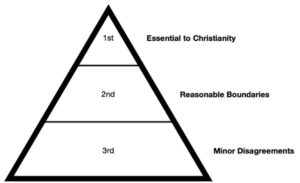
 

The Process of Theological Triage

1. Level 1: Doctrines Essential to Christianity

First level issues of doctrine are those most central and essential to Christianity. You can’t deny these issues and still be a Christian. Mohler includes here doctrines such as the Trinity, the full deity and humanity of Jesus Christ, justification by faith, and the authority of Scripture.

2. Level 2: Doctrines that Generate Reasonable Boundaries

Second level issues are usually those that distinguish denominations and local churches. These are issues that commonly spark the highest-level debates, are usually grounded in some form of biblical interpretation, and generate reasonable boundaries between Christians. Mohler includes among these the doctrines of the meaning and mode of baptism and views on the role of women in the home and church. To these, I add the questions of God’s sovereignty in salvation and of divorce and remarriage. Level two differences do not identify someone as a Christian, but most local churches will struggle if their leaders disagree on these matters.

3. Level 3: Doctrines Addressing Minor Disagreements

Third level issues are those doctrines over which Christians can disagree and easily remain in close fellowship, even within local congregations. These are matters of wisdom, conscience, and practice like, “Should Christians participate in Halloween?” or “Is it best to educate children through public school, private school, private Christian school, or homeschool?” Other times third-level issues are matters of simple dispute bearing little influence on one’s everyday life. Mohler includes among these questions about the millennium and those related to the timing and sequence of Christ’s return.[2]

How to Study Systematic Theology

Approaching the Bible’s doctrines is no light matter, for we are seeking to grasp all that God has revealed in Scripture on a given topic. I propose the following approach to the study of systematic theology.

1. Ask God to Supply Both Insight with Reason and Humility with Love

There are at least two reasons why all pursuit of doctrine must begin with prayer. First, we do not want to be ashamed of failing in rigorous, God-dependent thinking (1 Cor 14:20; 2 Tim 2:7). Failing at this point is serious. As Peter notes, “There are some things in [Paul’s letters] that are hard to understand, which the ignorant and unstable twist to their own destruction, as they do the other Scriptures” (2 Pet 3:16). Second, we need the Spirit’s aid to gain the experiential knowledge the Bible demands. This kind of experiential knowledge of God is only “spiritually discerned” (1 Cor 2:14; cf. Eph 1:17–19), and because of this, we must saturate with prayer our quest to grasp Bible doctrine.

2. Catalog and Synthesize All the Relevant Passages

After praying, collect the most relevant passages related to the topic with which you are wrestling. The best tool here is a concordance (see Word- and Concept-Studies post), which will allow you to look up keywords or concepts to find where the Bible treats your subject. Once you have identified the most relevant texts, you need to classify them. This process entails reading all the texts carefully, summarizing their points, and organizing them into groups based on distinct patterns or features. Ever keep in mind the flow of salvation history and the progress of revelation! The final step is to synthesize in one or more points what the Bible teaches on your topic and then to clarify how your passage contributes to this understanding. If your passage were not present in Scripture, would some crucial knowledge about your topic be missing?

A Case Study in Systematic Theology

Yahweh declares in Zeph 3:9–10: “For at that time I will change the speech of the peoples to a pure speech, that all of them may call upon the name of the LORD and serve him with one accord. From beyond the rivers of Cush, my worshipers, the daughter of my dispersed ones, shall bring my offering.” In the previous verse, Yahweh had commanded the believing remnant in Judah and from other lands to continue waiting on him in faith, looking through to the day of the Lord-judgment in hope. Verses 9–10 then provide one of the reasons why they must persist in their Godward trust.

On the very day of his judicial sentencing of the world (“at that time,” 3:9), Yahweh will cleanse the surviving peoples’ “speech,” which the Greek translation renders “tongue.” This speech transformation will, in turn, generate a unified profession that will result in a unified service: they will “call upon the name of the LORD and serve him with one accord” (Zeph 3:9; cf. Rev 7:9–10). The imagery of speech-purification implies the overturning of judgment (Ps 55:9) and likely alludes to a reversal of the Tower of Babel episode, where a communal pride against God resulted in his confusing “language/speech” and his “dispersing” the rebels across the globe (Gen 11:7, 9). To call on Yahweh’s name is to outwardly express worshipful dependence on him as the sovereign, savior, and satisfier (Ps 116:4, 13, 17). In Joel 2 the prophet similarly connected this phenomenon with the day of the Lord (Joel 2:28–32).

“Cush” was ancient Ethiopia, the center of black Africa, and located in modern Sudan. Its rivers were likely the White and Blue Nile (see Isa 18:1–2). As if following the rivers of life back up to the garden of Eden for fellowship with the great King (Gen 2:13; cf. Rev 22:1–2), the prophet envisions that even the most distant lands upon which the Lord has poured his wrath (Zeph 2:11–12) will have a remnant of “worshippers” whom God’s presence will compel to Jerusalem. Those gathered before God’s presence would be a worldwide, multi-ethnic community descending from the three families and seventy nations that Yahweh once “dispersed” in judgment at Babel after the flood (Gen 11:8–9). Indeed, even some from Cush, Zephaniah’s own heritage (Zeph 1:1), would gain new birth certificates declaring that they were born in Zion (Ps 87:4).

As we assess this text from the perspective of Systematic Theology, I believe it informs both our Eschatology and Ecclesiology. As for the doctrine of the last things, Zephaniah envisions that the new creation community will be born “at that time” (Zeph 3:9) when God rises as judge and executes his punishment on the world (3:8). What is significant here is that the New Testament authors view Jesus’ death to be an intrusion of the future judgment on behalf of the elect, and therefore his resurrection already inaugurates the new creation. “Since, therefore, we have now been justified by his blood, much more shall we be saved by him from the wrath of God” (Rom 5:9). “If anyone is in Christ, he is a new creation. The old has passed away; behold, the new has come… For our sake [God] made [Christ] to be sin who knew no sin, so that in him we might become the righteousness of God” (2 Cor 5:17, 21).

With respect to the doctrine of the church, Zephaniah speaks to both the disposition and international makeup of a community that God will preserve through judgment. If Jesus has already borne the day of the Lord-judgment anticipated in Zeph 3:8, it seems likely that the multi-ethnic community of worshipers he describes in 3:9–10 is indeed his church. Certainly, the depiction fulfills the hopes of the Abrahamic covenant (Gen 12:3), and it finds support in the way the New Testament sees the messianic new covenant community to be made up of Jews and Gentiles in Christ who are now one flock (John 10:16; cf. 11:51–52; 12:19–20), a single olive tree (Rom 11:17–24), and one new man (Eph 2:11–22).

In support of this view is the way Luke describes the beginnings of the church at Pentecost. The outpouring of the Spirit of Christ on the saints in Jerusalem inaugurated the change of speech and unity that Zephaniah predicted (Zeph 3:9–10). Not only does the early church speak in new “tongues” (Acts 2:4, 11; cf. 10:46; 19:6), but they also call on the name of Lord Jesus (2:21, 38) and devote themselves together “to the apostles’ teaching and the fellowship, to the breaking of bread and the prayers” (2:42). Through Christ’s atoning death, the blessing of God moves from “Jerusalem … to the end of the earth” (1:8; cf. Luke 24:47), reaching even into ancient Ethiopia/Cush, as the story of the Ethiopian eunuch testifies (Acts 8:26–40).

Now bringing together eschatology and ecclesiology, we can mark the initial fulfillment of Zephaniah’s hopes and say that already the Lord is shaping “a kingdom and priests” “from every tribe and language and people and nation” (Rev 5:9–10; cf. 7:9–10). Along with this reality, we can add that already as priests we are offering sacrifices of praise (Rom 12:1; Heb 13:15–16; 1 Pet 2:5) at “Mount Zion and … the city of the living God, the heavenly Jerusalem” (Heb 12:22; cf. Isa 2:2–3; Zech 8:20–23). Nevertheless, we are still awaiting the day when “the holy city, new Jerusalem” will descend from heaven as the new earth (Rev 21:2). At that time, our daily journey to find rest in Christ’s supremacy and sufficiency (Matt 11:28–29; John 6:35) will be consummated in a place where the curse is no more (Rev 21:24–22:5; cf. Isa 60:3; Heb 4:1, 9–11). Thus, I believe that we can see Zephaniah’s prophetic prediction already being fulfilled today in Jesus’s church, even as we the saints await its full realization.

[1] R. Albert Mohler Jr., “Confessional Evangelicalism,” in Four Views on the Spectrum of Evangelicalism, ed. Andrew David Naselli and Collin Hansen, Counterpoints (Grand Rapids: Zondervan, 2011), 77–80; see also http://www.albertmohler.com/2005/07/12/a-call-for-theological-triage-and-christian-maturity/.

[2] The best book on identifying and working through these minor disagreements is Andrew David Naselli and J. D. Crowley, Conscience: What It Is, How to Train It, and Loving Those Who Differ (Wheaton, IL: Crossway, 2016).

Find the rest of the articles in this series here. 



The Gospel That Rewrites Us

Although I was familiar with the word “gospel” growing up, I didn’t know what it meant. Despite sitting through countless Sunday morning services, the gospel itself was never fully articulated in context.

It makes sense that many people, even those who grew up in church, might have a muddied idea of the word. In our culture, there’s a wide array of meanings that are often attributed. It can be a music genre, a slang term for conveying something as important, or it can represent a generalized idea of religion.

“Gospel” is actually the translation of a Greek word meaning “good news.” But, there obviously needs to be context for it to be understood. If “gospel” means good news, what makes it good news?

You’ve probably heard a thirty second summary of the gospel message. However, without any backstory, it’s not easy to connect with. The gospel is the story of a Savior redeeming humanity by dying on our behalf — but if we don’t see a personal need for being saved from our sin, we’ll never see what makes any of it necessary. It’s like if you walked in on the third act of a movie, but missed the first 50 minutes. You aren’t going to care what happens if you don’t know why anything is happening. The pacing can feel disorienting, character motivations can be unclear, and you might not even be sure who the protagonist is.

For us to know why the gospel matters, we need to know why we need to be redeemed. Jesus can’t be a great Savior unless there is something terrible for us to be saved from, and something great for us to be saved for.

There are times when it seems obvious that the world is broken and needs redemption, but it isn’t often we feel something is wrong in ourselves. Even though we can name a long list of corrupt politicians and movie executives who clearly need redemption, we don’t think we do. At least, not to the extent that Jesus seems to think we do. Our default setting tells us we don’t need forgiveness in the way that is demonstrated by Jesus dying a brutal death on a cross.

But when we underestimate how much our actions matter and we excuse our sin as not really being a big deal, we sell ourselves short. We defend our actions, saying we aren’t hurting anyone, that we’re only committing victimless crimes. Or we remind ourselves how others have the same issues as us, and some people are even worse, so we aren’t that bad in comparison.

The reality is, our sin goes beyond our actions, because how we act is just a reflection of how we think. It might not always look like we’re clearly in direct opposition to God, but we tend to live in neglect of him. Apathy toward God is the human condition that we need to be rescued from.

Instead of choosing to follow him, we buy into the idea of writing our own journey, of following our heart— but nobody mentioned our heart isn’t always the best guide. Sometimes what we want leads to self-destruction.

This is the story of the Bible: that we’ve chosen our own way over God’s way, and we’ve created a distance between us and him because of it.

It’s the same story as when Adam and Eve decided to give into what they wanted over contentment with God and everything he had already given them. When they ate the fruit, Adam and Eve were told they would have the kind of knowledge and authority that only God has. They were told they would be like him, but in a sense, they already were like him. They had been made “in his image,” meaning God had created them as a smaller scale reflection of himself. They were “complete,” they were perfect as they were.

But they sacrificed their relationship with God to be independent from him in hope of becoming their own gods. It not only cost them the reality-encompassing peace they had— it cost them their identity. They separated themselves from God. They abandoned him, choosing not to be his children anymore.

In pursuing a life without God like Adam and Eve did, we’ve grown more attached to sin than to him. We’ve made ourselves numb. We’ve become accustomed to indifference and we’ve sidelined our Creator. God’s image in us has been shattered because we’ve chosen everything else over him.

“It would seem that our Lord finds our desires not too strong, but too weak. We are half- hearted creatures, fooling about with drink and sex and ambition when infinite joy is offered us, like an ignorant child who wants to go on making mud pies in a slum because he cannot imagine what is meant by the offer of a holiday at the sea. We are far too easily pleased.”
― C. S. Lewis, The Weight of Glory

The good news is, even though we can hardly comprehend our need to be redeemed, God came to us as a man, Jesus, to save us from the sin that had detached us from him.

Jesus lived for God— and not just the default desires that we live for, like appetite or success or thrill or popularity. He never gave into the temptation we give into on a daily basis. He didn’t have moments where he slipped into apathy and forgot the Joy that had been set before him. He lived out God’s will for humanity, knowing what he would eventually have to do.

Jesus was the Messiah, a promised Savior from an ancient prophecy, and God had said it was through him that he would redeem his people from their sin. Except, no one had any idea how this would happen. After Jesus was betrayed by his own followers, he was handed over to government officials to be executed as a rebel in the most humiliating way possible for that time. Innocent and alone, Jesus suffered a torturous death he didn’t deserve so we wouldn’t have to pay for the sin we’ve committed against God.

“Father, forgive them, for they know not what they do.” Luke 23:34

When Jesus died on the cross, the life he lived was transferred to us, and the judgment our sin deserved was transferred to him.

At the time, nobody had figured it out that this was how God was delivering his people from their sin to be reunited with him. After Jesus was buried, it was presumed by many that he wasn’t God. He died, and God doesn’t die. People thought he was just another one of the many frauds who claimed to be the Messiah.

But on the third day after his death, Jesus returned to life, showing us that the mission has been accomplished. He is God. It was through dying for his enemies that he was restoring our relationship to himself. Sin has been defeated, and even death couldn’t hold back the Author of Life.

Now, we can know God as only Jesus deserved to know him: as Father. Through the cross, Jesus gave us back the identity we gave up.

Instead of abandoning us like we did to him, God has loved us anyway. That’s why the gospel is a message of grace. It’s the story of God replacing our self-made narrative for the life that Jesus lived. It’s the story of God rewriting our lives by giving us something we could never earn apart from him. We’re saved from our sin, but what that really means is, we’re saved from ourselves. We’re lifted out of an alternate reality which we have curated on our own terms, and brought back into actual life as defined by its Creator.

By trusting Jesus and his sacrifice for us, we can know God personally and be forgiven of everything we’ve done against him. We can receive and embrace the story in context, looking to Jesus at the center.

Now, when God sees us, he sees us restored to the image that we shattered.


Does Love Prevail Over Hardship?

One of my first childhood memories is playing house. From a young age, I was the girl putting honeysuckle in my hair, donning my prettiest thrift store dress, and “marrying” the little boy across the street. I would often convince friends to participate in the pretend worlds I created for us; worlds filled with hardships over which love would always prevail.

Time eventually caused me to outgrow these worlds and the dresses that went with them. But adolescence brought new (and terrifying) reality to the dream that still rested in my heart. Getting older was exhilarating—attraction intensified and real dating was within reach. Wrestling with feelings of rejection and insecurity were a low price to pay knowing I could meet my real-life Prince Charming at any moment.

When the Lord saved me at the age of seventeen, my understanding of marriage fundamentally changed. It was no longer about having a Pinterest-perfect wedding or fairytale meet-cute with Prince Charming. God’s Word brought my vague understanding of companionship into perfect focus: love is sacrificial, selfless, sanctifying. Marriage is a means by which we can walk in love, just as Christ loved and gave himself up for his Bride (Eph. 5:25).

The truth that marriage exists to display this profound mystery stirred my soul. As I took every internship, job, and opportunity available to me during university, I definitely did not have a “ring by spring” mentality. Yet as my adventures and challenges increased, so did my desire to share them with another.

I got that chance for a season.

The taste of what life could look like alongside someone I loved was sweet. He placed honeysuckles in my hair and spun me around in beautiful dresses like I always dreamed. But after years of dating, something was missing. An article published by For The Church last year titled “The One Life Dream That Makes a Girl Blush” by Andrea Burke communicates what I desperately yearned for: to create and care for a home.

In what seemed a cruel twist, the release of Burke’s piece coincided with the less-than-graceful conclusion of the relationship I thought would last a lifetime. As I read her words on the value of marriage and motherhood, it was as if smoke from the questions burning in my heart drew endless streams of tears from my eyes.

Why would God take the responsibility of displaying the gospel through marriage from someone who recognized its purpose? What was the point of all those wasted years? Was I not strong enough for that calling?

Even if your dreams are not the same as mine, I am sure you’ve pondered similar questions about God’s plans and your purpose or worth. Everyone has experienced some sort of loss or change to what they thought their life would look like (repercussions of the COVID-19 pandemic, for example). Not even the follower of Christ is exempt from these effects of sin.

As we sojourn in this broken world we face calamities (Acts 28:1-4) and we cry out in affliction (Job 30). We are perplexed, persecuted, and struck down (2 Cor. 4:8-9). We feel the weariness of life ache in our bodies and minds (Ecc. 12). Did Christ not experience this suffering?

Jesus was pushed face-down in a garden. Stripped, spat on, beaten, mocked. Given wine with gall to gag upon. Punished as a criminal, crying out in agony before death by crucifixion. In light of such events, it seemed foolish to declare this man the anticipated Messiah who would reign on the eternal throne of the Lord (2 Sam. 7:16, Matt. 27:18).

In such a world, it seems love does not prevail over hardship.

Yet those of us who know Christ know this is not true. Evil looked as though it conquered at the cross, but in reality, God enacted His sovereign plan. For it was at the cross Christ claimed victory over the domain of darkness and established his kingship. It is the slain Lamb’s selfless sacrifice that necessitates this song of worship from the heavenly beings in the throne room:

Worthy are you to take the scroll and to open its seals, for you were slain, and by your blood you ransomed people for God from every tribe and language and people and nation, and you have made them a kingdom and priests to our God, and they shall reign on the earth.

Revelation 5:9-10

Just as the suffering of Christ was real and immense, it was purposeful and glory-filled. The Son of God bowed in obedience to the will of the Father to fulfill God’s plan of redemption of humanity and restoration of our fallen world. As followers of this Christ, we can take heart, for Christ has overcome the world (John 16:33).

So take heart, believer. There is nothing lost that cannot be redeemed; nothing broken that cannot be mended (Rev. 21). No matter what expectations are not met or what dreams die, we must call to mind the truth that “this light momentary affliction is preparing for us an eternal weight of glory beyond all comparison” (2 Cor. 4:17, ESV).

Beloved, let us pick up our crosses together—proclaiming Christ even with thorns in our flesh.  For one day we will stand beside a sea of glass adorned in pure and bright fine linen. On that day, lesser dreams will be forgotten and our deepest desires will be fulfilled at the sight of our nail-pierced Groom. And finally, blessedly, we will eternally enjoy unhindered fellowship with God through Jesus Christ our Lord.


The Rural Church Dilemma

Some time ago I drove to several small towns in rural Arkansas with my 89 year old father and my siblings, tracking the steps of the ministry of both my dad and his father. The experience was memorable. We visited small towns that even Arkansans might not recognize today: Cotter, Caledonia, Hagersville, Greenwood, LaVaca—twelve in all. These were the places where my father, and his father, labored for Christ eighty and ninety years ago.

Much has changed in the landscape of rural America in those eighty plus years. For one thing, most farms have been eaten up by large conglomerates, dramatically reducing population. The size of families has dropped and the area Walmart has made ghost towns of the typical downtown areas. Families long ago moved out of these rural places for the big cities in order to find work, and what young people you may find will almost certainly not stay where there is no action. With these demographic alterations, the country church has been reduced to only a shadow of what it once was.

But this does not mean the country church is not there. There are yellow brick buildings with mud stains around their base that still exist as the gathering place for those few faithful (and often reserved) older citizens and, in several cases, a family or two or even more containing younger people.

The “county seat” town churches are doing better, but even they feel the changes. Some have become regional churches for the surrounding areas. In fact, there are some notable exceptions to the general rule that rural churches are failing. In one Arkansas town that you have likely never heard of, there were 900 attending the largest church on Sunday mornings. The more remote rural churches have yielded their younger families over to these active centers which often carry on vibrant ministries. Regionalization is definitely a trend. We could call it the “Walmartization” of the rural church.

I’ve been there in my own ministry, pastoring in historic Washington, Arkansas as my first assignment. Thirty-five years ago, this town consisted of about 400 occupants, half black and half white. It has now lost much of that population and has turned into a state park (it was the old Civil War capitol of Arkansas). I never knew what quiet was until I pastored in that town. I used a “privy” behind the café and I waited out the lonely nights in a “Jim Walter” home provided by the church. It grew up to about 60 in attendance while I was there, but stayed mostly around 40. The grade school moved to Hope just after I was there, and things went down further. There is not as much going on now as far as church life is concerned, since the town has become a state park site. We said, even at that time, that the church was “just past Hope.” In more recent days, I’ve been back to that town and have reminisced about the good days of early ministry there, learning from kind people.

In addition to that, I’ve preached in so many rural churches that I could not even begin to recount them all. My ministry of 40 years of preaching has landed me in both city and rural churches, some huge, others in towns so sleepy that the grass grows unmolested on the two-lane highway—and deacons wear overalls. Though I’ve loved all of the experiences I’ve been privileged to have, I have to admit that it is often easier to visit than to stay in such a church. And I’ve scratched my head with the pastor wondering how the church could find vitality.

What happens when the young seminarian or college ministerial student takes his first churches in these areas? And what should the committed rural pastor think about his church’s future?

Some Thoughts for Rural Pastors

Here are some thoughts for rural pastors. You are the experts, not me. But these thoughts might stimulate something in a church that is not going to be known, outside of a miracle, for its numerical growth. In fact, you may wonder sometimes if God knows you are there.

Remember that you are entirely unaware of the impact of your ministry. For instance, you may teach older adults without much visible impact. But one of them, perhaps a grandparent of an unconverted child, may receive stimulus from your ministry that makes her a true witness to her grandchild. Her witness, prompted by your stimulus and instruction, may be the very thing God uses to bring that child to Him. She may not even be aware of her impact. In fact, it may not come to bear until after she has passed on. The grandchild, in time, may one day marry a believer and raise up children who also become believers in another part of America. Do you really know what that will mean in terms of eternity? Do you know what it means in terms of generations of believers? What if, three generations down the line, one of the Christians in this line is instrumental in the evangelization of an unreached tribal group? Did you see that when you taught that grandparent on a sleepy Sunday morning? Likely not.

Don’t forget that Jesus said, “I will build my church.” The time you taught that grandparent might be far more instrumental in the building of the universal church than ten years of ministry in some large city church with all its innovations and activities. You cannot know how God will work for sure, yet you can be confident that it would be a total surprise to you how significant your labors are. Therefore, “sow in hope.”

Be happy to know that you may not be able to change much but lives. I mean by this that the structure of things, the hackneyed songs, the unrefined style of your meetings, the organizational plan, the leadership set, may not be within your power to alter. I don’t say you should not try. But, at the end of the day, the real purpose of your being there is to change lives, not to make things look good.

I found, through years of ministry, that you will often not know your impact until you are gone. I recently received a letter from someone at that Old Washington, Arkansas church who was affected by my novice ministry in ways I did not dream. She was then a child visiting without her parents, and I had paid real attention to her. She continued to come, though almost always hidden in the shadows. My attention to her resulted in her eventual conversion and a life of serving God for which she was extremely thankful. Her brother, who died as a youth, had also been converted. She had been seen as not just a visiting girl, but as a soul important to God. The importance of that attempt at caring was completely unknown to me until I received that letter.

The focus, then, should be on people. So, keep your aim right. For instance, you may start a book club with any of your people who care to participate. Let’s say that you provide readable, accessible books, that have marvelous truths to be understood. You set reachable goals and meet every week, or every other week in your home, just to chat informally about what is learned. You drink coffee and just enjoy learning something. No pressure. Over time, this one idea may build some mighty believers. It’s not a great program that somebody will write up, but it focuses on people and the changes that God can bring.

Be energized by the concept that your church could become the most loving church in the world. I find this compelling. There will be many things your church may not be. It may not be the most educated church or the most innovative church, or the most evangelistic church,  but it can be the most loving church. There is nothing to stop that from happening except your lack of determination and/or the will of the people. Love, after all, is the sign of maturity as a church. Now, if you are seeing this, you will find ways to encourage love.

Putting love first will mean that you will work out ways for people to be in your home, and in the home of the other church members. You will think of ways to get people to really know the insides of each other. Sheep need help to overcome their reserved nature. They will need to be commended for acts of love, just as Paul often did. You will need to set the pace and demonstrate a passionate love for the people. Dream about this. And, my experience is (and the Bible’s teaching is) that this is a powerful way to witness. The love of the people of God for each other is, as Francis Schaeffer said, “the final apologetic.”

Well, there is more, but these three should serve to encourage you. I know you need it. When it is all said and done, we are going to be thrilled at the way God has used the out-of-the-way places, the forgotten places, to do some of His most significant things.

I love the rural church and hope you do. Some of you will serve all your life in them. God bless you for your perseverance and courage.

Editor’s Note: This article was originally published at ccwtoday.org. 


Keeping a Close Watch: On Cultivating and Maintaining Godliness in Pastoral Ministry

In March 2020, the world was rocked by COVID, its physiological consequences, and the compounded political upheaval that was already present in the country. At the time, I was not yet voted in as an elder at Emmaus but was in the applicant stage. So, I was in conversation with the elders on a few matters, let alone the natural friendships that were already present. The pastoral burdens were looming large.

At the time, the elders were praying, and encouraged the church to pray, that the Lord would use the time of isolation and uncertainty so sins that have been swept under the rug or self-justified would be brought out to the open and dealt with. The Lord not only answered that prayer swiftly in our own congregation, but also throughout sister churches. And now two years later, we’re pleading with the Lord to grant peace and holiness.

The falling of public figures has been happening since our father Adam. However, it seems more pronounced in the last two decades or so. It had always felt like an “out there” sort of thing for me until the last five years. Some local leaders that I had some sort of friendship with had fallen; it had even come within my own family. Now, the potency of sin and its effects were all the more real. I was sobered to the core.

This caused a lot of uncertainty and self-analysis in my own life. I know firsthand that the problems aren’t merely leadership failures or personal disagreements. Rather, it’s the assaults of hell coming after Christ’s church through her under-shepherds and through division and discord within her members. Part of which has birthed this short reflection and even a Sunday morning class at Emmaus on the Christian virtues. These are some reflections that I’ve been pondering on lately and pray they stir us on to keep a close watch on our life and doctrine.

Practice and Immerse Yourself in the Mystery of Godliness

Paul’s exhortation to Timothy in 1 Timothy 4:6-16 should be a passage that pastors return to often as a check on their life and doctrine. The imagery in verses 7-8 of training and repeated in verse 15 is clear that the mystery of godliness is definitively true of us but there still remains flesh to be killed and assaults of hell to subvert. In fact, Paul tells Timothy that in practicing and immersing himself in the mystery of godliness, other will see his progress.

When the Spirit applies the work of Christ to us and unites us to him, we begin to see how immersed in sinful patterns we are. The Spirit is the Gift of God that empowers us to turn from those patterns of the flesh and establish patterns of the new creation that God has made us to be. Peter picks up on this in his first epistle where he exhorts us to practice what we are.

Further, Paul tells Timothy that he is the one to set an example to the believers in godliness. Despite his age, he is to demonstrate godliness in speech, in conduct, in love, in faith, or in purity. Acting in godliness isn’t legalism; it’s being who we are. This should be even more sobering for the pastor as he is the under-shepherd demonstrating the way of the Chief Shepherd. The groaning and toiling of killing sin and subverting the assaults of hell is valuable and worthwhile “because we have our hope set on the living God.”

For pastors, it means that we are held to a higher standard and will be judged accordingly. Not only should we pastors be cultivating and maintaining godliness in a personal manner, but this should be the basis for how we shepherd the flock of God. Am I habituating myself in godly speech and not coarse joking? Am I immersing myself in godly conduct and not the passions of the flesh? Am I practicing godly love and not self-regard? Am I imitating godly faith and not self-justification? Am I occupying myself with godly purity and not secret immorality? The Hillbilly Thomists’ song Good Tree begins aptly:

You can’t gather grapes
From a bramble bush
Or pick a fig from thorns
Oh, would I like to be
Oh, to be a good tree

Way of Wisdom and Way of Folly

I was reminded recently of the fox metaphor on the Life and Books and Everything podcast. There, DeYoung asks questions like: Where have we allowed the metaphorical foxes to creep into our lives that erode our holiness and sanctified common sense? Where have we habituated ourselves to the point of danger? In the Matt Chandler situation, it was noted that the actions weren’t seen as unhelpful and stupid. This is a crucial question to ask ourselves, our wives, friends, and fellow pastors. Are there areas in our life that are being eroded by foxes? Are there areas in our life that we are blind to sinful patterns growing? Are there areas in our life where we are justifying our thoughts or actions, not calling sinful indulgences for what they are?

In my office, I have one of my favorite John Wooden quotes written on my dry-erase board: “It’s the little details that are vital. Little things make big things happen.” This may seem like too basic of a fact, but therein lies the irony. It’s the basics or the fundamentals that stabilize and empower as one moves forward. Christ’s conquering of sin and death applied to your account, pastor, is what stabilizes and empowers you. Christ’s ascension to God’s right hand is our pleasure forevermore. You can’t move forward or see progress unless the fundamentals remain the fundamentals. Which, as a silly example, is why the Duncan-Ginobili-Parker-Popovich Spurs were so dominant. Many jokes still make their rounds today about Tim Duncan being the “Big Fundamental” but there’s a reason why that crew won so many championships.

Though there are doubtless more, there are two areas of concern I want to briefly reflect on: use of the tongue and self-sabotage. The dangers of the tongue, which are really manifestations of the inner man, are prevalent throughout the Scriptures. James interestingly begins chapter 4 with a warning that not every brother should be a teacher because the tongue can bridle the wild horse or set a forest ablaze. Paul also has strong words against the unrighteous use of the tongue in Ephesians 4:29; 5:4. This is the more elusive of the foxes that erode our foundation. Sarcasm, crude joking, or gossip are far too pervasive in the life of the church, let alone those who teach. May the Lord have mercy on us and grant us a thankful heart.

The second area of concern is what I want to call self-sabotage. To be fair, this is a bit more subjective. However, more and more pastors are experiencing burn out, over work, and they are even potentially being called to another vocation. All of which are not necessarily bad or wrong. And not all burnout is self-sabotage. However, there is an overwhelming pressure, and possibly an unhealthy expectation, to remain committed and faithful to Christ’s church, no exceptions. And as such, they are looking for a way out without shame or scrutiny. Thus, a brother may self-sabotage in a variety of ways to get out.

Now hear me clearly that the pastoral office is a high and demanding one, and rightfully so. There should be a holy pressure and expectation. All of which is why there are particular guardrails such as a Chief Shepherd, plurality of elders, strict qualifications, and not every brother should be a teacher. Of course burnout still happens with these guardrails. But the way of folly leads to destruction when the ‘little things’ and the guardrails are set aside and neglected. LaPine recently wrote a helpful reflection on pastoral self-destruction. Now, this reflection is on the connection between pastoral abuse and the lack of relational reciprocity. LaPine asks some helpful diagnostic questions at the end that are worth considering. However, the lack of the relational habits of vulnerability and trust, or even the faux presentation thereof, can lead to destruction.

Pray for your pastors and leaders

The tone of this reflection seems a bit dim. And while I don’t necessarily prefer that, I’m not sure we can avoid it either. When close friends or family members are on the way of folly toward destruction, it should cause us to be sorrowful and sobered. The habitual foxes are elusive and erosive. However, we bring our sorrow and sobriety before the Lord, pleading with him to restore those on the path of folly back to the path of wisdom, and to keep us on the path of wisdom.
So, please, pray for your pastors, encourage them in the faith, love their families, and be an easy sheep. Then, go listen to the masterful Hillbilly Thomists’ Good Tree, whose next to last verse is a fitting conclusion.

Even when I’m old
I will still be
Still full of sap
Still green
That’s what I want to be
Oh, to be a good tree


Episode 177: Brant Hansen on The Men We Need

On this episode of the FTC Podcast, Jared Wilson talks with radio host and author Brant Hansen about Christian manhood — its problems and promise — about godly ambition, toxic masculinity, and the like, as well as Asperger’s, mission, and more.