

In Titus 1, Paul writes, “for the sake of the faith of God’s elect and their knowledge of the truth which accords with godliness, in hope of eternal life, which God, who never lies, promised before the ages began, and at the proper time manifested in his word through the preaching with which I have been entrusted by the command of God our Savior” (Titus 1:1–3).
Pastors, as platitudinous as this sounds—we were made for this moment. We are pastoring in one of the most seismic socio-cultural shifts at scale that the world has ever seen. We are guiding souls across the “new Roman roads” of a global age. Yes, it’s complex, confusing, and exhausting, but the essence of our job description remains, transcending the shifting sands of time—shepherding and feeding the flock, connecting with and confronting cultural narratives, and fulfilling the longings of an unsatisfied age. So it should be impossible to hear this encouragement as overly simplistic, arrogant, or even ignorant. Pastors, we were made for this moment. Let us now consider for a moment how we are to respond.
At the beginning of his letter to Titus, Paul gives a sweeping declaration of who he is and what the Lord has called him to do. He was set to live and lead into his moment in redemptive history. Now pastor, a great confidence should arise from Paul’s words, “before the ages began.” This changes everything about what we do, because it means that our work is woven into a timeless covenant propelled forward by a sending God—three in one—with a plan, an eternal plan to redeem. A missionary God coming to a people, His church, to bring them into His work. And we, pastors, like Paul, get to do what the entire cosmos hangs in the balance upon—preach His Word, “entrusted by command of God our Savior,” with the “grace and peace” given to us in Christ.
Paul goes on in his letter to exhort Titus to teach new believers “to adorn the doctrine of God our Savior” (Titus 2:10). But can something so grand and glorious as the gospel be improved? What does it mean to adorn it? Charles Spurgeon helped get at the question when he said that, “The gospel is best adorned when most unadorned.”[1] We need a little bit more, so maybe a picture from home will illustrate.
My wife has a knack for “urban treasure hunting.” Step into the dim, golden glow of our living room—books and trinkets from around the world—yet nothing stands out more vibrantly than a 19th-century Victorian painting. Meet Bianca, an elegant woman complete in form, substance, and beauty. Yet what allows Bianca’s Victorian majesty to shine is actually the frame: gilded, regal, floral in pattern, perfectly complementary.
The frame doesn’t steal from the glory of the painting; it adorns it.
As we read on we see that this is Paul’s point. Believers are to display its beauty through the way that they live. It is this witness that makes the gospel truly shine. Pastor, let us consider our work of adorning the gospel in three movements—training, waiting, and declaring. And I want to give you a glimpse of how each one of these is at work in a part of the world renowned for its grandeur and indescribable beauty. A place that is spilling over with common grace, set within a meticulously crafted, Baroque-lined frame. Can the doctrine of God our Savior really be adorned in a place like this?
Grace Trains Us
“For the grace of God has appeared, bringing salvation for all people, training us to renounce ungodliness and worldly passions” (Titus 2:11–12).
Grace has appeared. Grace is a person—Grace is Jesus, who pitched His tent and tabernacled among us (John 1:14).
Grace isn’t a detached gift given by God; grace is personified and He has come to us. This changes everything about our ministry—our preaching, our care of souls, our equipping of the saints. And it is through His training that He is bringing salvation for all people. To put it simply, our work is about displaying His rescue plan by our conduct. And as we labor, emitting the aroma of His love through our joy, mercy toward enemies, integrity, patience, and forgiveness, we show our people that adorning the doctrine of God our Savior is worth giving our lives to. Grace trains.
One living example of grace training a people appears in the 5th Arrondissement of Paris—one of the most consequential neighborhoods in the post-Christian West. A collision course of culture and history—Roman ruins, Baroque-lined streets, an influential university shaping Western thought. A place where the beating drum of expressive individualism finds some of its earliest articulations, where the mantras of our age were formed: “live your truth,” “you do you.” But its allure cannot satisfy.
In 2025, people are tired, lonely, and parched from moral disarray. They need to encounter grace that trains. This is exactly God’s plan for the 5th through the birth of a new evangelical church: L’Eglise de la Montagne. Housed in an old cinema, the training begins on Launch Sunday in full and glorious display. Pastor Philip Moore stands at the entrance, black-rimmed spectacles and warm grin, welcoming guests into a lobby permeated with the sweet smell of pastries and coffee. The theater fills. Praises ascend in French. A handshake between the sending pastor and Philip becomes a vivid reminder that churches plant churches, and that meaningful partnership—sending and receiving—is still the way of mission.
Grace is training a people in Paris. Grace is training a people in your city.
Grace Helps Us Wait
“… waiting for our blessed hope, the appearing of the glory of our great God and Savior Jesus Christ” (Titus 2:13).
As Grace trains us and others in godliness, He also helps us wait for our blessed hope. Have you ever considered the divine hardwiring of human beings to long for something beyond this life? Whether we are in Atlanta or Wichita, Phnom Penh, or Cairo, notice how everyone is living toward an end, a telos. Really, it is that everyone is eschatological, yet this longing for final resolve can only be fulfilled in the gospel.
As that old cinema fills up for the first time on launch Sunday in Paris’ famous 5th, Philip preaches to these very longings. A context far and distinct from ours, yet also so near and relatable. The ‘religious anatomy’[2] of humanity expressing the common insatiable search for meaning in this life—all needing to hear how truth, goodness, and beauty, each finds its fullest expression in God through Christ.
In Paris, on this very Sunday, many who have never heard the gospel listen intently as this news begins to shape their imagination with an invitation to enter His story through repentance and faith. They can now know what they are waiting for: the blessed hope of their salvation, Jesus.
There is a hopeful sense that a new day is dawning for the advance of the gospel in Paris. Protestants of old were persecuted nearly to extinction on these very streets. Calvin’s unrealized vision for France to be flooded with new churches comes to mind.[3] A small, yet resilient community of pastors and their churches waiting in hopeful anticipation that the beauty of Christ will soon burst forth from arrondissement to arrondissement, and even better, He will appear again.
Pastors worldwide, we all know this waiting—this longing for Christ to come again, for His glory to renew our cities, and for His hope to strengthen our people. Grace helps us to wait with hope. The kind of waiting we are called to is proactive. It is individual and corporate; it is patient and urgent. It adorns the gospel in visible display as we gather and scatter.
Grace Authorizes Our Declaration
Paul says the gospel was “manifested in His word through the preaching with which I have been entrusted” (Titus 1:3). He instructs believers to adorn the doctrine (2:10) and Titus, a pastor, to declare the gospel (2:15). Declaring Christ also adorns the doctrine.
In Paris, the declaration looks like a cinema transformed into a sanctuary. Music begins, and praises rise in French. Philip’s sermon on truth, goodness, and beauty declares Christ’s supremacy.[4] The people of Paris hear the good news echo into their historic streets. Pastor, whether you are in a traditional sanctuary on Sunday morning, gathering at a storefront, meeting in a living room, a school, or an old warehouse, you get to declare that He “gave Himself for us to redeem us… and to purify for Himself a people for His own possession, zealous for good works” (2:14).
Pastor, we were made for this moment. Adorning the doctrine of God our Savior is the mission. Grace appeared, grace trains, grace helps us to wait with hope until Christ appears again, and grace empowers us to declare. That means that there is hope for Paris, our town, and our city.
May we adorn the doctrine of God our Savior until that day.
The work of adorning the gospel continues in cities around the world. See it in action in this documentary: Watch now.
[1] Spurgeon, Charles H. “Adorning the Gospel.” Sermons vol. 18 (London: Passmore & Alabaster, 1872), 377.
[2] Strange, Making Faith Magnetic, p. 27.
[3] Michael A. G. Haykin, “John Calvin’s Missionary Influence in France,” Reformation and Revival 10, no. 4 (2001): 41–42. Haykin notes that by 1562 more than 2,000 Protestant churches had been planted in France, many through the efforts of Geneva trained missionaries under Calvin’s global vision of gospel advance.
[4] From his launch sermon at L’Église de la Montagne, Philip Moore described the church’s vision this way: “We want to be … a church in the 5th arrondissement, for the 5th arrondissement; a church where everyone can encounter God through Jesus Christ; a church where we live out the three values we have chosen for our church: truth, beauty, and goodness. We believe that when we understand the truth about God, we see him as he is—perfect beauty and goodness—and that this experience allows us to live out truth, beauty, and goodness in our everyday lives.”
 “Admittedly, I have a bias towards local-church histories, finding each and every local-church’s story fascinating. But Caleb Morell’s A Light on the Hill: The Surprising Story of How a Local Church in the Nation’s Capital Influenced Evangelicalism proved especially gripping to me, and will prove encouraging for every minister who reads it. Morell details the 150-year story of Capitol Hill Baptist Church in well researched but easy-to-read prose, grippingly telling the story of one of America’s most influential churches. The attentive reader will find lessons for local-church ministry sprinkled throughout but will also find the culminating chapters, which focus on the long, fruitful tenure of pastor Mark Dever, particularly of interest. The book is a reminder of how influential one church, strategically placed and biblically led, can be and how impactful one pastor, through one church, can impact multiple generations of ministers.”
 “The past decade has witnessed non-stop Trinity dialogue and debate in much of evangelicalism. Much of that discussion has trickled down to the local church level, prompting church members to rediscover ancient, essential doctrines. Along these lines, the 40 Questions Series, capably edited by Benjamin Merkle, has served the church well by answering commonly asked questions in well informed, yet understandable terms. Matthew Emerson and Lucas Stamps’ 40 Questions about the Trinity is a helpful contribution and a welcome addition to the 40 Questions Series. All trying to sort out the contemporary Trinity conversations—or just those needing a refresher on theology proper—will be well served by Emerson and Stamps’ work.”
 “As a perennially misunderstood group, the Puritans are in regular need of definition and introduction. The first edition of this book in 2006 served that purpose well, but when I learned the second edition contained 40% new material I knew this revised and expanded edition of Meet the Puritans would serve now as the standard resource for its intended reading audiences of pew, pulpit, and podium. The authors are like informed and enthusiastic docents greeting you at the entrance of a large museum—eager to tell you where to start and happy to share their own favorite galleries to help you make the most of your visit. Meet the Puritans is very much worth the price of admission.”
 “Churches are the Bible’s missions strategy. This simple premise rings throughout this book as both a head-nodding reminder and as a chin-scratching epiphany. Written by two seasoned missionaries who pastor international, English-speaking churches in Muslim countries, Prioritizing the Church in Missions rehearses for the reader the centrality of the local church in God’s plan while also explaining why this idea is needed to bring clarity for 21st missiological practice. For anyone or any church who loves the nations, this book will prove helpful.”
 “This book is neither complicated nor clever, but its thrust is utterly consequential. The church does not need more hired-hands or professionalized parrots. No, the church needs paternal pastors. Having written my dissertation on 1 Timothy 3:4-5, I was supremely curious to read Chap Bettis’s practical exposition of these verses, and he did not disappoint. From exegetical insights to relational wisdom and experiential guidance, this book outlines how the weight of fatherhood trains men for the work of ministry. Numerous sections within the book reveal Bettis’ acquaintance with the gritty questions of daily parenting and daily pastoring – each of which are answered (or navigated) with skill and grace. I encourage any father, pastor, or man aspiring to be such to read this book, and then internalize it. May we raise more fathers who feel like a pastor, and pastors who feel like a father.”
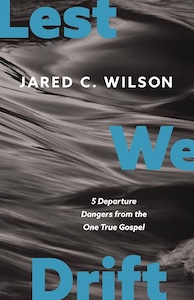 “We all have turned to look for something in the back seat while driving down the highway, only to look up again and realize the car has veered off course into danger. Dr. Jared Wilson warns of this drift in ministry too: “The moment we take our eyes off the center is when we begin to move away from it” (9). Partially a post-op on the gospel-centered movement of the past 20 years, and partially a prophetic plea with the church’s leaders of the next 20 years, Wilson exposes the dangers of drifting into victimhood, dryness, superficiality, pragmatism, and legalism. We must return, again and again, to gospel-centrality. Yes, indeed, “we must pay much closer attention to what we have heard, lest we drift away from it” (Heb. 2:1). ”
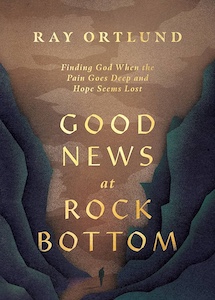 “Nobody today speaks to the heart with such pastoral grace as Ray Ortlund, and this book, while short and sweet, is nevertheless a loving stare at a deep, deep well of God’s mercy. With a scholar’s resource and a father’s tone, Ortlund guides the reader through the pains of betrayal, loss, death, and the entrapment of his or her own sins to see that the Lord who abides high on his holy hill is also down in the smoking crater, abiding with the lowly and brokenhearted. Especially for those whose life has bottomed out — but not just for them — Good News at Rock Bottom ministered to me unlike any other 2025 book I read.”
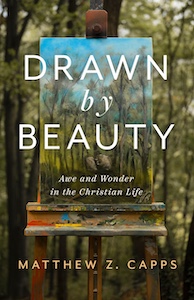 “For believers living in an age drowning in entertainment but still diminished in wonder, Matthew Capps’s Drawn to Beauty is a course corrective with deep discernment and a keen understanding of Christianity’s theological heritage of aesthetics. This book is as challenging as it is compelling, and it will draw readers into a more resonant faith, one that more gloriously adorns our glorious God.”
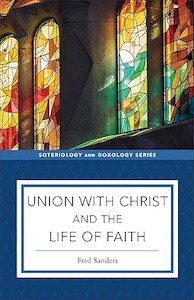 “Fred Sanders has long helped the church recover the beauty and centrality of Trinitarian theology, and in Union with Christ and the Life of Faith he offers one of his most pastorally valuable works yet. With precision and warmth, Sanders shows that union with Christ is not a niche doctrine; it is the unshakable foundation of the Christian life. He writes with a rare blend of academic clarity and everyday accessibility, inviting readers to marvel at what it means to belong to Jesus, to participate in His life, and to walk by faith in the power of the Spirit. Every chapter reminds believers that the Christian life is not grounded in self-effort but in the finished work of Christ applied to us. This book strengthens weary saints, steadies young believers, and deepens the roots of any disciple hungry to grow in grace.”
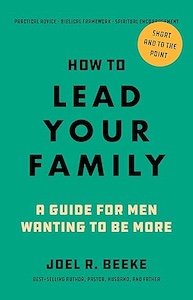 “Joel Beeke’s How to Lead Your Family is a deeply needed word for a cultural moment marked by distraction and drift. Drawing from decades of pastoral ministry and a lifetime of devotional wisdom, Beeke offers a vision of family leadership that is both countercultural and wonderfully ordinary. He refuses to reduce spiritual leadership to technique; instead, he calls parents to a life of repentance, prayer, Scripture, and intentional discipleship. With clarity and gentleness, Beeke shepherds readers toward cultivating a home shaped by grace, where parents model what they teach, where worship becomes a pattern of life, and where children are invited into the rhythms of the Christian life. This book is both convicting and hope-giving, offering practical steps without ever losing sight of the gospel that empowers them. It is a resource every Christian parent, pastor, and church leader should keep close at hand.”
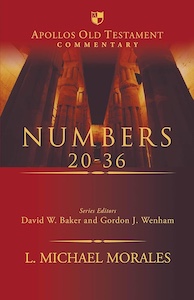 “The second volume of Morales’ commentary on Numbers brings readers into Israel’s wilderness journey with clarity and insight. Morales carefully unpacks the Hebrew text and the book’s structure while highlighting moments of challenge, faithfulness, and God’s guidance that speak directly to life today. His exposition is both thorough and approachable, making this a resource that pastors, students, and everyday readers can use to engage the text thoughtfully and faithfully.”
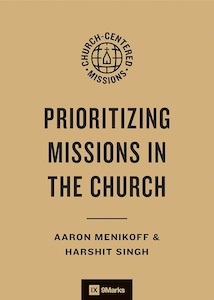 “This book is the counterpart to Prioritizing the Church in Missions, providing a helpful, much-needed guide for making missions central to your church’s culture. Menikoff and Singh show how practices like preaching, prayer, discipleship, and community can naturally support sending and sustaining missionaries. Grounded in Scripture and pastoral experience, it argues that missions isn’t just a program or parachurch work but should be woven into the heartbeat of every congregation. Whether you are a missionary, pastor, leader, or member, this book offers practical, biblical guidance for aligning your church with God’s heart for the nations.”
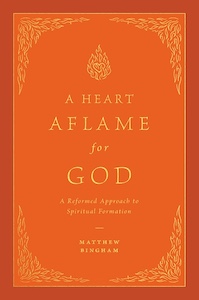 “Never has it been easier for the glint and glimmer of this world to steal our gaze from the God who redeemed us. Our natural inclination in fighting this distraction is to try harder, as if doing more will rekindle a heart grown cold. Matthew Bingham reminds us otherwise: only the Holy Spirit, through reading, praying, and pondering the illuminated Word, can set us ablaze from within. This formation from within is critical for the local church as we are “living stones…being built into a spiritual house, to be a holy priesthood” (1 Pet. 2:5). A heart kept aflame for God during the week stokes the flames of corporate worship, offering a pleasing aroma to the Lord.”
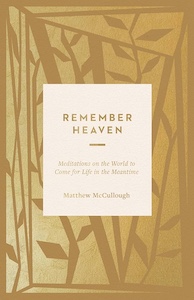 “Only the hope of heaven is big enough for a world that never will be. Yet we have become masters of drowning our aches and longings for more in vain and unfulfilling distractions. It is with forceful tenderness that Matthew McCullough presses the hope of heaven into our wounded longings and shows that the new creation is the only answer big enough for hearts that were made for eternity. A church that truly remembers heaven will live differently now and preach a gospel that finally feels like Good News.”