

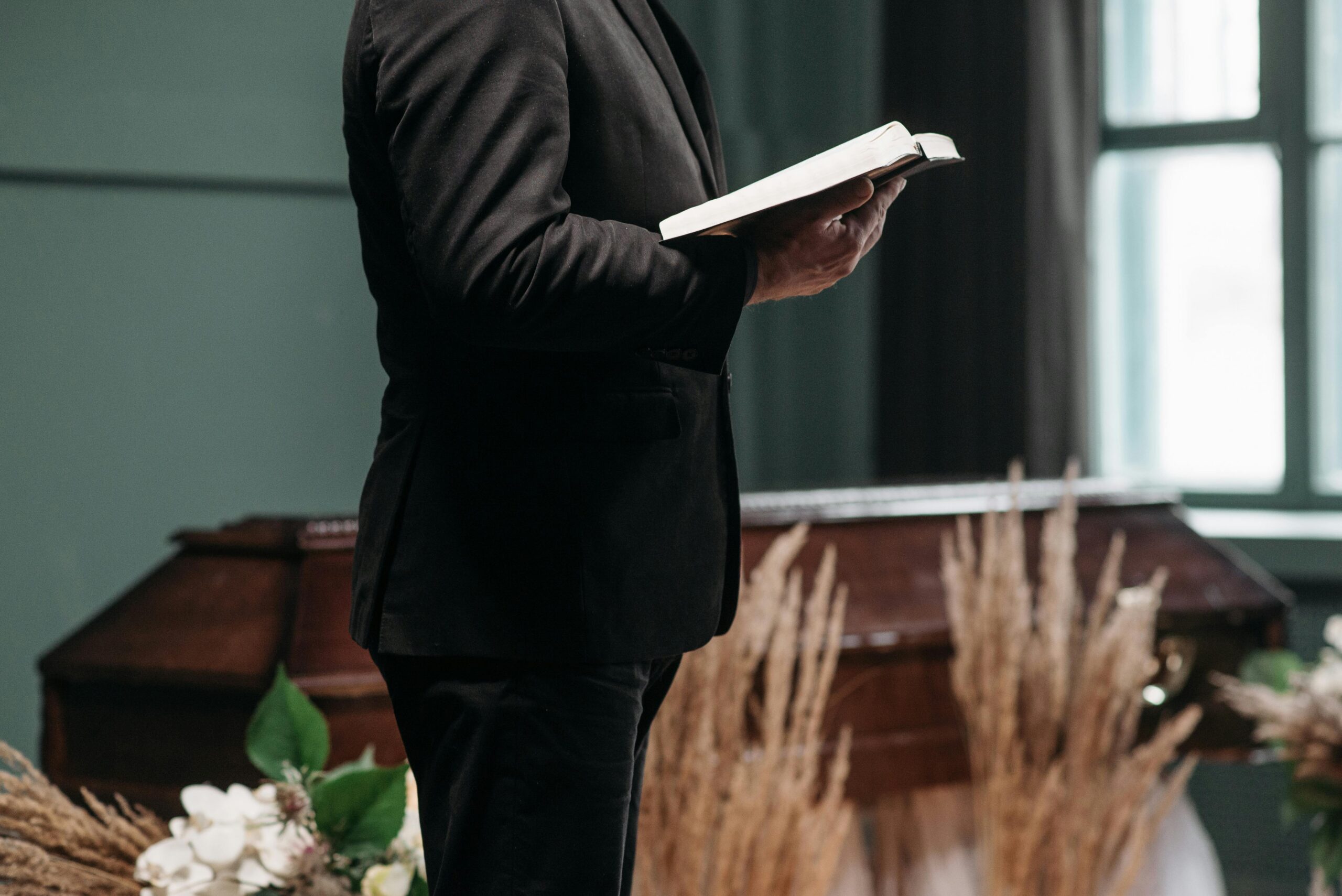
In almost seven years as a lead pastor, I have stood beside graves almost thirty-five times.
Some were expected. A saint in her nineties whose Bible had nearly fallen apart before her body did. An older husband who slowly forgot names but never forgot the Lord’s Prayer. Or a sick child only twenty weeks in the womb. Those funerals carry tears, but also a quiet gratitude. You feel like you are escorting a pilgrim to the finish.
Others were not like that.
I have preached for a young man whose friends cannot delete his number from their phones. I have preached for parents who had to walk behind a child-sized casket. I have stood in a hospital room where there was no casket at all—only a silence heavier than wood could hold.
When my wife miscarried several times, we buried the tiny bodies next to our house and planted tulips above them. The spring flowers make us smile, but there is a peculiar grief in the makeshift burial of someone you never heard cry. A grief made sharper by the strange fact that your memories are not events, but expectations—no birthdays, no food fights, no prom dates. An unwrapped future.
I write this especially to younger pastors and seminarians, because no class will truly prepare you for what funerals will ask of you.
The Preparation and Weight of Every Funeral
In seminary, I had a pastoral ministry professor who taught the basics—funerals, weddings, counseling, administration, baptism. I remember thinking he had more to say than I could possibly absorb. He was excellent, and I still keep the notes from that class. Yet more than a decade later, I realized something else: Though he put me on a good trajectory, funerals would ask more of my heart and focus than any classroom could cover.
I think there’s a danger hidden within all the great advice you can receive from seasoned pastors. For pastors, in all of this, there is danger in repetition.
You will eventually know the routine. How long to preach, when to stand, where to sit, and how to dismiss the crowd. You will coordinate meals with the kitchen team, contact a deacon for flowers, arrange slides and music, and you will know the cemetery undertaker by name.
And if you are not careful, this repetition can produce callousness.
A friend of mine owns a funeral home in town. One day, I jokingly asked if he had been busy lately. He said he had directed eighteen funerals that month—but did not consider it busy. That stunned me. That is roughly two hundred funerals a year.
For you, it might be the fifth funeral this year. For the family, it’s chaos.
It is the worst day of their lives. The room you have stood in many times is completely new territory for them. They will probably not hear any of what is said. They will have watched the slideshow a hundred times while preparing it. They are exhausted, disoriented, and fragile.
You are not managing an event but shepherding wounded people. You may be the primary speaker, but you are mostly a presence.
Sometimes the most pastoral thing you will do is sit quietly. Sometimes it’s offering a short prayer. Sometimes it’s helping them choose hymns because they cannot think clearly. Sometimes it’s gently telling them it is okay not to have an open mic or an open casket.
Your calm and confidence become borrowed stability.
Even when the deceased is elderly, the loss is not small. A ninety-year-old mother can leave behind a sixty-five-year-old child who now feels like an orphan. Even when a baby dies in the womb, another baby may never come to the younger parents.
Every funeral is catastrophic for someone.
Why the Work Matters
I once heard a seasoned minister say he preferred funerals to weddings because people are more ready to hear the gospel when facing a casket than when looking at a bride. I understand what he meant and do not entirely disagree.
But I still hate funerals.
After nearly thirty-five funerals before personally turning forty years old, I would gladly never do another. I do not like leaving a hospital knowing that was my final conversation. I do not like late-night messages from a young couple saying they lost the baby. I do not like sitting in a cold, stale office holding my wife’s shaking hand while we wait for another ultrasound to hear “no heartbeat.”
I hate it—because death is not right.
Genesis 3 explains every cemetery. Hebrews 9 reminds us death is tied to judgment. John 11 shows us that Jesus wept at Lazarus’s tomb.
Yet this is exactly where pastors are called.
Part of our calling is to stand where people most need a shepherd. We are called to confidently stand at hospital bedsides, in living rooms, and beside open graves just as confidently as we stand behind the pulpit. We will say words no one else in the room knows how to say.
Basil Manly, Jr. wrote in a hymn, “we meet to part, but part to meet.” Funerals place a pastor in that doorway of grief—but always with the hope of reunion.
Preach to Everyone
A funeral is not merely therapeutic—it is truthful. The most loving thing you can do is speak honestly about death and clearly about Christ.
First Corinthians 15 must become familiar territory. Paul says the body is sown perishable and raised imperishable, sown in weakness and raised in power. Christianity does not merely promise that souls survive—it promises resurrection.
The empty tomb of Jesus is not only His victory, but the believer’s future. We hold this in faith now, trusting it will one day become sight.
The woman confined to a wheelchair for years—will she run? The middle-aged mother whose cancer reduced her to frailty—will she be restored with strength and color? The children my wife and I buried—will they know us?
Scripture gives certainty without exhaustive detail. Enough to anchor hope, not enough to eliminate faith.
Your task is not to solve every mystery. Your task is to point people to Christ.
The Honor Hidden Inside the Grief
You will never enjoy coordinating funerals. You will schedule volunteers, organize meals, contact the funeral home, arrange music, and confirm seating. Much of it will feel administrative.
But do not miss what you are actually doing. You are honoring the sending off of an image bearer.
For most of church history, Christians buried their own near the church’s building. Believers worshiped within sight of tombstones because they believed in bodily resurrection. Even mowing grass between graves becomes a quiet confession that death is temporary.
This is one of the most honorable acts of pastoral care you will ever perform.
You accompany someone to the final step of earthly discipleship and publicly entrust them to the promises of Christ. You help a family grieve with hope. You stand where theology becomes tangible—you get to be the messenger of that message.
The Grief Comes with a Destination
Paul says Christians grieve differently. Our tears have a destination. Because Christ has been raised, death is not a wall but a used doorway. One day God will wipe away these tears—not metaphorically, but personally.
And even with all this, I am still waiting for another funeral.
My dad has stage four cancer.
My parents are members of my church. It amazes me that I get to be my dad’s final pastor, since he was the first to tell me about Christ’s gospel. Though I dread the impending day of his funeral, I am grateful to speak when it comes.
I will walk my mom down the aisle and seat my wife and my sister’s family. Then I will go to the pulpit and preach—an honor I never expected a decade ago, but a delight I know my dad has as the day approaches. Because we all know that moment, and all of grief’s moments, are temporary.
Because Jesus Christ died, was buried, and rose again, I can stand beside any grave and say something true. I’ll never forget my seminary professor’s words: “When you’re at that pulpit, at that funeral, you point at that casket and say to everyone ‘this is not the end for this person.’”
Remember that every funeral is a loss for someone and a sacred moment entrusted to you. You are caring for souls at their most fragile moment and commending a believer to the promises of God.
Few acts in ministry are heavier. Few feel more holy.
And one day, faith will become sight.
Until then, we testify—one funeral at a time.